Blog
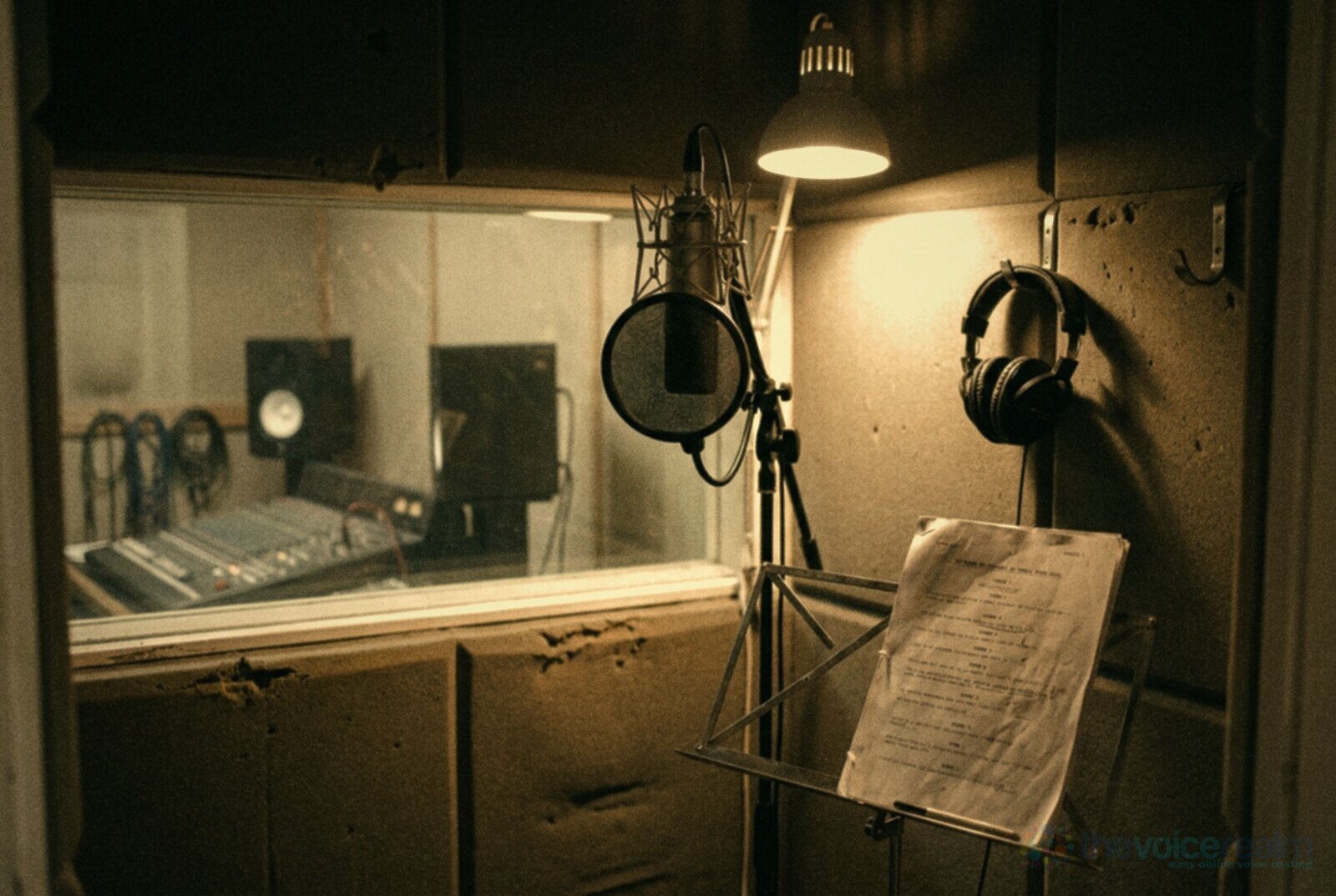
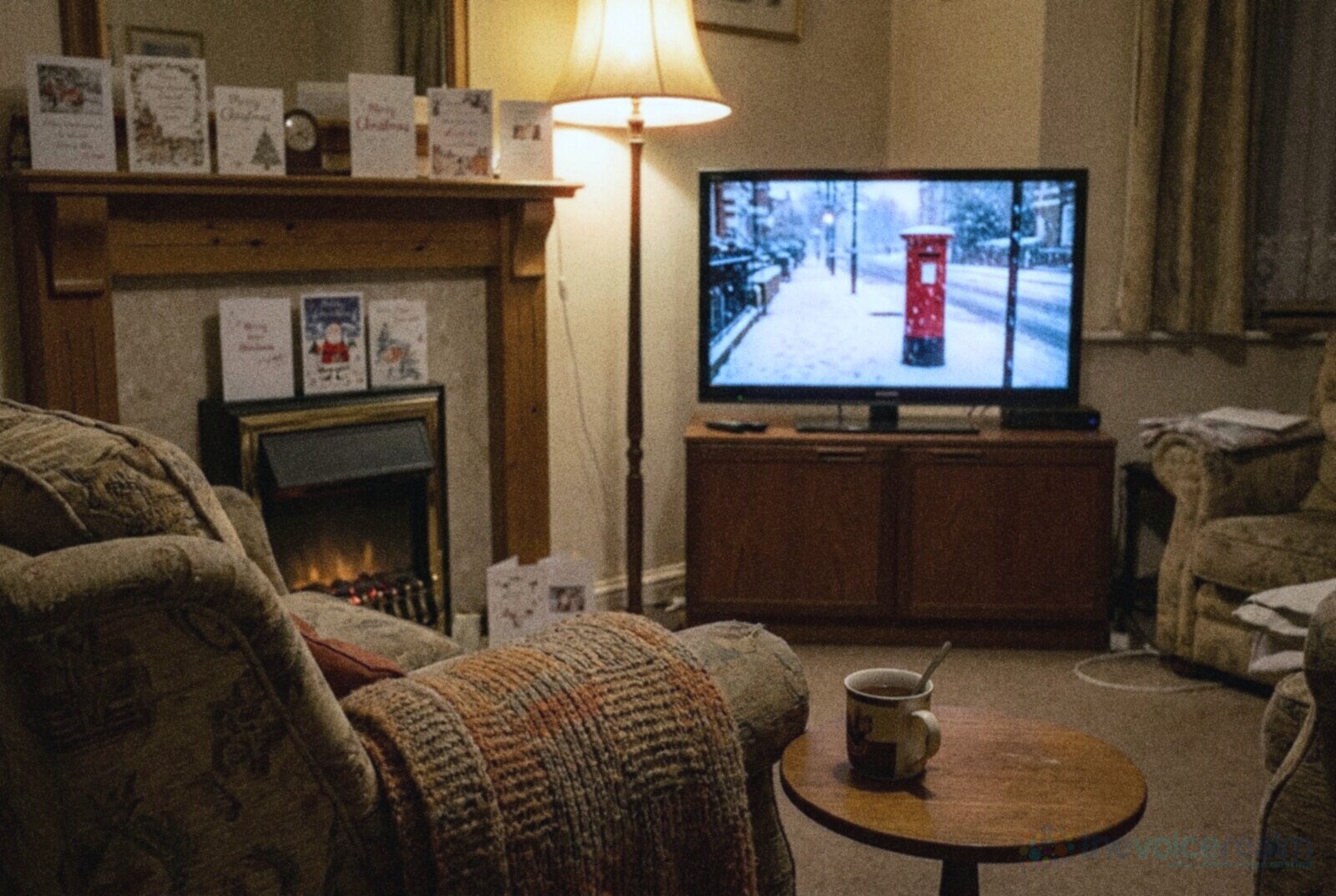
Last November, a woman in Buckinghamshire was half watching television when a Royal Mail Christmas advert came on. The narrator spoke one line and she froze. It sounded exactly like her father, the BBC narrator Paul Vaughan. He’d died eleven years earlier.
Nobody had hired him, of course. Royal Mail later admitted the voice had been made with artificial intelligence. This month the story ran in one of the biggest entertainment trade papers in the world, with a professor of forensic speech science on the record and a grieving daughter calling it “outrageous”. A thirty second slogan about Christmas cards had turned into a story about a dead man’s voice.
This piece is for the people who decide who speaks for a brand: marketing managers, agency producers, founders and the person who signs off the budget. AI voices are cheap and quick, and some of them sound very good. But the reason brands keep booking real voice actors has little to do with how a voice sounds on the first listen. It’s about credibility, and what happens to yours when someone works out where the voice came from.
© The Voice Realm
The Christmas ad that spoke in a dead man’s voice
Paul Vaughan’s voice was his work. He narrated the BBC science series Horizon, was the voice of Radio 4’s arts programme Kaleidoscope and read the Paddington audiobooks. A Daily Telegraph obituary once said that when God speaks, he uses Paul Vaughan’s voice. In other words, there’s a lot of professional recording of him out in the world, which is exactly what an AI voice model learns from.
His daughter, Lucy Wynne, told Deadline’s Jake Kanter that she recognised him straight away. Royal Mail confirmed it had used AI for the narration. A spokesperson described the practice as “increasingly common” and said the voice was “not designed to replicate any specific individual”. The company also said the advert’s producers “carried out checks and advised that these did not identify any resemblance concerns.”
Then the experts listened. Vincent Hughes, a professor of forensic speech science at the University of York, found “considerable phonetic similarity” between the advert and Vaughan’s recordings. Dr Nadine Lavan, a voice psychology researcher at Queen Mary University of London, explained that family members are very good at recognising a loved one’s voice. “With Wynne recognizing the voice from the advert as being Paul, we can conclude the voice is very similar,” she said. Deadline also ran the audio through three open-source analysis tools, and all three found enough similarity to say there was a good chance it was the same speaker.
Wynne’s verdict was simpler. “Pay the money and get somebody in to do the job,” she said. She told Deadline she hadn’t received an apology. Royal Mail’s statement read: “We understand the concerns raised and have taken them seriously.”
“Pay the money and get somebody in to do the job.”
Lucy Wynne, daughter of narrator Paul Vaughan, to DeadlinePost this quote
Here’s the uncomfortable part for every brand. Nobody is suggesting Royal Mail set out to copy anyone. It may well have been an accident. That didn’t matter. The headline didn’t say “supplier’s checks found nothing”. It said a national institution had put a dead narrator’s voice in its Christmas advert without asking his family. Peter Caulfield, the actor who founded the Save Our Voices Now campaign, put it like this: “Using AI in this way, whether inadvertently or not, without thorough checks, can result in a company stealing a voice from the grave and causing great upset to the family involved.”
The irony wasn’t lost on anyone, either. The campaign’s whole message was that a real card from a real person means more than something quick and easy.
Credibility is the whole job of a voice
A voiceover is there to be believed. It tells you the bank is safe, the medicine is tested, the car is worth the money and the company behind it is decent. If the audience stops trusting the voice, the rest of the advert has nothing to stand on.
Researchers have started measuring how the word “AI” lands with buyers, and it isn’t good news for anyone hoping nobody minds. A Washington State University team led by Mesut Cicek ran experiments with more than 1,000 adults in the United States, across eight product and service categories. Products described as using artificial intelligence were consistently less popular. “When AI is mentioned, it tends to lower emotional trust, which in turn decreases purchase intentions,” Cicek said. The effect was strongest for what the researchers called high risk purchases, like expensive electronics, medical devices and financial services. His advice to marketers was blunt: “Focus on describing the features or benefits and avoid the AI buzzwords.”
NIQ, the consumer research company, went further and looked inside the brain. Its study had more than 2,000 people watch AI generated adverts, with brain activity measured on about 150 of them. Viewers spotted most of the AI ads on their own and rated them more “annoying,” “boring,” and “confusing” than traditional ones. Even the AI ads people judged to be high quality produced weaker memory activation. Ramon Melgarejo, President of Strategic Analytics and Insights at NIQ, said the study showed “consumers are quite sensitive to the authenticity of ad creatives, both at the implicit (nonconscious) and explicit (conscious) levels.”
NIQ was testing whole adverts rather than voices on their own, but the lesson carries straight over. An advert people don’t trust and don’t remember is money spent twice: once to make it, and again to repair what it did.
Nobody can hear the difference, which is the real problem
You might expect the case for AI voices to rest on quality, and the quality is getting better fast. In 2025, a team from Queen Mary University of London and University College London, led by Nadine Lavan, played people a mix of real voices and AI copies of the same voices, published in the journal PLOS One. Cloned voices fooled listeners 58 percent of the time. Real voices were correctly identified only 62 percent of the time. The researchers found “no significant sensitivity” in people’s ability to tell them apart, and each clone was built from less than five minutes of recorded speech. Some of the clones were even rated as more trustworthy than the real people.
That sounds like a win for the machines. Read it again from a brand’s point of view, though. If ordinary listeners can’t tell a clone from a person, then your marketing team can’t reliably tell whether a “new” generated voice happens to sound like somebody real. Royal Mail’s producers ran checks and found nothing. A daughter heard one sentence and knew.
The people best placed to catch a borrowed voice aren’t your target audience. They’re the voice’s family, its colleagues, its fans, and the journalists who now have audio comparison tools a click away. Most viewers will never notice. It only takes one person who does.
Backlash moves faster than any correction
The Royal Mail story stayed quiet for most of a year and then broke all at once. Other brands haven’t had that long.
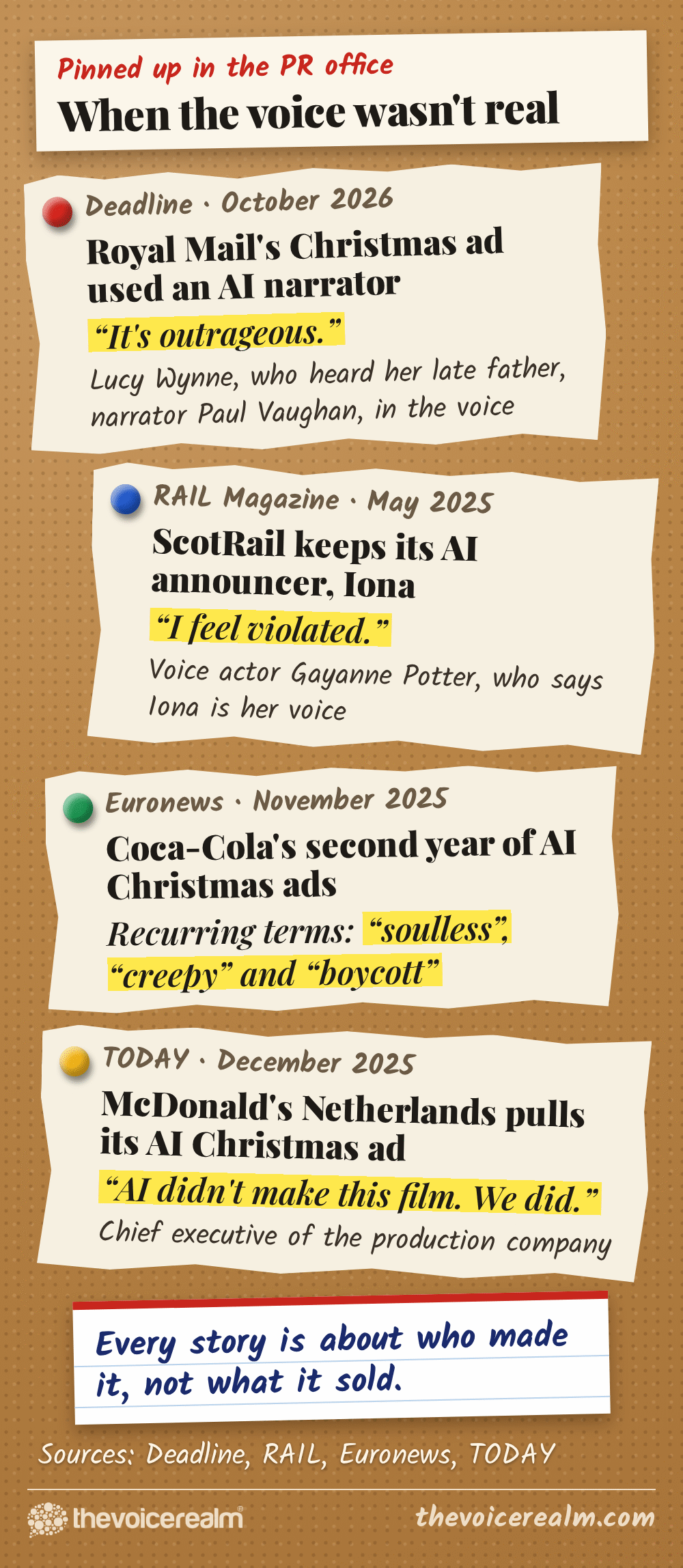
Coca-Cola’s AI generated holiday adverts drew criticism in 2024, and when the company released more for Christmas 2025, Euronews reported that the backlash featured recurring terms like “soulless”, “creepy” and “boycott”. The company’s head of generative AI, Pratik Thakar, defended the choice: “The genie is out of the bottle and you’re not going to put it back in.” A behind-the-scenes video then boasted that a “tiny team of five specialists” had produced more than 70,000 video clips in 30 days, which only fed the argument that creative people were being cut out.
In the Netherlands, McDonald’s posted an AI generated Christmas advert on 6 December 2025 and pulled it after a wave of criticism, TODAY reported. The production company’s chief executive defended the work in a statement: “AI didn’t make this film. We did.” When the people who made your advert are publicly arguing about who made it, nobody is talking about your food.
Notice what these stories have in common. None of them is really about whether the result looked or sounded good enough. They’re about the audience feeling that a company it liked had cut a corner and hoped nobody would mind. That feeling spreads through comment sections in hours. A clarification, an apology or a quietly deleted video arrives days later, and the screenshots last for years.
© The Voice Realm
The chain of consent you can’t see
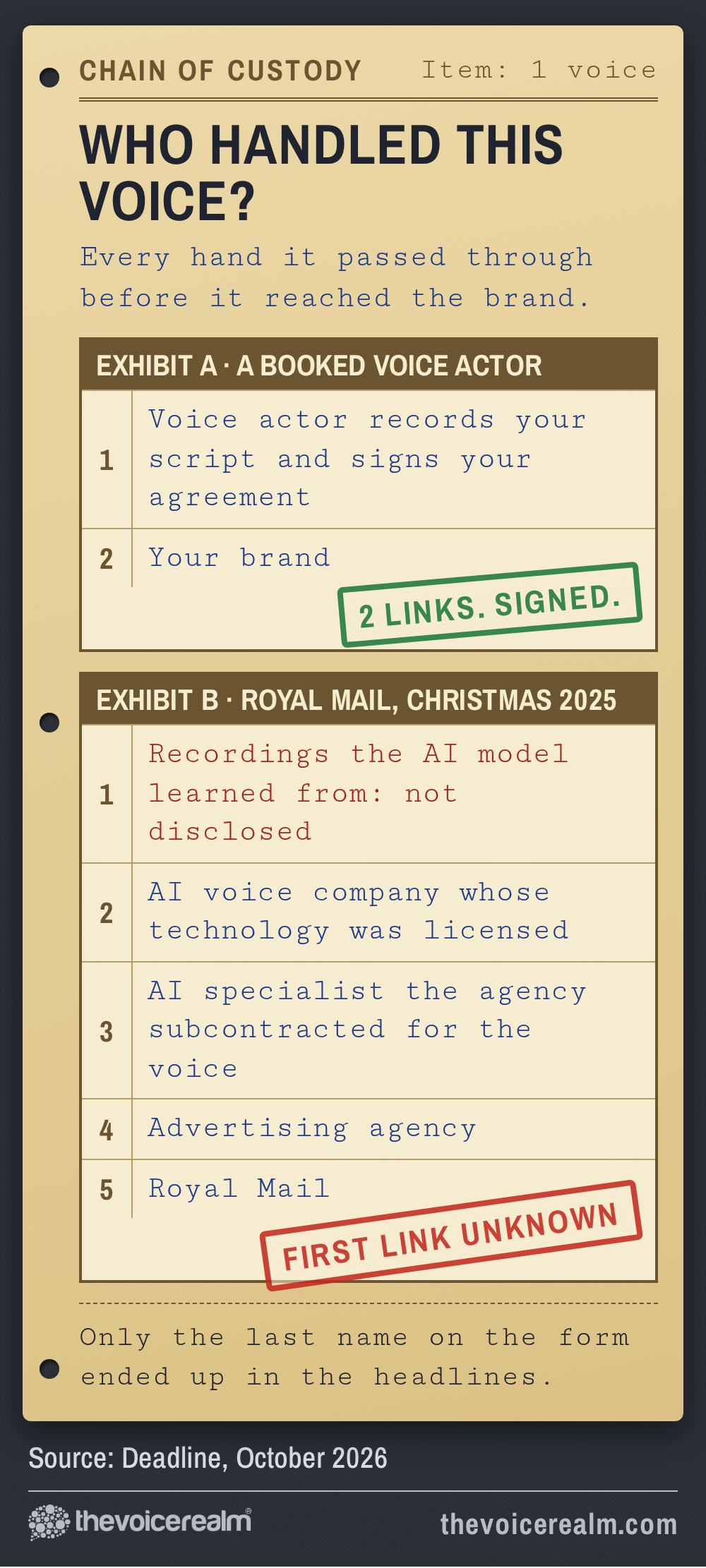
When you book a voice actor, the consent chain is short. The person in the booth agreed to record your script, for your use, on terms you both signed. If anyone ever asks whose voice that is, you can answer in one sentence.
A generated voice comes with a much longer chain, and you’re only holding the last link. Ask the Scottish voice actor Gayanne Potter. She told RAIL Magazine she recorded her voice for a technology company in 2021 and was told it would be used for accessibility and e-learning software. Then she found a synthetic Scottish voice called Iona, which she recognised as her own, making announcements on ScotRail trains. “It’s not about money. It’s about my identity. I feel violated,” she said.
 VoiceEditSuiteYour breath. Your pace. Your edit.Auto Clean Up learns your pace from every file and puts your own pause back wherever it cuts a mistake.See how it worksLearns from numbers, never your audio. Never used to train AI.
Asked whether it was confident the voice was being used legally, ScotRail first replied: “This would be a matter for Ms Potter to take up with ReadSpeaker, who her contract is with. We have no plans to remove the voice from our trains.” It may have been legally tidy, but it sounded like a brand saying the person whose voice it was using was somebody else’s problem. Passengers complained, ministers asked questions, and by August Transport Scotland said ScotRail was “working to make changes to the system, and this includes implementing an alternative ‘voice’ as soon as practicable.” The brand ended up exactly where it could have started, just a summer of headlines later.

© The Voice Realm
When the chain breaks, the brand is holding it
In New York, two voice actors, Paul Lehrman and Linnea Sage, sued an AI voice company after saying they’d been paid for recordings they were told were for research, then heard clones of their voices for sale. In July 2025, Judge Paul Oetken allowed their breach of contract claims, claims under New York’s privacy law and claims under its deceptive business practices law to go ahead. The case is still being fought, and the claims are allegations, but it shows where the trouble lives: somewhere between the original recording session and the brand that pressed play.
If you’re the brand at the end of that chain, you inherit whatever happened at the start of it. And you’ll be the one whose name is in the headline.
© The Voice Realm
The law is starting to ask questions too
Regulators have noticed. The European Union’s AI Act includes transparency rules in Article 50 that apply from 2 August 2026. Companies that put out AI generated or manipulated audio, image or video that counts as a deep fake “shall disclose that the content has been artificially generated or manipulated.” The Act defines a deep fake as content that “resembles existing persons, objects, places, entities or events and would falsely appear to a person to be authentic or truthful.” A synthetic narrator that sounds like a real person, in an advert people take at face value, is exactly the kind of grey area brands will want to stay well clear of.
In the United States, the Lehrman and Sage ruling showed that New York’s long standing privacy law can reach the misuse of someone’s voice. More states are writing voice and likeness protections of their own. None of this is legal advice, and the rules differ by country and change quickly. The practical point is simpler: with a hired voice actor, the paperwork answers the legal questions before they’re asked.
The brands betting on real
Some companies have decided that being human is now part of the pitch. In October 2025, the clothing brand Aerie pledged never to use AI to create images of people or bodies in its campaigns, and said it would ask its partners and creators to make the same promise. Its chief marketing officer, Stacey McCormick, later told the fashion trade site Glossy: “Now, more than ever, we get a sense that people don’t know what they see today. Is it real? Is it not? Is it generated?” Dove made a similar promise in 2024, saying it would never use AI generated imagery to represent “real bodies” in its adverts.
Those pledges are about pictures, not voices, but the thinking is identical. When audiences are constantly wondering whether anything is real, a brand that can say “yes, that’s a real person” has something its competitors can’t copy with a prompt.
- Whose voice is it built on? If your supplier can’t tell you what the voice was made from, you won’t be able to tell a journalist either.
- Does it sound like anyone? Royal Mail’s producers checked. A daughter recognised the voice anyway. Your colleagues aren’t a reliable test.
- Would you say it out loud? If you’d be uncomfortable writing “this voice was generated” in your press release, ask yourself why.
- Who answers when it goes wrong? “A matter for Ms Potter to take up with ReadSpeaker” is not a reply your customers will warm to.
- Where will it air? In the European Union, Article 50 disclosure rules have applied since 2 August 2026.
© The Voice Realm
What a real voice actor actually gives you
Booking a person isn’t nostalgia. It buys you specific, practical protection that a generated voice can’t offer.
A named person who said yes. Your voice actor chose to speak for your brand. You know who they are, and if a reporter asks, you can tell them proudly.
Terms in writing. Where the recording can be used, for how long and in which media is agreed before anyone presses record. If you’ve ever wondered how that works, our guide to who owns a voice recording after the session walks through it.
A performance, not a guess. A professional reads your script, asks how to say your product name, and gives you the warmth, urgency or calm the brief calls for. They take direction. We’ve written before about why a trained voice actor still beats a synthetic read, and the gap shows most in the lines that carry feeling.
A voice that’s yours. You can agree exclusivity in your category, so the voice of your brand isn’t also selling your competitor’s product next week, or turning up in a stock library.
Someone accountable. If something needs fixing, a real person fixes it. There’s no chain of subcontractors to untangle and nobody’s estate to apologise to.
Our take
We’re a voice over marketplace, so you’d expect us to say this, and we’re happy to own that. But the argument here doesn’t rest on our opinion. It rests on a university study showing the word AI lowers trust, a neuroscience study showing AI adverts are remembered less, research showing nobody can reliably hear a clone, and a list of brands that learned all of it in public.
Every one of those stories started with a reasonable sounding decision to save time and money. Royal Mail saved the cost of one voice actor for a single line. It spent the next year with its Christmas campaign attached to a family’s grief. The cost of a real voice is right there on the quote. The cost of getting found out doesn’t show up until it’s in the papers.
If you’d like to hear real people read your script before you decide, you can post a free casting and get auditions from professional voice actors, or browse voices by style and accent and book one directly from their demos. Every one of them is a real person who’s agreed to be heard, and can tell you so.
Sources: Jake Kanter, Deadline, “Daughter Of Dead BBC & ‘Paddington’ Star Accuses Royal Mail Of Resurrecting Her Father’s Voice Using AI”; Voiceover Herald, Royal Mail’s AI Christmas voice; Washington State University, “Using the term ‘artificial intelligence’ in product descriptions reduces purchase intentions”; NIQ, “NIQ research uncovers hidden consumer attitudes toward AI-generated ads”; The Register, “Humans flunk the Turing test for voices as bots get chattier”; Euronews, “‘Real magic’? Coca-Cola’s AI-generated Christmas ad sparks widespread backlash (again)”; TODAY, McDonald’s removes AI-generated Christmas ad; Holyrood, “Scotrail to replace controversial AI announcer”; RAIL Magazine, “No plans for ScotRail to remove AI voice used on trains ‘without permission'”; Pollock Cohen, rulings in the voice cloning case against Lovo; EU Artificial Intelligence Act, Article 50; Brittaney Kiefer, Adweek, “Aerie Rejects AI in Ads, Vowing to Stay ‘100% Real'”; Glossy, “Pamela Anderson fronts Aerie’s anti-AI push as it bans generated bodies”; afaqs!, “Dove vows to shun AI for portrayal of ‘real bodies’ in its advertising”.
Need a voice for your project?
Search voices nowAbout Sarah Robbins
Sarah Robbins writes for The Voice Realm about finding voice over work, home studios, casting and the business side of voice acting.