Blog

You have found the voice. The audition sounds right, the script is approved, and the recording is ready to begin. There is just one final thing the voice actor needs from you: direction. So you type three words that seem perfectly clear: “Warm, natural and conversational.”
There is nothing inherently wrong with that direction. In fact, those words appear frequently in voice-over briefs because they describe qualities many clients genuinely want. The difficulty is that they can mean very different things to different people, and a professional voice actor still has to translate those adjectives into specific performance choices.
Does “warm” mean reassuring, intimate, sympathetic or simply less formal? Does “conversational” mean relaxed and understated, or energetic and friendly? Does “natural” mean imperfect and spontaneous, or polished without sounding like an advertisement? The more subjective the direction, the more room there is for the client and actor to imagine completely different performances.
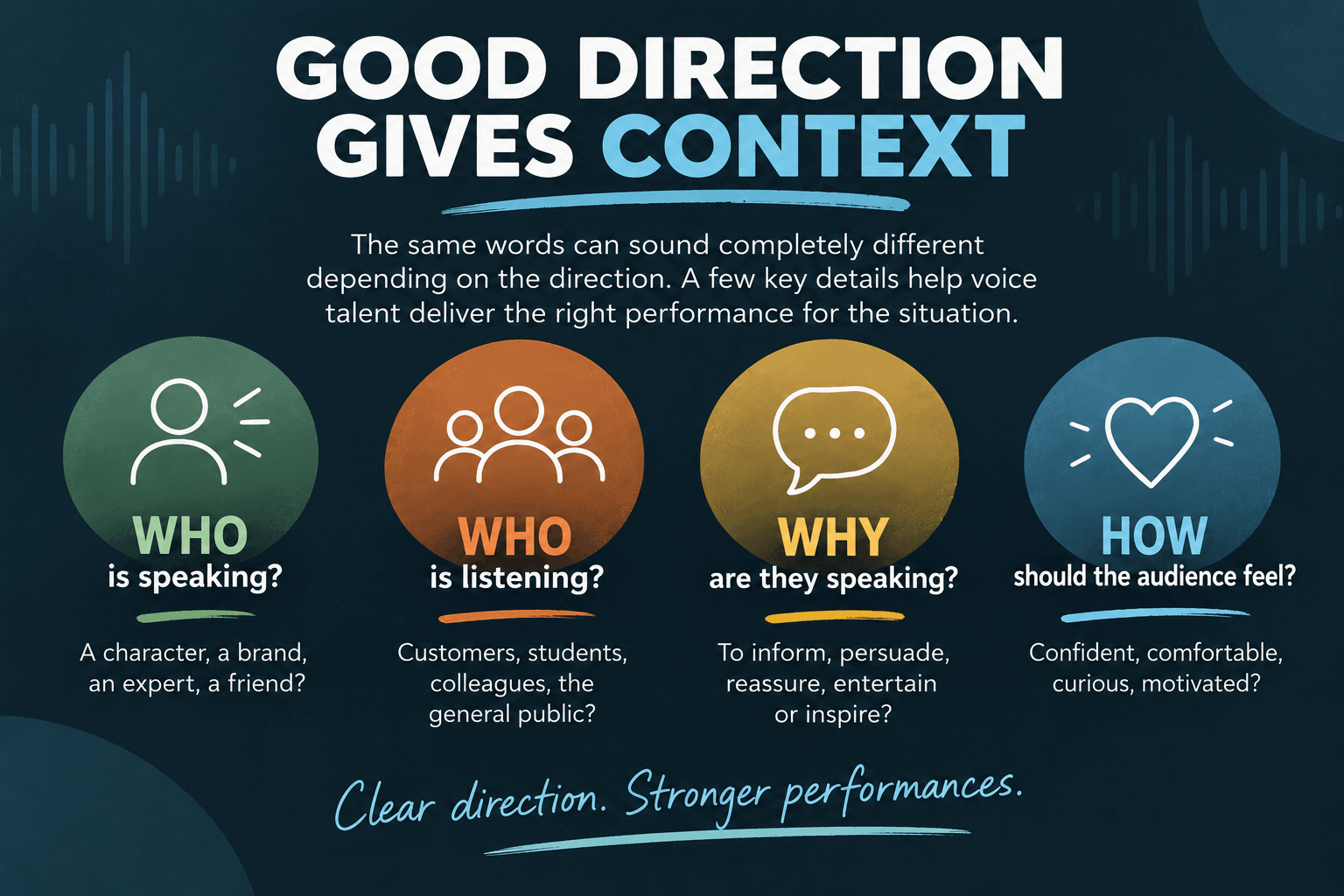
That difference in interpretation can result in additional takes, longer sessions and revisions that might have been avoided if the creative intention had been clearer from the beginning. Good voice-over direction does not require a client to become an acting coach. It requires enough context for a professional performer to understand who is speaking, who is listening, why the words are being said and what the audience should feel when they hear them.
The Problem Is Not the Word “Warm”
Words such as warm, friendly, authentic, conversational, authoritative and energetic are useful starting points. The mistake is expecting one adjective to communicate an entire performance, because the same adjective can describe very different creative intentions.
Imagine a healthcare organization producing a video explaining a difficult procedure to nervous patients. The client may ask for a “warm” voice because the recording should feel reassuring and compassionate. Now imagine a coffee brand requesting a “warm” read for an online advertisement. In that context, warm might mean welcoming, relaxed and pleasantly upbeat.
The adjective is identical, but the performance probably should not be. This is why useful direction connects an adjective to a situation rather than leaving the actor to decide what the word means in isolation.

Instead of saying only, “We want this to sound warm,” the healthcare client might say, “Imagine you are calmly explaining this to someone who is nervous and wants to know what will happen next.” The coffee company might say, “Imagine recommending your favorite local café to a friend who has never been there.” Suddenly the actor has something to perform rather than an adjective to interpret.
That distinction matters because voice acting is not simply the process of making a voice sound pleasant. A professional actor is making decisions about pace, emphasis, energy, phrasing, emotional intention and the relationship between the speaker and listener. Better context gives those decisions a clearer target.
“Conversational” Can Mean Almost Anything
Few words are used more frequently in modern voice-over direction than “conversational.” It sounds specific because everyone knows what a conversation sounds like, but real conversations vary enormously depending on who is speaking and why.
You probably speak differently to your closest friend than you do to a new colleague. You would explain a complicated insurance policy differently from a new restaurant. You might sound conversational while being excited, serious, skeptical, comforting, amused or concerned. Even the size of the imagined audience can affect the performance.
A more useful brief therefore explains the conversation the client has in mind. Instead of simply saying “Make it conversational,” give the actor enough context to understand what kind of conversation you are imagining.
For example, you might say: “Imagine you’re explaining this to one customer who is interested in the product but knows nothing about it yet. Keep the delivery relaxed and helpful rather than promotional.” The actor now has a listener, a relationship and a reason for speaking.
That direction does not tell the performer exactly where to breathe or which word to emphasize. It provides the situation and allows the performer to do the acting. Good direction gives the actor enough information to understand the destination without attempting to control every step of the journey.
Tell the Actor Who Is Listening
One of the simplest pieces of information a client can provide is also one of the most useful: Who is the audience? The answer can influence everything from pace and vocabulary to authority, intimacy and emotional tone.
Consider the sentence “Getting started is easier than you think.” That line could appear in a children’s educational program, a banking advertisement, a software tutorial, a healthcare explainer or an employee training course. The words remain exactly the same, but the appropriate delivery could change considerably.
An actor reading for experienced financial professionals may use a different rhythm and level of authority from an actor speaking to teenagers. A narrator explaining a new app to first-time users may need to sound encouraging and accessible, while the same sentence in an internal corporate presentation might require a more restrained delivery.
Age is not the only consideration. Clients can tell the performer whether the audience is familiar with the subject, whether they are likely to be enthusiastic or skeptical, and what they are expected to do after hearing the message. Those details help the performer understand the listener rather than simply reading at an undefined audience.
This is especially useful when the script contains technical language. A narrator does not necessarily need to simplify the performance simply because terminology is complex. If the audience consists of specialists who use those terms every day, sounding overly explanatory may be just as inappropriate as moving too quickly for a general audience.
The actor does not need an extensive market-research document to benefit from audience information. A sentence or two describing the intended listener can be enough to transform how the script is interpreted and help the performance feel more deliberately targeted.
Give the Voice a Reason to Speak
Another useful question is deceptively simple: Why is this person saying these words? Every effective piece of communication has an objective, whether the speaker is trying to reassure someone, persuade them, explain something, build excitement, establish credibility, make them laugh or encourage them to take action.
That objective gives the performance direction and helps an actor decide which ideas deserve attention. Take the line “Your account can be set up in just a few minutes.” The same sentence can carry different intentions depending on what the listener needs to understand.
If the purpose is reassurance, the important idea may be that the process is easy and there is nothing to worry about. If the purpose is excitement, the speed and convenience may become more prominent. If the audience has previously experienced a frustrating setup process, the actor might need to acknowledge that concern without explicitly mentioning it.
This is why an instruction such as “more energy” can sometimes create the wrong result. Energy is not an objective. It is a quality of the performance, and increasing it without understanding the purpose of the line can simply make the actor louder, faster or more enthusiastic.
A better note might be: “This is the moment the customer realizes the process is much easier than expected, so let a little more optimism come through here.” The actor now understands why the energy should change rather than simply being instructed to increase it.
“More Energy” Does Not Necessarily Mean Faster
When a client asks for more energy, an actor has several possible ways to respond. They might increase pace, strengthen emphasis, brighten the tone, vary the pitch, shorten pauses or simply increase vocal intensity. The client may have intended only one of those changes, which is why the reason behind the note matters.
Describing what feels wrong can therefore be more useful than prescribing an abstract solution. If the recording feels too slow, say that the pace needs to increase. If it feels emotionally flat, explain where enthusiasm should begin to build. If the opening sounds too serious, describe the relationship you want with the listener.
There is also a practical limit to how much energy a script can carry naturally. A sensitive medical narration should not suddenly sound like a retail promotion simply because the client wants it to be more engaging. Likewise, a high-impact commercial may genuinely need a degree of intensity that would sound inappropriate in an e-learning module.
The genre, audience and purpose should influence what “energy” actually means. Connecting the note to those factors gives the performer a much clearer idea of what should change while preserving the character of the project.
Direction Should Describe the Destination, Not Every Footstep
Detailed direction can be extremely helpful, but more direction is not automatically better direction. A script covered with instructions such as “pause here,” “smile on this word,” “go up here,” “emphasize this,” “sound excited,” “slow down” and “take a breath” can force the performer to concentrate on individual technical instructions instead of communicating the message naturally.
Some lines genuinely require precise emphasis. A legal disclaimer may depend on exact wording, a product name may require a particular pronunciation, or a sentence may need to synchronize with an on-screen event. Those are useful constraints for the actor to know because they affect what the finished recording must accomplish.
Creative direction is different because it deals with how the message should feel and what the performer is trying to communicate. When every phrase is prescribed, the actor has less room to respond naturally to the meaning of the script and may begin performing the instructions rather than the message.
Professional voice actors are hired partly because they know how to interpret written language for performance. Give them the information they need, identify anything that cannot change, and allow them enough creative space to bring the script to life. Sometimes the most productive direction is explaining the intended result and allowing the actor to determine how best to achieve it.
References Can Help, but Explain What You Like About Them
Clients sometimes have a reference in mind before casting begins. It might be an existing campaign, a previous recording, a style used elsewhere in the brand, or simply a performance that captures the general feeling they want. References can be useful when they communicate qualities rather than demand imitation.
If you provide an appropriate reference, explain what you like about it. Is it the relaxed pace, understated delivery, sense of humor, confidence or intimacy? Perhaps the performer sounds as though they are speaking directly to one person. Without that explanation, the actor may focus on something completely different from what attracted you to the reference.
There is also an important distinction between inspiration and imitation. Asking a performer to capture qualities such as restrained confidence or dry humor gives them creative information. Asking them to reproduce another identifiable performer’s voice is a very different request and may create unnecessary ethical or creative problems.
The goal should be to communicate the characteristics of the performance you want rather than turn one professional actor into a copy of somebody else. A useful reference points toward a creative destination while still allowing the selected performer to bring their own voice and interpretation to the project.
Visual Context Can Change a Read
When voice-over accompanies video, the script does not exist in isolation. What viewers see can influence what they need to hear, which means visual context can be just as useful to a performer as written direction.
A line that appears over an emotional customer story may require a different approach from the same line over a product demonstration. A narrator may need to leave space for an animation, react to a visual reveal or avoid sounding overly enthusiastic while serious information appears on screen.
Whenever possible, giving the actor access to a storyboard, rough cut, animation or relevant visual reference can help them understand those relationships. This is particularly useful when timing matters because the performer can see why a particular sentence has to occupy a certain amount of time.
Saying “this sentence needs to fit into eight seconds” provides a technical constraint, but showing the actor what happens during those eight seconds provides creative context as well. The performer can then make choices that support the picture rather than merely racing against a stopwatch.
For projects that do not yet have visuals, a simple description can still help. Tell the actor what the audience will be looking at and what role the voice plays in relation to it. Even a brief explanation can provide information that is impossible to infer from the script alone.
Pronunciation Is Direction Too
Creative performance receives most of the attention when people discuss voice-over direction, but pronunciation can cause just as many avoidable interruptions. Brand names, surnames, towns, technical terminology, abbreviations and invented product names may appear obvious to the person who wrote the script, but they may not be obvious to somebody encountering them for the first time.
Providing pronunciation guidance before recording saves time and reduces uncertainty. Phonetic spellings can help, although a short audio reference is often even clearer when a pronunciation is unusual. Giving the performer that information before the session is usually easier than correcting an entire series of completed recordings afterward.
 VOICEMASTERACADEMYTwenty modules, one at a time.Breath controlHome studioCommercial techniqueAuditionsStart module oneNo experience needed.
The same applies to numbers, dates, abbreviations and acronyms. Should “2026” be spoken as “twenty twenty-six” or “two thousand and twenty-six”? Should an acronym be pronounced as a word or spoken letter by letter? Is a telephone number intended to be grouped in a particular way?
These decisions may seem minor until the recording is complete and somebody realizes the approved version was supposed to sound different. TVR has been advising clients for years to clarify difficult names, numbers and other potentially ambiguous wording before recording, and that principle remains one of the simplest ways to make a session more efficient.
Tell the Actor What Cannot Change
Actors benefit from creative freedom, but they also need to know where that freedom ends. A client may have a slogan that must be delivered exactly as approved, while a pharmaceutical or financial script may contain wording that cannot be altered. A product name may require a precise pronunciation, or a sentence may have to fit an animation that is already locked.
Those constraints should be identified clearly before recording. Doing so is particularly important when a performer notices wording that sounds awkward, because experienced actors often develop a strong instinct for spoken language and may recognize that a sentence is difficult to say naturally.
Sometimes a small wording change would improve the flow considerably. If the wording is flexible, telling the performer that minor adjustments can be suggested may improve the result. If the script has passed legal or regulatory approval and cannot change, the actor needs to know that too.
Clear boundaries prevent a well-intentioned performance decision from creating a new production problem. They also allow the actor to concentrate their creativity on the parts of the performance where flexibility genuinely exists.
Be Specific About What Is Not Working
Revision notes are often where vague direction becomes expensive in time and patience. A note such as “We like it, but can you make it better?” tells the actor that something is wrong while providing almost no information about what should change.
Even slightly more specific comments such as “not quite right,” “needs more personality” or “make it pop” can leave several possible interpretations. Useful feedback identifies the difference between the existing performance and the desired one, giving the actor something concrete to adjust.
For example: “The opening feels slightly too promotional. Could you make the first paragraph more relaxed, as though you’re introducing the idea rather than selling it?” That explains both the problem and the intended direction without trying to perform the line for the actor.
Another useful note might be: “The pace works, but the final call to action needs more confidence so it feels like a clear invitation to take the next step.” Again, the actor knows what should remain and what needs to change.
It can also help to identify what is already working. Saying “keep the pace and tone from the first paragraph, but make the final section more reassuring” gives the actor a reference point within their own performance. That is much easier to act on than starting again with an entirely new collection of adjectives.
Avoid Giving Five Directions That Fight Each Other
Creative briefs sometimes accumulate adjectives because every stakeholder wants to contribute something. The result might ask for a performance that is “natural, conversational, energetic, authoritative, warm, youthful, sophisticated, exciting, relaxed and professional.”
Individually, none of those words is unreasonable. Together, they may pull the performance in several directions at once, particularly when the brief does not explain which qualities matter most or how they relate to the message.
An actor can certainly sound warm and authoritative, or energetic and conversational. The difficulty arises when one creative choice appears to conflict with another and the performer has no indication of which quality should take priority.
Instead of ten adjectives, choose the two or three characteristics that genuinely define the performance and support them with context. For example: “The priority is calm confidence. This is aimed at business owners who already understand the problem, so don’t oversell it. Keep the delivery conversational, but let the expertise come through.”
That gives the actor a hierarchy of priorities. If one creative choice conflicts with another, the performer knows which quality should win and can make decisions accordingly.
Different Parts of the Script May Need Different Direction
A voice-over does not always need one emotional setting from beginning to end. A commercial may begin by describing a problem, shift into discovery when the solution appears and finish with a confident call to action. An explainer may open conversationally, become more precise while explaining technical information and then relax again at the conclusion.
Giving the entire script one instruction such as “friendly and upbeat” can flatten those changes. Instead, think about the journey of the script and identify the moments where the listener’s understanding or emotional response should shift.
Ask where the audience should become interested, where the key information appears and whether there is a moment of surprise or discovery. Consider where confidence should increase and which sentence contains the idea the audience most needs to remember.
You do not need to direct every line to create that journey. Identifying two or three important turning points can give the actor enough structure to shape the entire performance while still leaving room for natural interpretation.
This approach can also make a longer recording feel more natural because the delivery develops with the content rather than maintaining exactly the same energy for several minutes. The result can feel more like purposeful communication and less like a script being read from beginning to end.
Live Direction Works Best When Everyone Speaks the Same Creative Language
For some projects, clients prefer to direct the actor during a live recording session. This can be extremely efficient because adjustments can be heard immediately instead of being communicated through messages after the recording, but live direction does not eliminate the need for a clear brief.
In fact, vague terminology can become even more confusing when several people are listening to the session. One stakeholder may ask for more energy while another asks for a more natural performance. Somebody else may want it slower, while another person wants the delivery to feel more urgent.
When that happens, the actor is not necessarily struggling to take direction. The direction itself may need to be reconciled before the performer can respond effectively.
If several stakeholders are attending a session, it helps to establish who has final creative approval. Feedback can then be consolidated before it reaches the performer rather than forcing the actor to solve conflicting opinions in real time.
The most efficient live sessions often begin with everyone agreeing on the audience, purpose and overall tone before the first take. That shared creative language gives subsequent notes a common reference point and can make the session considerably easier for everyone involved.
Let the Audition Tell You Something
Casting is not only about identifying a voice you like. An audition can also reveal how different performers interpret the same brief, which makes the casting process a useful source of creative information.
If several professional actors all make a similar choice that you did not expect, the problem may not be the performers. The brief may be communicating something different from what you intended, and recognizing that early gives you an opportunity to clarify the direction before the full recording.
Listen beyond vocal tone when reviewing auditions. Notice pace, emphasis, emotional approach and how the actor interprets important phrases. If one audition comes close to what you imagined, identify exactly what worked.
You can then use that information when directing the selected performer. Instead of saying, “Do it like your audition,” you might say, “We liked the understated confidence in your audition, particularly in the opening. Please keep that quality for the full recording.”
That tells the actor exactly what succeeded and provides a clear foundation for the session. It also reduces the possibility that the performer will unknowingly change the very quality that led you to select them.
Professional Talent Still Need Useful Information
Hiring an experienced voice actor does not mean the client should provide no direction at all. Professional performers bring training, experience and interpretive ability to a project, and they can often make strong choices from a well-written script with minimal guidance.
TVR’s own long-standing guidance emphasizes the value of working with talent who can follow direction and professionally self-produce recordings. Those abilities are important, but professionalism cannot make an actor know information they were never given.
The performer cannot automatically know that your target audience is first-time homeowners, that the product name has an unusual pronunciation, that the animation pauses for three seconds after paragraph two, or that the client wants the final sentence to feel reassuring rather than promotional.
The strongest working relationship combines professional interpretation with useful context. The client knows the project, brand and audience, while the actor knows how to turn those intentions into performance. When both sides contribute that expertise, there is much less need for guesswork.
A Better Voice-Over Brief Can Be Surprisingly Short
None of this means every project requires several pages of creative direction. For many recordings, a genuinely useful brief can fit into a few sentences as long as it answers the questions that actually affect the performance.
Before sending your script to a voice actor, make sure the performer can understand the intended audience, the purpose of the recording, the relationship between speaker and listener, the most important emotional quality and any technical restrictions that affect delivery. Include pronunciation guidance for anything ambiguous and identify wording that cannot be changed.
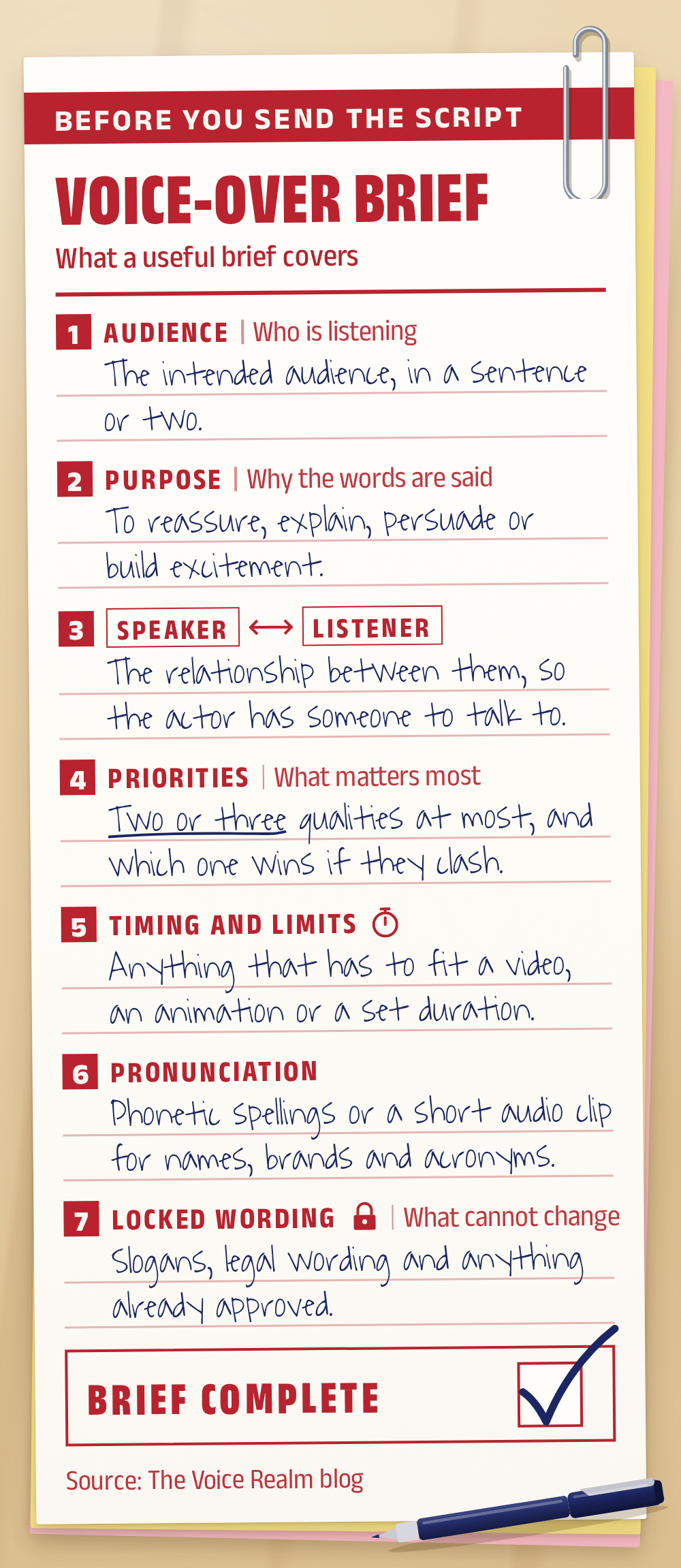
A brief the actor can act on © The Voice Realm
A useful brief might read: “This is a two-minute explainer for small-business owners who are unfamiliar with our software. Imagine you’re showing one business owner a simpler way to handle a task they currently find frustrating. Keep it relaxed and helpful rather than sales-heavy. The middle section contains the key benefit, so give that idea slightly more emphasis. Please use the attached pronunciation guide for the product name, and the final sentence must match the on-screen animation timing.”
Compare that with simply writing “Warm, natural, conversational and professional.” The difference is not really the number of words. It is the amount of usable information those words give the performer.
Better Direction Usually Means Fewer Surprises
A strong voice-over performance is a collaboration between the words on the page, the person who understands the project and the professional actor interpreting the message. Vague direction does not automatically produce a bad recording, and experienced performers are often very good at interpreting limited information, but vague direction increases the number of assumptions everybody has to make.
Clearer direction reduces those assumptions. It tells the actor who is listening, why the message matters, what the speaker is trying to achieve and where the important moments occur. It also identifies practical constraints such as pronunciation and timing before they become problems.
Most importantly, good direction does not tell a professional voice actor how to move every syllable. It gives them a destination and enough information to make intelligent creative choices on the way there.
The next time you find yourself typing “warm, natural and conversational,” you do not necessarily need to delete those words. Add the context that makes them meaningful, and the actor will have a much clearer idea of the performance you actually want.
Ready to Find the Right Voice for Your Project?
The right performance starts with the right talent and a clear understanding of what your project needs. The Voice Realm connects clients with pre-screened professional voice actors across a wide range of styles, accents and voice-over categories, making it easier to audition talent and find a voice that fits your message.
Once you have found the right performer, give them the context behind the words rather than simply a list of adjectives. A professional voice actor can do far more with “Who am I talking to and why?” than with another request to make the performance “a little more natural.”
Featured image: Photo by XT7 Core on Unsplash
Sources: unsplash.com.
Ready to get booked?
See the jobs open right nowAbout Sarah Robbins
Sarah Robbins writes for The Voice Realm about finding voice over work, home studios, casting and the business side of voice acting.