Blog
Blog

You’ve recorded the job, sent the files and the client says it sounds great. Then comes the part nobody trains you for: asking to be paid. Plenty of voice actors are brilliant in the booth and a bit shy with paperwork, and it shows up as late payments, muddled usage terms and awkward emails. This guide covers what a voice over invoice needs to say, when to send it, and how to follow up without feeling like a nag.
It’s written for freelancers who invoice their own clients. If a booking runs through a platform that handles payment for you, you’ll still find it useful for the clients who find you directly.
The invoice is part of the job
A clear invoice does three things. It tells the client exactly what they bought, it tells their finance team exactly what to pay and when, and it gives you a record you can point to months later. Vague invoices get queried, and queried invoices get paid last.
Most late payments aren’t a client being difficult. They’re a bill sitting in somebody’s inbox with a question nobody has asked yet. Skye Moffett, writing for Such A Voice, says it plainly: “9 times out of 10, the client has simply forgotten when the payment was due or got busy.” Good paperwork removes the excuses, and a friendly nudge handles the rest.

© The Voice Realm
Agree it in writing before you record
The invoice should never contain a surprise. Everything on it should already have been agreed, in writing, before you pressed record. Moffett’s advice on this is to agree things “via email, not on the phone or in-person”, covering the amount, the timeline and the details. A short email that says “just confirming: one thirty second spot, two takes, web and social for twelve months, fee as quoted” takes a minute to write and settles most arguments before they start.
If the client changes the scope after that, such as more versions, a longer script or wider use, reply with the new price before you record the extra work. It feels awkward once. It feels much worse to invoice for something the client thought was included.
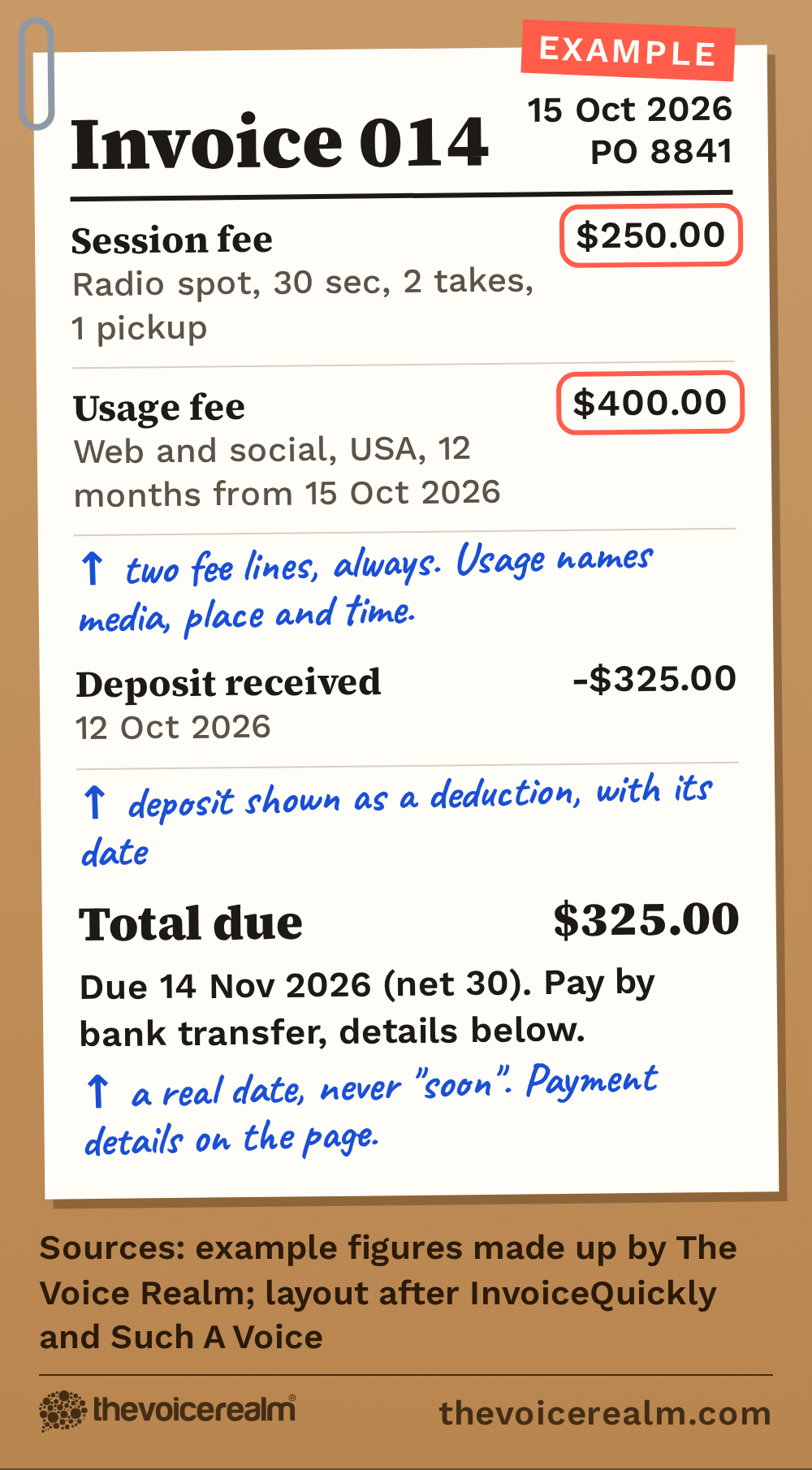
Two lines, not one: the session and the use
This is the part new voice actors most often skip. The money you charge for the work in the booth and the money you charge for how the recording gets used are different things, and they belong on separate lines.
The invoicing site InvoiceQuickly, in its guide for voice actors, puts it this way in its key takeaway: “Separate session fees from usage fees on every invoice, specify the territory, media, and term of the usage licence”. In its FAQ it explains the reasoning: “The session fee compensates your time and talent in the booth.” The usage fee covers the value the client gets from airing or publishing the recording. Splitting them makes renewals simple too, because when a licence runs out you only re-invoice the usage part.
The session
Your time and talent on the day. Number of takes, versions and any pickups. It’s charged once, however long the client uses the recording.
The use
Where it runs, in what media, in which territory and for how long. It’s what you renew, extend or negotiate when the client wants more.
If you’re not sure how to describe usage, our guide to who owns your voice after the session walks through media, territory and term in plain words, so the line on your invoice says the same thing as the agreement.
What else belongs on the page
The example below is a worked invoice with a few notes in the margin. The figures are made up purely to show the layout. Beyond the two fee lines, a client’s finance team will usually look for the following:
- Your name or business name, contact details and any tax number your country asks for.
- The client’s name and billing address, plus any purchase order or job number they gave you.
- A short description of the work, such as the script title and the session date.
- Any deposit already received, shown as a deduction.
- The total, the due date and exactly how to pay you.
Itemise rather than lumping everything into one figure. A single line that says “voice over services” invites questions, where three clear lines usually don’t. Name the invoice with a number so it’s easy for both of you to refer to later.
© The Voice Realm
When to send it
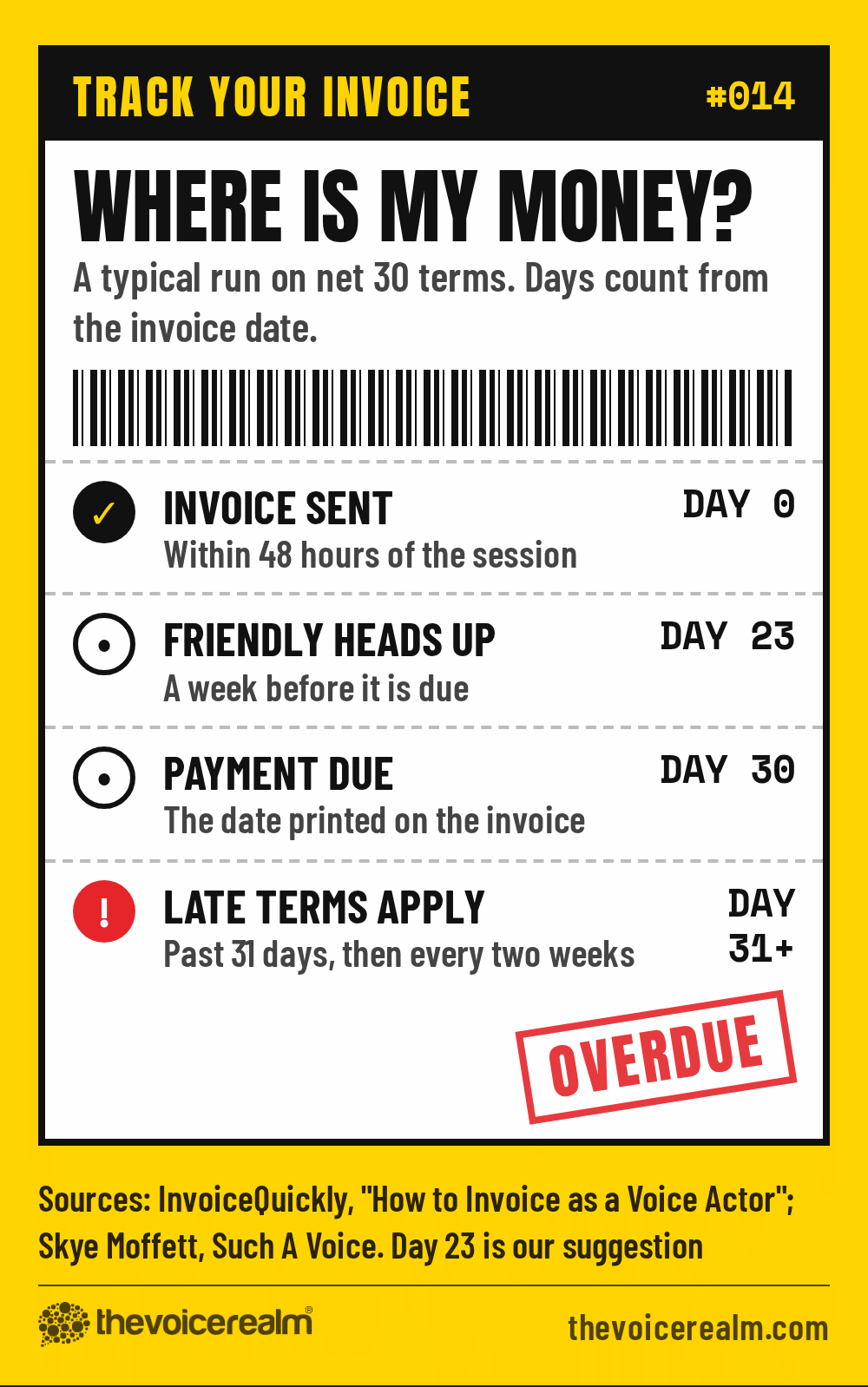
Send it quickly. InvoiceQuickly’s advice for commercial work is to “invoice within 48 hours of the session for fastest payment”. The reasoning is simple: the job is fresh in everyone’s mind, the person who booked you hasn’t moved on to the next thing, and your invoice joins the queue early instead of late.
 VOICEMASTERACADEMYLearn the craft in order.Module one is freeStart module oneTwenty modules, start to finish.
Don’t wait for the client to say it has aired or been approved, unless your agreement says payment follows approval. If it does, put the approval step in your confirmation email so nobody is guessing. And if you recorded a series of spots, a single invoice at the end of the project is usually tidier than one per spot.
Send the invoice with a two line email: thanks for the booking, the invoice is attached, and the due date. It reads as friendly and clear, which is the tone you want from a business that expects to be paid on time.

© The Voice Realm
Deposits for new clients
With a brand new client, a deposit is a sensible way to start. It tells you the client is serious, and it keeps you from doing a lot of work for someone you haven’t met. Moffett’s advice from Such A Voice: “Collect half up front”, and the article explains that “It gives your client the option of breaking up their payment, but ensures you at least have some form of payment.”
InvoiceQuickly suggests a range for new relationships: “First-time clients without referrals: 25-50% deposit on signing.” Regular clients who’ve paid you promptly before probably don’t need one. Whatever you choose, say so in your confirmation email, show it as a deduction on the invoice, and keep it consistent so it never feels personal.
Payment terms and the friendly follow up
Terms tell the client when the money is due. InvoiceQuickly notes that “Net 30 is common in commercial production”, meaning payment thirty days after the invoice date. Some clients will ask for longer, some will pay faster. Pick the terms you can live with and print them on every invoice, so the date is never a matter of opinion.
You can also say what happens if payment is late. Moffett’s suggestion: “Beyond 31 days, and every 2 weeks after that, additional percentage or flat fee should apply.” Having it written down gives you something to point to, and you can always choose to waive it for a client who pays up straight away after a polite reminder.
Then diarise the due date. When it passes, don’t wait and stew. The advice there is to “Send a friendly but firm reminder that their bill is coming up (or was already due).” Something like: “Hi, a quick note that invoice 014 was due on the 15th. Could you let me know when I can expect it? Thanks so much.” If that doesn’t work, our piece on how to deal with late payments covers the next steps in more detail.
© The Voice Realm
Small slips that slow a payment down
Most delays come from small, fixable things rather than anyone refusing to pay. Here are the ones worth checking before you hit send.
The first is sending the invoice to the wrong person. The creative who booked you often isn’t the person who pays bills, so ask at the start: “Who should I send the invoice to, and do you need a purchase order number?” If the client has a number for the job and you leave it off, the invoice can sit in an accounts inbox until somebody asks for it.
The second is missing payment details. It sounds obvious, but a due date without a way to pay is just a deadline. Put the account details or payment link on the invoice itself, not in a separate email, so whoever opens it has everything in front of them. The third is a vague date. “Due on receipt” and “soon” mean different things to different people, so write the actual calendar date.
The fourth is sending something hard to open. Send a PDF, name the file with your name and the invoice number, and keep it to a single page where you can. And finally, don’t bury a change. If the final job grew from the quote, say so in the covering email in one sentence, so the figure on the invoice never comes as a shock.

© The Voice Realm
Keep your paperwork where you can find it
Create a simple system and stick with it. One folder per client, with the confirmation email, the invoice, the payment confirmation and any usage terms. Keep a running list of invoices with the date sent, the due date and the date paid, so a quick glance tells you who owes what.
Records matter beyond chasing money. When tax time comes round, a tidy invoice history makes it much easier to see what you earned. Our guide to taxes for voice actors covers the records worth keeping and why.
Invoicing won’t be the part of the work you enjoy most, and it doesn’t need to be. Get the terms agreed first, split the session from the use, send it within two days and follow up kindly. Do those four things every time and you’ll spend far less of your week thinking about money.
Sources: Skye Moffett, Such A Voice, “How to Collect Voice-Over Payments From Clients” (19 July 2018); InvoiceQuickly, “How to Invoice as a Voice Actor: Rates, Terms and Templates”.
Ready to get booked?
See the jobs open right nowAbout Sarah Robbins
Sarah Robbins writes for The Voice Realm about finding voice over work, home studios, casting and the business side of voice acting.