Blog

Sooner or later someone asks a voice actor for a resume. An agent wants one before a meeting. A theatre-trained coach asks what you’ve done. A studio’s talent form has an upload box marked “Resume (PDF)”. And most voice actors either don’t have one, or have an old acting resume with their height on it.
This guide is for anyone in that spot, whether you’ve booked a hundred jobs or none yet. It covers what a voice actor’s resume is really for, what to keep from the acting version and what to cut, how to lay out credits, what to do when you don’t have any, and the small formatting habits that make the page look like it came from a professional.
Nobody hires a resume, and that’s the point
Let’s get the awkward truth out of the way. In voice work, the demo does the hiring. Dee Bradley Baker, whose voice you’ve heard in more cartoons than you could list, says it bluntly on his advice site for new voice actors: “Your aim is to impress with your acting, your range- not your resume’. Nobody hires a resume’.”
So why bother? Because the resume does a different job. It’s proof that you’re serious. In the same guide, Baker lists what he’d want an actor to have ready before meeting an agent, and the first item is “Evidence that you are working at your career and are serious about pursuing this: A professional looking resumé, some recognizable learning experience (classes, workshops, teachers), performing experience”.
That’s the brief. The demo shows what you sound like. The resume shows that you’ve put in the work and that you keep training. It’s the page that sits behind the audio and quietly says “this person is for real”.

© The Voice Realm
Where a voice actor’s resume actually gets read
You won’t attach it to every audition. Most voice buyers want a file and a slate, not paperwork. But there are places where it matters a lot:
- Agents. If you’re looking for representation, the resume sits next to your demo in the email or on the table at the meeting.
- Theatre, audio drama and on-camera crossovers. Anyone from a stage background will expect one, and they’ll read it the stage way.
- Studios and production companies building a list of local talent, especially for narration, e-learning and dubbing.
- Your own website. A credits page is your resume in a different coat, and it’s often the first thing a producer checks after your demo.
- Teachers and coaches deciding which class level suits you.
Notice what those readers have in common. They’re deciding whether to invest time in you. They’re not deciding whether you’re right for one commercial. That changes what goes on the page.

© The Voice Realm
Start from an acting resume, then cut
The acting resume is the template everyone knows, and it’s a good starting point. Binghamton University’s career centre sums up how it differs from an ordinary job resume. One difference is that physical details are expected: “Physical characteristics (height, hair color, eye color, and sometimes clothing size), which are typically not included on a standard U.S. resume, are expected here as they help casting directors visualize and cast you appropriately.”
For voice work, that whole line goes. Nobody casting a narrator cares about your eye colour, and a height and weight line on a voice resume tells the reader you’ve copied a stage template without thinking about it. The same goes for the headshot stapled to the back. Here’s how the two compare.
The acting resume
Name, union status and contact at the top, then height, hair and eyes. Credits grouped by film, television and theatre. A printed page stapled to an 8×10 headshot. Special skills can run from juggling to stage combat.
The voice resume
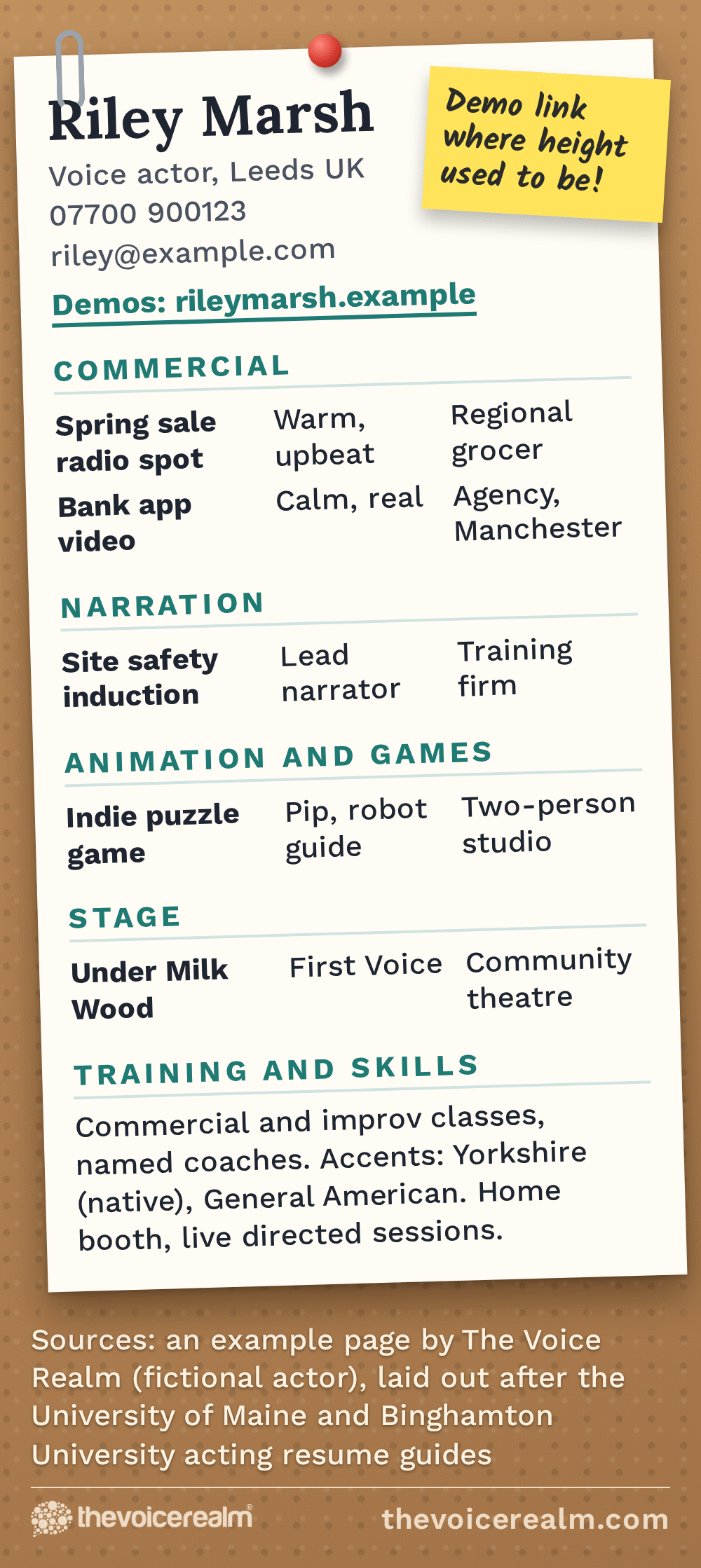
Name, contact and a link to your demos at the top, where the physical stats used to be. Credits grouped by genre: commercial, narration, animation and games, audiobooks. Your studio setup in place of the headshot. Skills limited to things a voice buyer can book: accents, languages, character range, turnaround.
Keep the structure the acting resume gives you, though. Clear sections, credits in columns, training listed with names, one page. Casting people from every corner of the business read that layout fast, and fast is what you want.
The top of the page: name, contact and your demos
Your name goes first, big, and the same way it appears everywhere else. The University of Maine’s acting resume guide puts it neatly: “Be consistent! Are you Mike or Michael?” If you work under a different name from the one on your passport, use the working one here and on your website, and if you haven’t settled that yet, our piece on choosing a name to work under walks through it.
Under the name: a phone number you actually answer and an email address you’ll still have in five years. Not a school or day-job address. Maine’s guide adds one line in capitals for good reason: “NEVER list your home address or Social Security number!” Your city or region is plenty. It helps a local studio know you can come in, and it says nothing a stranger can misuse.
Then the line that replaces height and eyes: your demos. One short web address that lands on a page where every demo plays straight away, labelled by genre. If you only have one demo, that’s fine. If it’s old, that’s a bigger problem than anything on the resume, and it’s worth reading why the demo carries so much weight before you tidy the paperwork.
Union status goes up here too if it applies, in plain words, the way a casting person would write it. If you’re not in a union, leave it off. There’s no need to explain.
Credits: three columns, no bullet points
Credits are the heart of the page. Binghamton’s guide makes a point that surprises people coming from office jobs: “Acting resumes generally avoid bullet-point descriptions of responsibilities, since your credit itself implies what was required”. Nobody needs to read that you “delivered high-quality audio to tight deadlines”. The credit says it for you.
Use three columns that a voice buyer can scan: the project, what you did on it (a role name for character work, a style for everything else, such as “lead narrator” or “warm conversational read”), and who you did it for (the brand, the studio, the publisher or the director). Group the rows by genre, with the genre you most want to be booked for at the top.

 VoiceEditSuiteHow your room really sounds, measured.Read a 30-second script in your normal setup. Home Studio Analysis measures reverb, noise floor, hum and sibilance, then tells you what to fix first. Free.See how it worksYour recordings are never used to train AI.
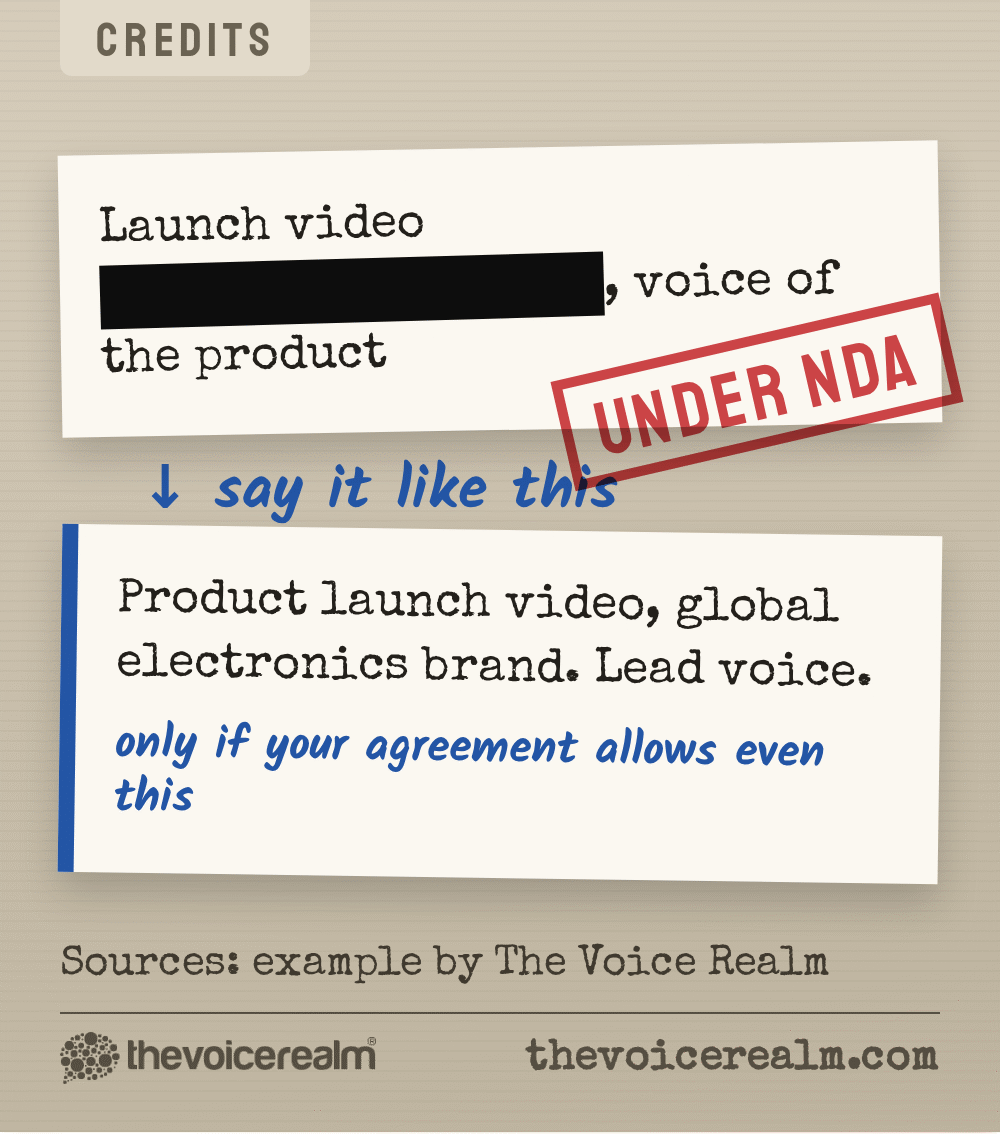
Two voice-specific wrinkles. First, a lot of corporate and e-learning work is covered by a non-disclosure agreement. Never name a client you’ve agreed not to name. Describe the job instead, such as “Compliance training series, international bank”, and only if your agreement allows even that. Second, never put your rate or what a job paid on the page. That’s a conversation, not a credit.
Order within each genre is up to you. Most recent first is the usual habit. Biggest name first is fine too, as long as every row is true. Inflating a credit is the one thing that can’t be undone: the voice world is smaller than it looks, and someone on the other end of that email may have been in the session.
© The Voice Realm
When you don’t have credits yet
Everyone starts with a short page, and a short honest page beats a padded one. Maine’s guide is firm about the most common padding: “Scenes performed in class do not count as theatre credits and should not appear on your resume.”
So what does count? Real work in front of a real audience, paid or not. Stage plays and musicals. Community radio. An audio drama that was released. A student film. A podcast you voiced that people actually listen to. Improv shows. Narration you did for a local museum or charity. List them under honest headings such as “Stage”, “Audio drama” or “Other voice work”.
Then lean on the sections you can fill: training and skills. If you’re at the very beginning and the page looks thin, that’s usually a sign to train before you send it out, and a structured course like Voice Master Academy gives you both the skills and a training line that means something. Once you’re ready to earn credits, the voice over jobs board is where the first real ones start.
Training and skills a voice buyer actually cares about
Training is a list of people, not just places. Maine’s guide suggests listing “the instructors you studied with for any key skills such as Voice, Movement, Improvisation, Stage Combat, Shakespeare, etc.” For voice work that means the coach who shaped your commercial reads, or whoever ran the animation workshop that changed how you approach a character. A teacher’s name tells a reader far more than “voice acting course, 2025”.
Special skills on a voice resume should be things someone can book. Accents and dialects, but only the ones you’d be happy to deliver on a paid job tomorrow. Languages, with an honest level: native, fluent, or able to read with good pronunciation. Character range if you do animation or games: creatures, kids, elderly voices, singing in character. Long-form stamina if you narrate.
Then add something an acting resume never has: your studio. One short line covering the microphone and interface you record with, your treated space, and how you can connect to a live directed session. Producers booking remote work read that line closely, because it tells them whether the files will arrive clean and on time.
© The Voice Realm
Format: one page, a PDF and a sensible file name
Maine’s guide gives the rule most theatre departments teach: “Resumes should not extend beyond one page and should be saved and submitted as a PDF file.” It also asks for a plain, readable font and says “Do not use a font size smaller than 11 in most cases.” If your page only fits at size 9, it has too much on it. Cut the oldest and smallest credits first.
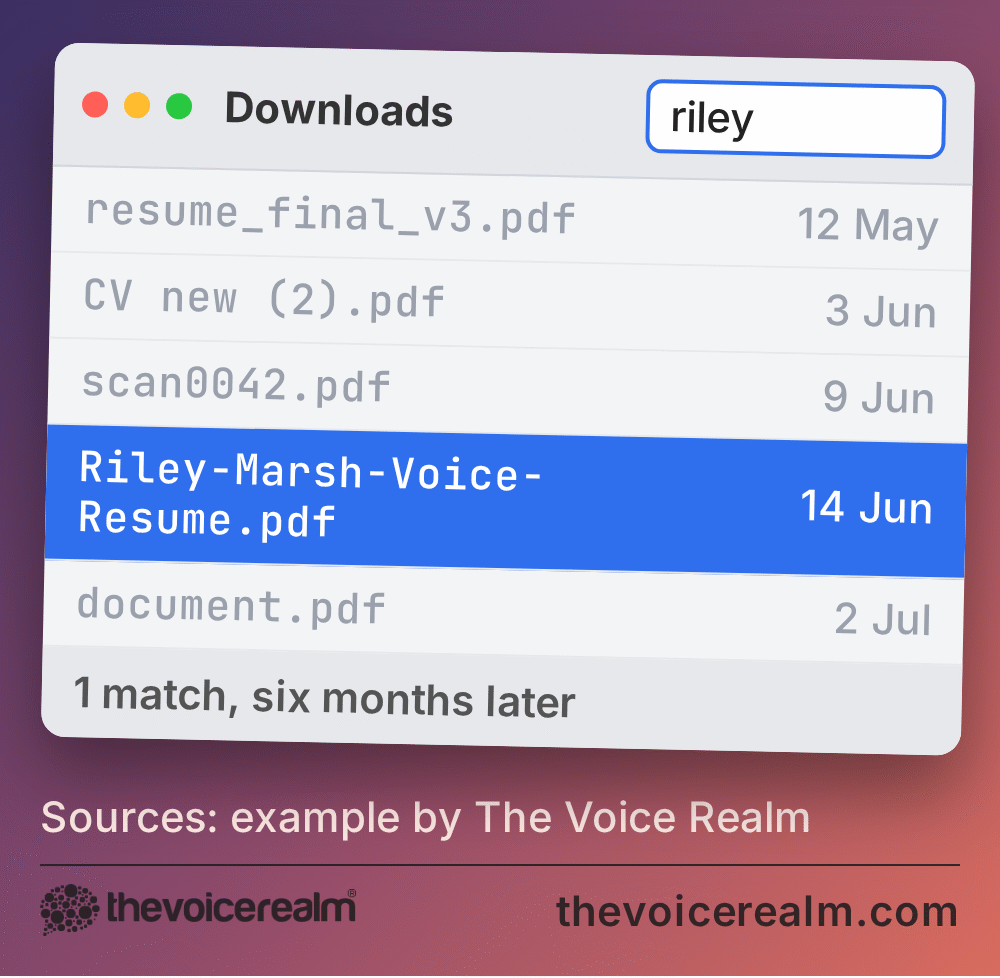
Name the file so it still makes sense in someone’s downloads folder six months from now: your working name, “voice”, “resume”, and nothing else. Keep a plain text version of the credits too, because some talent forms want you to paste rather than upload.
Set yourself a reminder to update it every few months. A resume that ends two years ago reads as “stopped working two years ago”, even if you’ve been busy the whole time.
© The Voice Realm
One last look before you send it
Read it as the person receiving it. Can they hear your demo within ten seconds of opening the email? Can they tell what you’re best at from the first section? Is there anything on the page they’d have to ask you about? If the answer to the last one is yes, either explain it in plain words or take it off.
Then send it with a short, friendly note and the demo link in the body of the email, not only in the attachment. The resume does its job quietly. The demo still has to do the talking.
Sources: Dee Bradley Baker, “Your Demo” and “Getting an Agent”, I Want To Be A Voice Actor. Binghamton University Fleishman Center, “How to Create an Acting Résumé”. University of Maine System Pathways to Careers, “How to Make Your Acting Resume”.
Ready to get booked?
See the jobs open right nowAbout Sarah Robbins
Sarah Robbins writes for The Voice Realm about finding voice over work, home studios, casting and the business side of voice acting.