Blog
Blog
This one’s for any voice actor who’s listened back to a take and heard a creak at the end of their lines, like a door hinge or bacon in a pan. That sound is vocal fry. Everybody makes it sometimes, it isn’t the disaster the internet says it is, and in some reads it’s exactly what the client wants. In others it quietly costs you the booking.
Below you’ll find what vocal fry is, what the research says about how listeners hear it, whether it’s bad for your voice, how to catch it in your own recordings, and how to lift the ends of your lines when you don’t want it there.
What vocal fry actually is
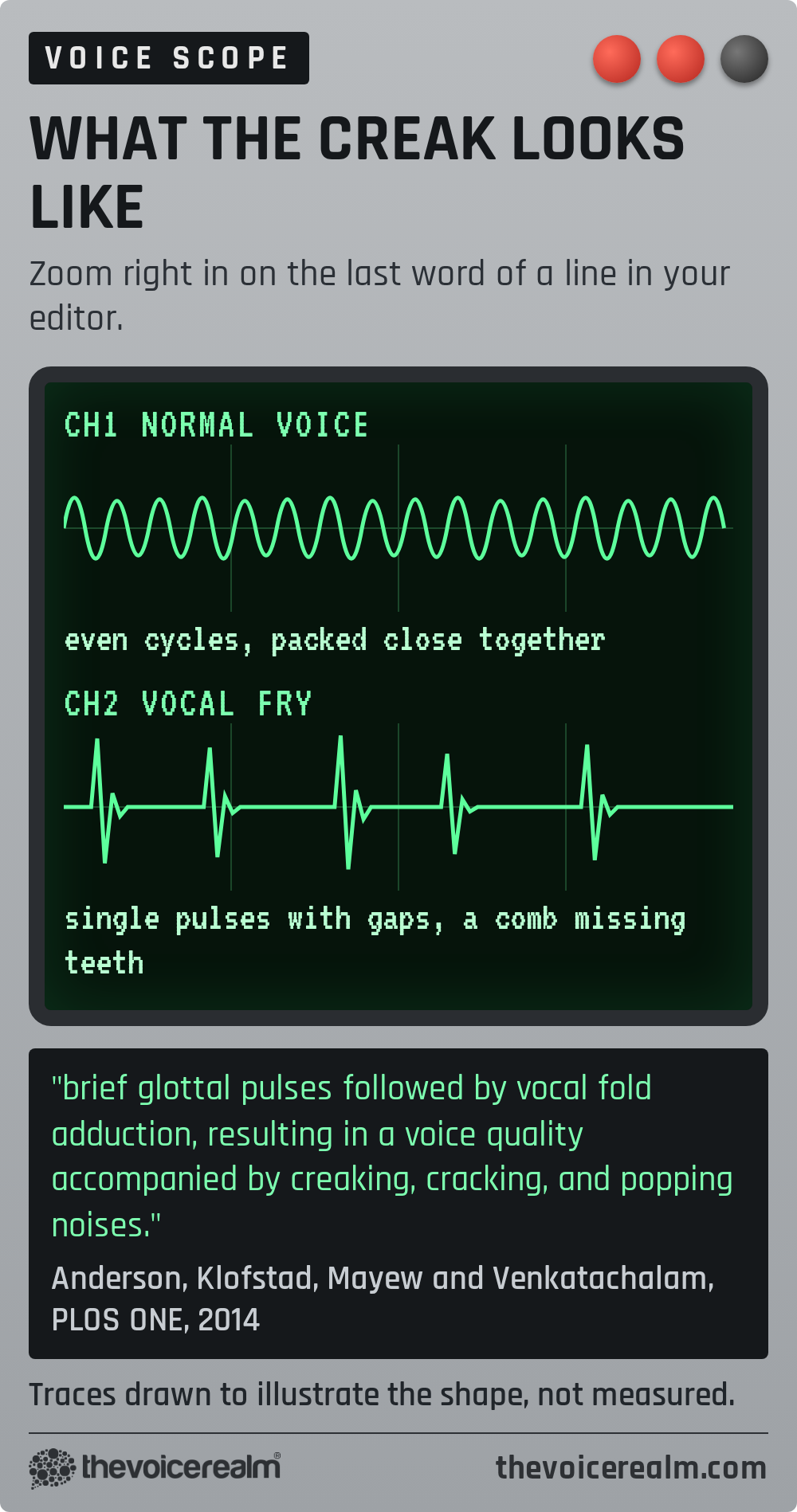
Your voice usually comes from your vocal folds vibrating in a smooth, regular pattern. Vocal fry happens when that pattern breaks into slow, uneven pulses. A 2014 study in PLOS ONE describes it neatly: “Vocal fry is produced through brief glottal pulses followed by vocal fold adduction, resulting in a voice quality accompanied by creaking, cracking, and popping noises.” The same paper adds that it “occurs typically when speakers lower their vocal pitch to the lowest register they are capable of producing.”
Linguists often call it creak, or creaky voice. Lisa Davidson, a linguist at New York University, describes it as what happens when the vocal folds come together in an irregular way, with an abrupt, incomplete closure instead of the usual smooth vibration. She told NYU’s own news service that it’s easy to spot in the sound waves of speech, and that it’s far more ordinary than its reputation suggests.
“The fact is that pretty much everybody creaks,” as the NYU piece put it. Davidson’s explanation of why is the most useful line for a voice actor: “In English we generally use it as an indication that we’re coming to the end of a sentence.” Your pitch drops as you finish a thought, your breath runs low, and the voice slips into creak for the last word or two. That’s why you hear it at the ends of lines far more than in the middle.

© The Voice Realm
Is vocal fry bad for your voice?
You’ll find plenty of warnings online that fry damages the vocal folds. The evidence for that is thin. Davidson tackled it directly: “So to say that if you creak you’re causing damage to your vocal folds is just crazy.” Her reasoning is that some languages use creak to change the meaning of a word, so whole populations would have voice problems if it were harmful. She suggests the worry may come from confusing cause and effect, since some voice disorders can produce a creaky sound without the creak being what caused them.
That doesn’t mean you should ignore your voice. Fry often shows up when you’re tired, dehydrated or pushing your pitch lower than is comfortable for long stretches, and those things matter on a long narration day. If your voice feels strained, stays hoarse, or it hurts to talk, rest it and see a doctor or a voice specialist. That’s a sign of something worth checking, whatever the cause.
For most voice actors, the question isn’t health. It’s whether the creak is helping the read or getting in its way. Our guide to looking after your voice between sessions covers the rest of the daily care.
© The Voice Realm
Why fry creeps into your reads
Fry tends to arrive for a handful of reasons, and most of them are fixable once you know which one is yours.
The commonest is running out of air. You start a long line on a decent breath, spend it on the first two thirds, and the last few words come out on what’s left. With too little air going through the folds, they can’t keep up a smooth vibration, so they crackle.
The next is reaching for a lower pitch than your natural one. A lot of actors drop their voice to sound authoritative or intimate, especially for corporate or luxury copy. Push down to the floor of your range and you’re right where fry lives.
Then there’s energy. The end of a line is where your attention drifts to the next one, and the energy dips with it. In everyday talk that’s natural. In a voice over it sounds like you’ve lost interest in the last word, which is often the most important word in the line.
“In English we generally use it as an indication that we’re coming to the end of a sentence.”
Lisa Davidson, linguist, New York UniversityPost this quote
Time of day plays its part too. Morning voice is lower and rougher, and many actors fry more in an early session than they would in the afternoon. A proper warm-up helps, and our set of warm-up exercises for voice actors includes the gentle glides that bring your pitch up to its normal home before you record.
How listeners hear it
Here’s where it matters for your bookings. The 2014 PLOS ONE study, led by Rindy Anderson with colleagues from the University of Miami and Duke University, recorded young men and women saying the same phrase in their normal voice and in vocal fry, then asked hundreds of listeners to compare them.
The headline finding was blunt: “Relative to a normal speaking voice, young adult female voices exhibiting vocal fry are perceived as less competent, less educated, less trustworthy, less attractive, and less hirable.” The researchers found the effect for men too, but weaker: “The negative perceptions of vocal fry are stronger for female voices relative to male voices.”
Davidson offers one reason for the gap. Because women’s voices are generally higher, the drop into creak is a bigger change, and so “it’s really noticeable when a woman is changing from her normal voice to creaky voice, because of the pitch change.” She also points out, fairly, that some of the criticism aimed at women for something everyone does looks a lot like plain bias.

 VoiceEditSuiteClean it up, check it, send it.Loudness NormalizerScript AccuracyRate CalculatorSee the suiteThe studio check is free to try.
You don’t have to agree with how listeners judge fry to work with it. The study measured the qualities a corporate, medical or financial client is buying: competence and trust. If a client’s audience might hear your line endings as less trustworthy, that’s a reason to control them in those reads, while keeping the creak in your toolkit for the jobs that want it.
© The Voice Realm
Catching it in your own recordings
Fry is easy to miss while you’re reading and obvious once you listen back. The trick is to listen on purpose. Play a take and pay attention only to the last two or three words of each line. You’ll hear a crackle, a rattle or a sound like a stick being dragged along a fence.
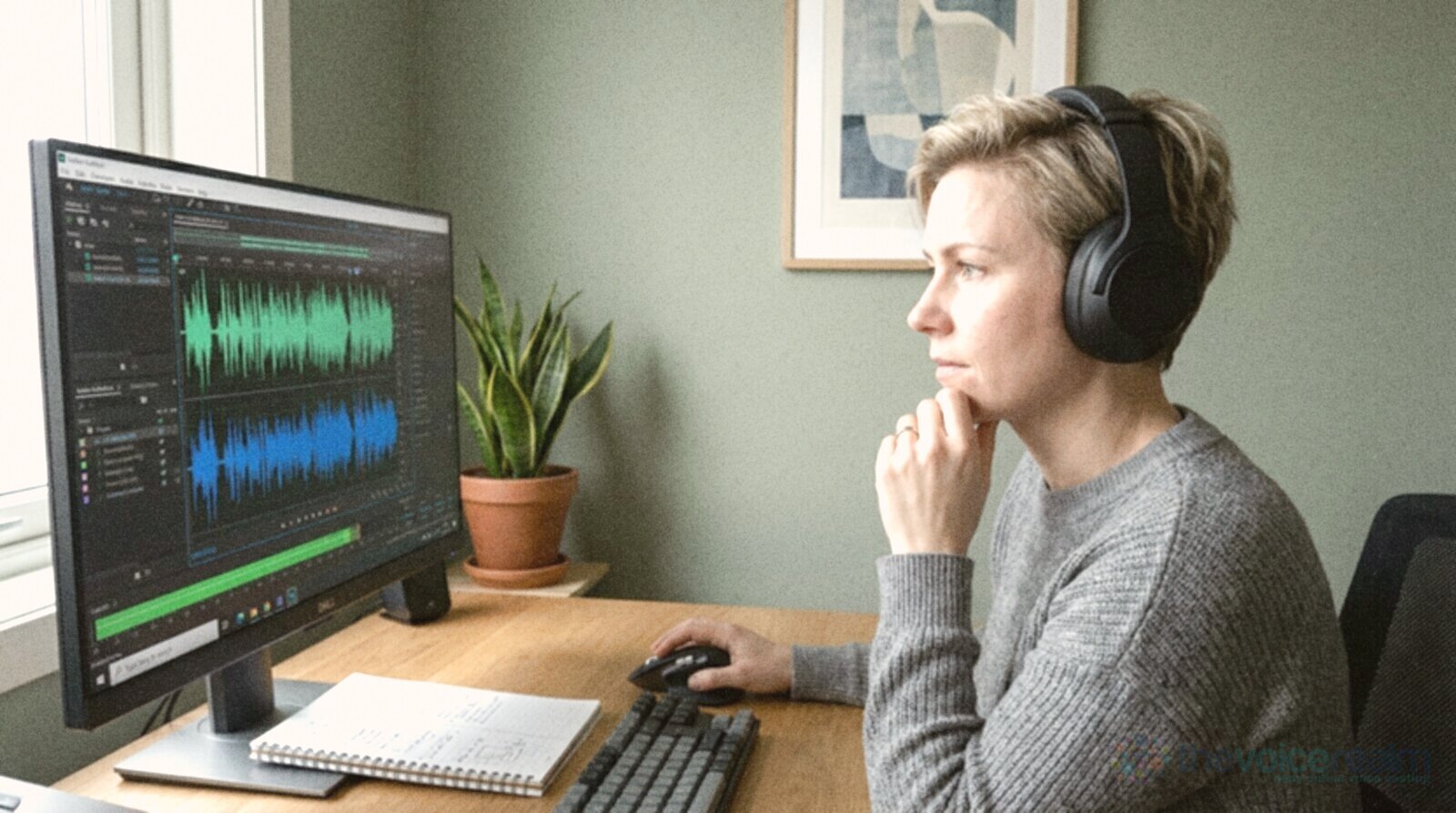
Your editing software helps here too. Zoom right in on the last word of a few lines, then on a word from the middle of the same line, and compare the two. The creak has a shape you can see, usually just before a pause, and once you’ve spotted your own a few times you’ll find it at a glance.
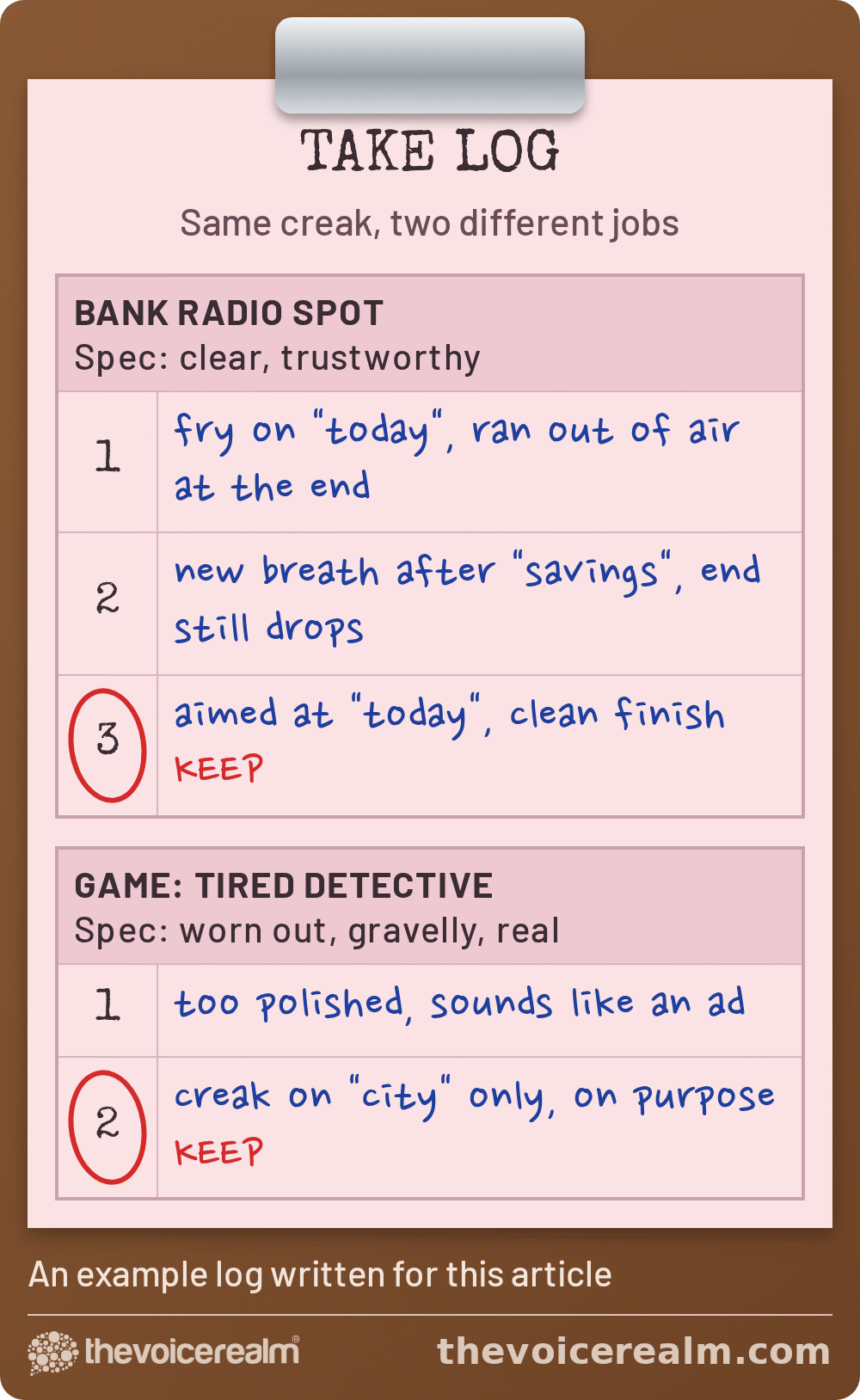
Keep a short log for a week. Note which scripts and which times of day bring it out. Most actors find a pattern: long sentences, low reads, early mornings or the last hour of a long session. That tells you which fix to reach for first. When you’re cleaning up takes, our guide to editing your own voice over shows how to drop in a cleaner line ending from another take without the join showing.
© The Voice Realm
Five ways to lift the end of a line
None of these are about forcing your voice up. They’re about keeping the folds working smoothly right to the last word.
- Breathe for the whole line. Mark breaths on the script before you record, so long sentences get a fresh breath at a natural break instead of a gasp at the end.
- Find your real middle. Glide up and down on an “mmm” and settle where it feels easy. Read from there, not from the basement of your range.
- Aim at the last word. Decide which word each line lands on and think of it as the destination. Energy follows intention, so the end of the line stops sounding like an afterthought.
- Keep the sound moving forward. Imagine the final word travelling to the listener rather than falling into your chest. A small smile helps some people.
- Hydrate and pace your day. Sip water through the session and take short breaks in long narration days, before tiredness starts doing the reading for you.
Practise on copy you know, then on cold copy. Record, listen to the line endings only, and repeat. Most people hear a difference within a week.
When fry is the right call
Here’s the part the warnings leave out. Fry is a sound, and sometimes it’s the sound the script wants. A relaxed, late night radio feel, a world weary detective, a gravelly villain, a teenager in an animated series, a young lifestyle brand that wants its ad to sound like someone talking to a friend. In all of these, a touch of creak can make the read feel real.
The difference is control. A deliberate creak on one word to show a character’s exhaustion is acting. A creak on the end of every line because you ran out of air is a habit. Directors can hear the difference, and so can clients.
Read the specs. “Natural”, “real”, “unannounced” and “conversational” often leave room for a little texture. “Authoritative”, “trustworthy”, “clear” and “professional” usually don’t, and neither does most medical, financial and e-learning work. When in doubt, send the clean read as your main take, and offer a looser alternate.
© The Voice Realm
Keep the creak where you choose it
Vocal fry isn’t a flaw in your voice. It’s a sound everyone makes, usually at the end of a thought, and the research says some listeners judge it harshly, especially from women. For a voice actor, that adds up to a simple goal: make it a choice. Breathe for the whole line, read from your natural pitch, aim at the last word, and use the creak on purpose when the character or the brand calls for it.
If you’re just starting out and want help with breath and line endings, Voice Master Academy’s beginner voice acting course works on exactly this with feedback on your reads. Our guide to breathing techniques for long lines is a good place to start today.
Sources: Anderson, R. C., Klofstad, C. A., Mayew, W. J. and Venkatachalam, M., “Vocal Fry May Undermine the Success of Young Women in the Labor Market”, PLOS ONE, 2014; NYU, “Lisa Davidson on vocal fry”, 2015.
Ready to get booked?
See the jobs open right nowAbout Sarah Robbins
Sarah Robbins writes for The Voice Realm about finding voice over work, home studios, casting and the business side of voice acting.