Blog
This one’s for voice actors who’ve landed, or want to land, their first video game session and just spotted a word on the booking they don’t recognise: efforts. It’s the part of game work nobody puts on a demo reel and every game needs. The grunt when a character vaults a wall. The sharp exhale when a sword connects. The long, ugly sound of someone losing a fight.
Efforts look simple on the page, a list of one-word cues. They’re anything but simple on your throat. Below is what efforts are, what to ask before you say yes, how the union draws the line on vocally stressful work, how to order and perform the sounds so they read as real, and how to look after your voice when the session’s over.
What counts as an effort
An effort is any non-verbal sound a character makes while doing something physical. Jumps, climbs, landings, pushes, pulls, punches thrown and punches taken, falls, deaths, and the breathing that ties them together. Games need dozens of each, in several sizes, because a player might hear the same jump four hundred times in an evening and the sound designers don’t want it to get stale.
You’ll also hear the word barks. Barks are short spoken lines a character shouts during play (“Reloading!”, “Over here!”, “Get down!”), and they often sit on the same session sheet as the efforts. ACTRA Toronto, the performers’ union, sums up the load plainly: “Actors are asked to “Bark” or yell aggressively, 100 dialogue lines an hour, or voice “ONOS,” (pained reactions) for up to two hours.”
If you’re new to game work in general, our guide to breaking into video game voice acting covers auditions, demos and where the work comes from. This piece is about the session itself.
Why efforts are the hardest work in the booth
Commercial copy asks for control. Narration asks for stamina. Efforts ask for both at once, at volume, with your whole body tensed, again and again. ACTRA Toronto calls game acting “easily the most vocally challenging and potentially vocally dangerous work an actor can take on.”
That isn’t just a union being dramatic. When ACTRA Toronto surveyed members who do game voiceover, “Almost 3 out of 4 actors (74.32%) said that their sessions included loud/projected, aggressive, or vocally extreme work, very often or almost always.” And “More than 4 in 10 actors (42.74%) said that it took 2 or more days for their vocal quality to return to “normal” after a vocally extreme voice-over session.”
Two days is a long time if you’ve got a corporate narration booked for tomorrow morning. That’s the first practical lesson: efforts sessions affect your whole week, so plan the week around them.
© The Voice Realm
Ask what you’re walking into
Before you accept a game booking, find out how much of the session is efforts and how extreme they’ll be. Is it light movement for a puzzle game, or a full combat set with deaths, burns and creature sounds? Those are very different days.
SAG-AFTRA’s guidance to producers on its Tiered Budget Independent Interactive Media Agreement puts the onus on the studio to say so up front. If a producer expects vocally stressful work, they “should describe the anticipated work as fully as possible prior to recording, so the performer understands what to expect and can prepare for it.”
Union job or not, that’s a fair thing to ask. Useful questions:
- Roughly how many efforts, and which kinds?
- Are there deaths, screams or creature sounds?
- Is there reference video or animation to match?
- Will dialogue and efforts be in the same session, and in which order?
“Avoid jumping back into intense vocal work too quickly.”
Jesse Nerenberg, speech-language pathologist, WELL SAID: Toronto Speech TherapyPost this quote
Then look at your calendar. ACTRA Toronto’s own advice to producers is “Do not book sessions less than 48 hours apart from one another.” You can apply the same rule to yourself: leave a gap after an efforts day before anything that needs your voice at its best.
© The Voice Realm
Two hours is the line the union drew
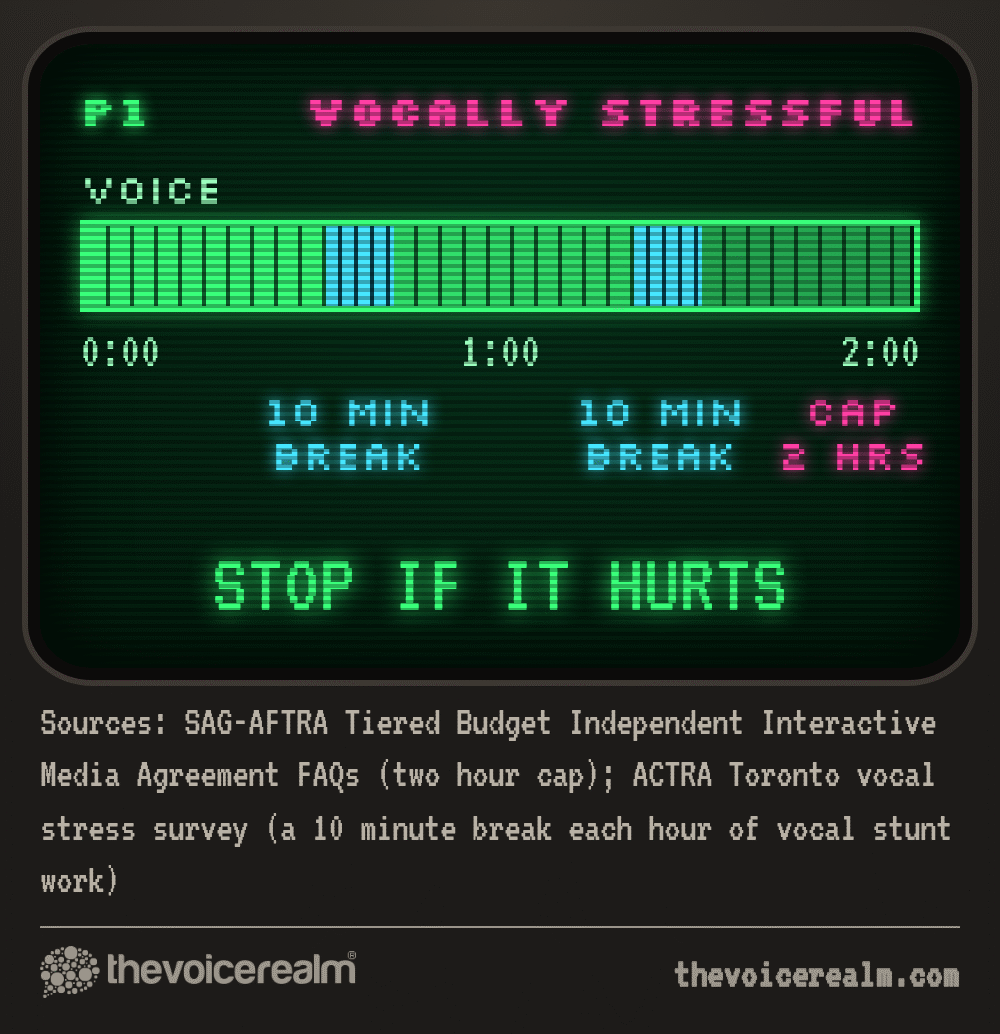
SAG-AFTRA’s FAQ for that agreement is blunt about it: “Vocally stressful sessions are capped at two hours, rather than the usual four- or six-hour session length.”
It also spells out what counts. A vocally stressful session is “one that includes any work that risks damage or undue strain to the performer’s voice, which may be due to prolonged requests for the performer to enact: yelling/shouting/screaming, fighting sounds, death sounds, battle cries, complicated creature sounds, unnatural vocal textures, extensive whispering, high-pitched vocal sounds, or any other voice/sound that is difficult/challenging for the performer to deliver.”
Notice that whispering is on the list. Long stretches of hushed, breathy stealth lines can wear you down as much as shouting. And notice the word “prolonged”. One scream isn’t the problem. Forty of them in a row is.
If you’re working outside a union agreement, the two-hour figure still makes a sensible ceiling for your own planning. ACTRA Toronto goes a step further: “If a session is two hours or more, vocally stressful material should only take a portion of that time and the demands on the performer’s voice should be factored into the rate.”
Put the big sounds at the end
Order matters more than almost anything else you control. Jesse Nerenberg, a speech-language pathologist at WELL SAID: Toronto Speech Therapy, warns that “Shouting early in a session can cause rapid vocal fatigue, compromising your performance for the rest of the day.”
 VOICEMASTERACADEMYFirst read to first booking.Twenty modules. The first one is free.Start free
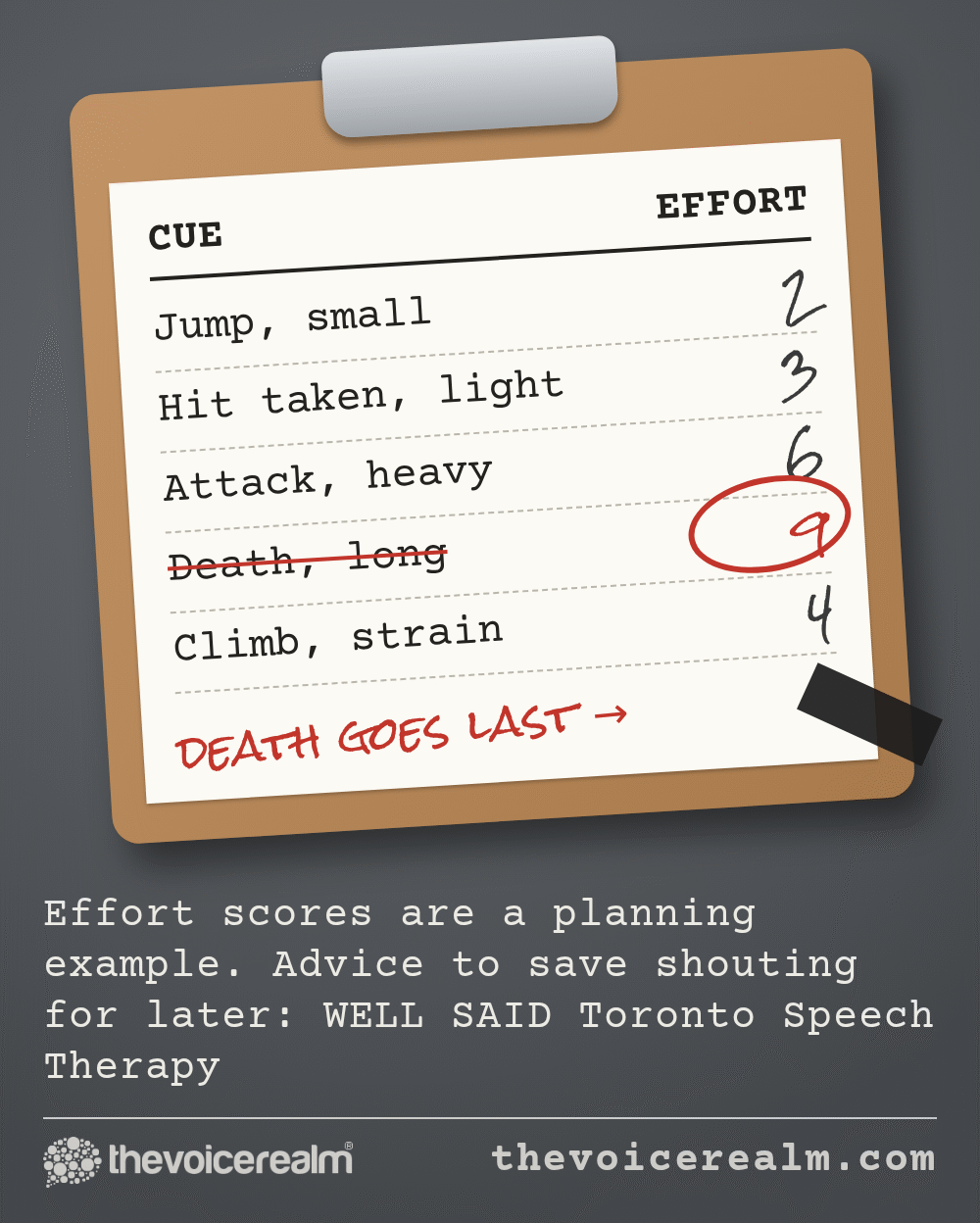
So build the session like a workout. Start with any dialogue and quiet breathing. Move on to small efforts, the jumps and light hits. Then medium, then heavy attacks. Leave the deaths, screams and creature work for last, when there’s nothing left in the session that needs a clean voice. If the director wants to run in script order, it’s worth asking politely whether the biggest sounds can be grouped at the end. Most will say yes, because a tired voice in hour one costs them takes in hour two.
It helps to give every cue on the sheet a quick score for how much it’ll take out of you before you start, then let that score set the running order.
© The Voice Realm
How to perform efforts that sound real
The fastest way to sound fake is to make the noise with your throat alone. Real effort sounds come from the body. When you actually lift something heavy, your core braces, your breath catches and the sound is pushed out by what your body is doing. Do a smaller version of that movement at the mic and the sound follows.
- Move, a little. Brace for a push, flinch for a hit, drop your weight for a landing. Keep your mouth at the same distance from the mic while you do it.
- Breath first. Most efforts start with a breath in or a catch. Let the player hear it.
- Vary the size. Give three versions of each cue unless told otherwise: light, medium and big. The sound team needs choices.
- Back off for the big ones. Lean away or turn slightly off the mic for screams and battle cries so you don’t have to hold back. The engineer will thank you for not clipping.
- Watch the reference. If there’s animation, match its timing. A grunt that lasts longer than the jump looks wrong in game.
Deaths deserve their own word. A good death isn’t always the loudest. A short, surprised exhale can land harder than a long scream, and it costs you far less. Offer both. For the full screaming technique, from support to placement, see our piece on screaming without shredding your voice.
Breaks are part of the job
ACTRA Toronto’s recommendation to producers is specific: “Provide at least a 10-minute break for each hour of vocal stunt work.” Nerenberg suggests performers “Schedule/advocate for short breaks every 30-60 minutes to rest your voice.”
Use the break properly. Stop talking, including the chat with the engineer. Sip water. On that point Nerenberg says to “Avoid icy beverages, as they can constrict your vocal cords, making recovery slower.” Room temperature or warm is the safer bet. If you’re recording at home, set a timer when you start so the break happens whether or not you feel you need it. By the time an efforts session feels hard, you’re usually past the point where a break would have helped most.
And if something hurts, stop. Pain, a scratch that won’t clear, or a sudden change in your voice in the middle of a take is your body telling you the session’s over. No single game is worth a vocal injury.
© The Voice Realm
After the session
What you do in the hours afterwards matters almost as much as the session. Nerenberg’s advice is simple: “Avoid speaking excessively following a big session.” Skip the phone calls on the drive home. And don’t switch to whispering to protect your voice, because, in his words, “Resist the urge to whisper, as it can strain your vocal cords even more than speaking softly.”
A gentle cool-down helps your voice settle. Our post-session cool-down routine takes about five minutes and is worth doing after any loud day.
Keep an eye on how you sound the next morning. Some roughness after a heavy efforts day is normal. Roughness that hangs around isn’t. The Ohio State University Wexner Medical Center puts it this way: “Any hoarseness that lasts beyond 24 hours can indicate damage beyond just minor swelling, and a physician should be consulted.” See an ear, nose and throat doctor or a voice clinic rather than waiting it out.

© The Voice Realm
Your first efforts session, start to finish
Here’s the whole thing in order. Ask what’s on the sheet before you book. Leave a clear day after it. Warm up gently at home, then start the session with dialogue and quiet sounds. Work up through small, medium and heavy efforts, saving deaths and screams for last. Move your body, breathe before each sound and give three sizes. Take ten minutes off every hour, with water that isn’t ice cold. Go quiet afterwards, cool down, and if your voice is still rough a day later, get it looked at.
Do that and efforts stop being the scary part of game work. They become the part where you get to be the hero, the monster and the poor soul who didn’t see the trap coming, all before lunch. When you’re ready to put that range to use, the voice over jobs board is a good place to look for your next game role.
Sources: “Tiered Budget Independent Interactive Media Agreement FAQs”, SAG-AFTRA; “Vocal Stress in Video Game Voiceover Survey”, ACTRA Toronto; “Essential Vocal Care For Video Game Voice-Over Actors”, Jesse Nerenberg, WELL SAID: Toronto Speech Therapy; “Cheer For Your Team, But Save Your Voice”, The Ohio State University Wexner Medical Center.
Ready to get booked?
See the jobs open right nowAbout Sarah Robbins
Sarah Robbins writes for The Voice Realm about finding voice over work, home studios, casting and the business side of voice acting.