Blog

This one’s for voice actors who keep hearing the same note from directors: “Can you land that?” “You’re asking me.” “Make it a statement.” If your sentences drift upward at the end, the way a question does, you’ve got upspeak, also called uptalk. It’s one of the most common habits in voice over reads, and one of the hardest to hear in yourself.
Below you’ll find what upspeak actually is, why it sounds perfectly normal in conversation and wrong in a commercial, how to catch it in your own takes, and a short drill that fixes it without flattening your read into a robot.
What upspeak is, and why you won’t hear it in yourself
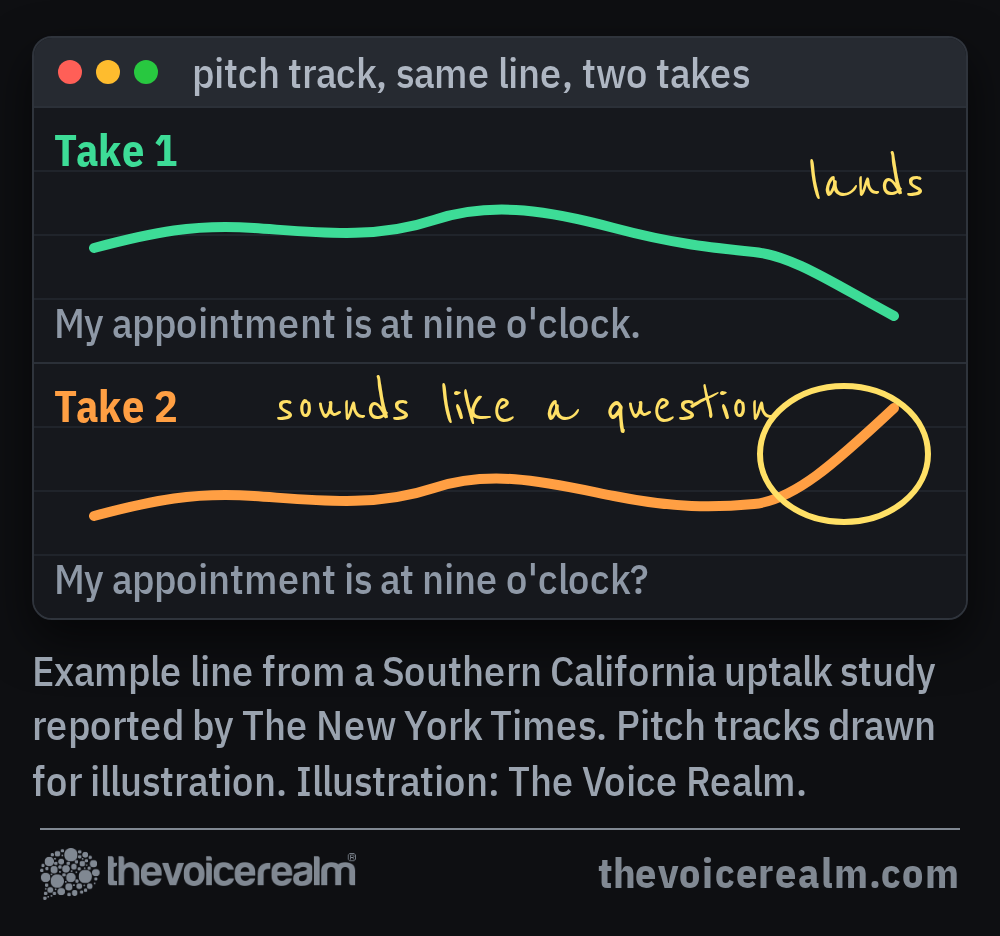
In most English, a plain statement falls at the end. “The store opens at nine.” Your pitch drifts down on the last stressed word and the sentence settles. A question that wants a yes or no usually rises. “The store opens at nine?”
Upspeak is when a statement takes the question shape. The words say “I’m telling you”, the tune says “am I right?” Linguists have been studying it for decades, and it shows up in speakers of every age and gender, across many English accents. In parts of Australia and New Zealand, a rising tune on statements is simply part of how people talk.
The reason it’s hard to catch is that you’re not doing it on purpose. It lives below the level you’re listening at when you record. You’re thinking about the words, the pace, the emphasis, the breath. The last syllable of each line slips through on autopilot, and autopilot is how you speak to friends.
In conversation, the rise is doing a job
Upspeak gets mocked a lot, but researchers who’ve looked closely say it isn’t empty. A 2013 New York Times report by Jan Hoffman, republished by William & Mary, described a study of young Southern Californians at the University of California, San Diego. The researchers found that uptalk turned up in very particular moments.
When people gave directions, they rose at the end of each step, as if checking the listener was keeping up. The report says “Both the men and women in the study used uptalk 100 percent of the time in these so-called “confirming” statements.” The study also found a use called floor-holding, “in which the speaker, anticipating an interruption by the listener, tries to stave it off by using a rising tone at the end of a statement.” The rise says: wait, I’m not finished.
It isn’t only a habit of the uncertain, either. The same report says “some studies suggest that uptalk has been used by the more powerful person in hierarchical exchanges, such as those between employer and employee, teacher and student, or doctor and patient.”
So in a live chat, the rise is a tool. It checks in, keeps the other person with you and holds your turn. That’s exactly why it creeps into voice over. Good copy asks you to sound like you’re talking to one person, and when you talk to one person, your conversational habits come with you.

© The Voice Realm
On a recording, nobody can nod back
Here’s the problem. Every job the rise does in conversation needs a listener who can answer. On a recording, there’s no one to confirm, no one to interrupt and no one to hand the turn to. All that’s left is the sound of a question where a statement should be.
And listeners do hear it as doubt. A 2023 paper in Frontiers in Psychology by researchers at Kent State University and the University of Louisville put it plainly: “Previous research suggests that rising intonation is a common cue that both women and men produce to communicate lack of confidence, but listeners are more sensitive to this cue when it is produced by women.” That last part is unfair, but it’s worth knowing. The same rise can cost one voice more than another.
In voice over, doubt is expensive. Think about where a line usually rises:
- The brand name. “Brought to you by Harbour Bank?” Now the client sounds unsure of itself.
- The call to action. “Visit us today?” turns an invitation into a shrug.
- The key fact in e-learning. “Always lock the screen when you leave your desk?” The learner hears an option, not a rule.
- The last line of a narration. A documentary that ends on a rise feels like it stopped mid thought.
Directors don’t always name it. You’ll get notes like “more confident”, “more authority”, “don’t sell it so hard”, or “make it a statement”. Very often, all of them mean the same thing. Your endings are floating.
© The Voice Realm
Catch it in your own takes
You can’t fix what you can’t hear, so the first job is learning to hear it. Three ways that work.
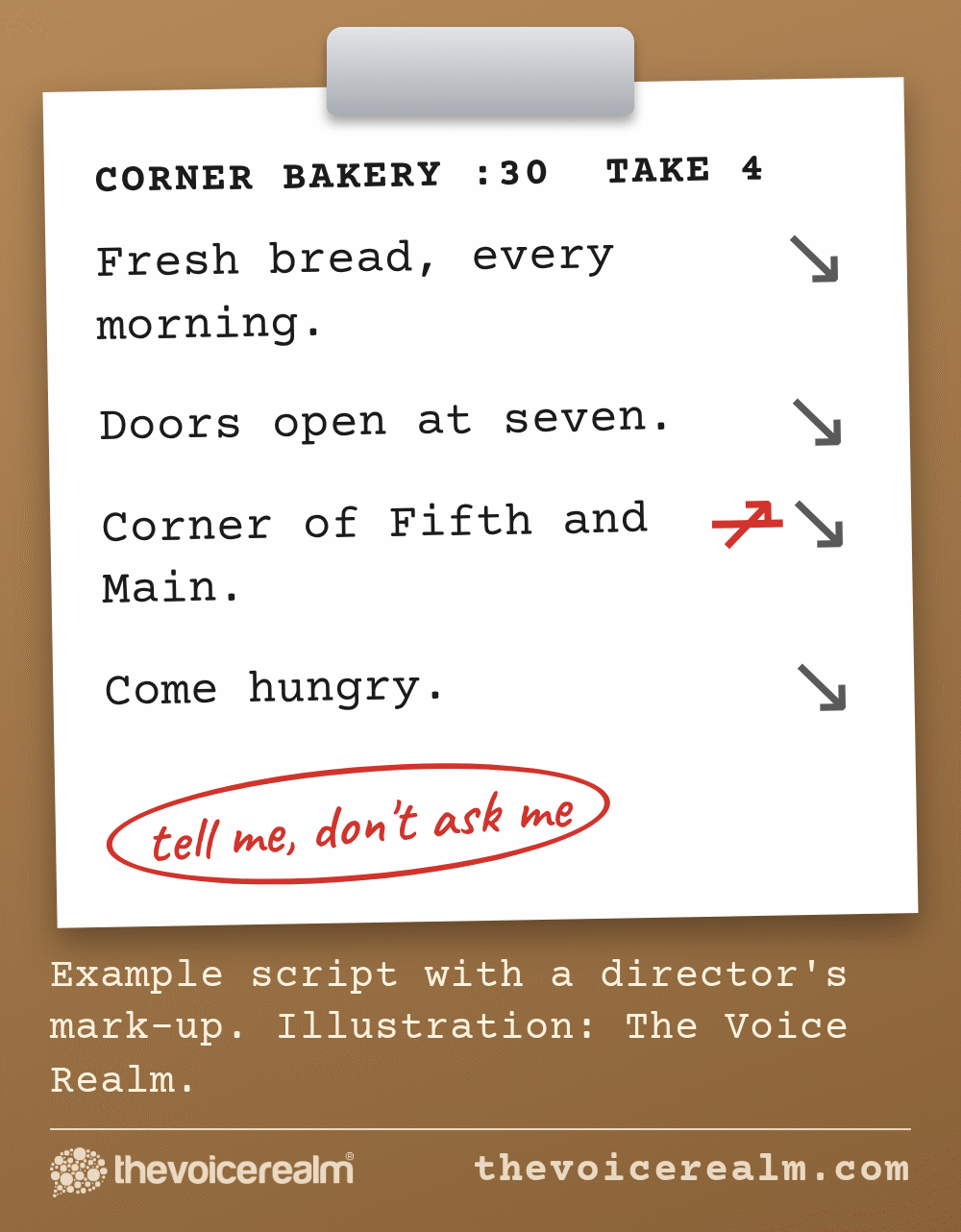
Listen to the last word only. Record a paragraph of real copy. Play it back and pay attention to nothing but the final word of each sentence. Is it lower than the word before it, or higher? Write an arrow on the script for each one as you listen. Most people are surprised by how many arrows point up.
Look at it. Free speech analysis software, such as Praat from the University of Amsterdam, will draw your pitch as a line across the screen. Some editing programs can show a pitch view too. You don’t need to understand the science. Just look at the tail of each sentence. Statements should end with the line heading down.
Ask someone who doesn’t know the script. Play them a few lines and ask, “Did that sound like a question or a statement?” Fresh ears hear the tune, because they don’t already know what the words mean.
© The Voice Realm
Landing the line
The fix isn’t to push your pitch down on purpose at the end of every sentence. That sounds stiff, and it can tire your throat. The fix is to change what you mean, and let the pitch follow.
Know where the full stop is. Before you record, find the end of every complete thought in the script. Not every full stop, every thought. That’s where the line should land.
 VOICEMASTERACADEMYTwenty modules, one at a time.Breath controlHome studioCommercial techniqueAuditionsStart module oneNo experience needed.
Finish the thought before you start speaking. Upspeak often comes from building a sentence as you go, hoping it’ll work out. When you know exactly what you’re saying before you start, the end of the sentence sounds finished because, in your head, it already is.
Land on the last important word, not the last syllable. In “Corner of Fifth and Main,” the weight sits on “Main”. Let your voice settle there, and the line closes itself. Pushing down on a tiny word like “it” or “today” sounds odd.
“A rising ending asks the listener to agree with you. In a recording, they can’t, so all that’s left is the doubt.”
The Voice RealmPost this quote
Talk to someone who already agrees. Picture the listener as a friend who’s nodding. You don’t need their permission, so you stop asking for it. This keeps the warmth of a conversational read without the check-in tune.
Use your hand. It sounds silly, but a small downward gesture as you finish a line really helps many voice actors. Your body and your voice like to move together.
Breathe after the full stop, not before the last word. Running out of air at the end of a line can make the voice lift and thin. Plan your breaths so you have enough left to finish properly. Our guide to where the air goes before the words covers that in detail.
© The Voice Realm
When a rise is the right call
Don’t overcorrect. If every line lands with a thud, you’ll swap one problem for another: a flat, heavy read. If that’s where you end up, our piece on getting out of the same-note trap will help you put the movement back where it belongs.
Rises are right in plenty of places. Real questions, obviously. Lists, where each item lifts a little until the last one falls. A line that leads straight into the next, where the thought really isn’t finished. Playful characters, teens and anyone the script wants to sound casual or unsure. And of course, an Australian or New Zealand read where the client wants the natural local tune.
Also listen for a cousin of upspeak. Some voice actors fix the rise by dropping so far at the end that the voice runs out and creaks. That’s vocal fry, the creak at the end of a line, and it’s just as distracting. You want the line to settle, not to sink.
The aim is choice. When a line rises, it should be because you decided it should, not because your conversational habits slipped in.
A ten minute drill
Do this a few times a week for a fortnight and most people hear a real change.
- Pick a short script. A thirty second ad is perfect. Print it.
- Record it cold. Read it the way you normally would, no preparation.
- Mark it. Play it back and draw an arrow above the last word of every sentence, up or down, honestly.
- Find the thoughts. Circle the end of each complete thought. Any up arrow on a circle is a target.
- Say each target line three ways. As a question. As a statement. Then as a statement to a friend who’s nodding. Notice how the third one sounds warmest.
- Record it again. Same script, the third way throughout.
- Compare. Listen to both takes back to back, last words only. Keep the second one as your reference.
Then do it with a script you’ve never seen. The habit tends to come back on cold reads, because that’s when your attention is busiest. Catching it there is the real test.
© The Voice Realm
Why it matters for bookings
Commercial copy is short. A thirty second spot might have six or seven sentences, and if three of them float, the whole read sounds tentative. Casting is often a quick listen through many auditions, and confident endings are one of the things that make a voice sound like it’s already done the job. Our guide to the real-person commercial read explains why that matters even when the brief says casual.
The good news is that this is one of the quickest habits to fix once you can hear it. Spend a fortnight listening for your endings, and you’ll start hearing them while you record. When you do, take your next set of auditions from the voice over jobs board and listen for the difference.
Sources: Jan Hoffman, The New York Times, republished by William & Mary, “Overturning the Myth of Valley Girl Speak”; Jennifer M. Roche, Katie Asaro, Bradley J. Morris and Shae D. Morgan, Frontiers in Psychology, “Gender stereotypes and social perception of vocal confidence is mitigated by salience of socio-indexical cues to gender”.
Ready to get booked?
See the jobs open right nowAbout Sarah Robbins
Sarah Robbins writes for The Voice Realm about finding voice over work, home studios, casting and the business side of voice acting.