Blog
Can you be paid to sound like someone famous? Sometimes, yes. Sound-alike work is a real corner of the voice over business, and impressions are a skill plenty of voice actors are proud of. But there’s a line, and two court cases from the United States drew it so clearly that ad agencies still talk about them. This guide is for voice actors who’ve been asked to “do” a celebrity, or who’ve seen a brief that names one. We’ll go through what happened in those cases, what the law protects and what it doesn’t, how newer laws have widened the net, and the questions to ask before you take the job. We’re not lawyers and this isn’t legal advice, but it will help you spot the jobs worth a second look.
The ad agency that couldn’t book Bette Midler
In 1985, Ford and its advertising agency, Young & Rubicam, made a run of television commercials for the Lincoln Mercury, each one built around a popular song. The agency tried to get the original singers. When it couldn’t, it hired what it called “sound alikes.” One of the songs was “Do You Want To Dance,” as Bette Midler had recorded it on her 1973 album.
The agency called Midler’s manager first. According to the court’s account, the manager asked “Is it a commercial?” and, when told yes, answered: “We are not interested.”
So the agency went to Ula Hedwig, who had sung backup for Midler for ten years. She was told, in the court’s words, that “they wanted someone who could sound like Bette Midler’s recording” of the song. She made a demo, got the job and, as the opinion puts it, “imitated Midler to the best of her ability.” After it aired, Midler was told by “a number of people” that it “sounded exactly” like her record, and Hedwig’s own friends thought it was Midler singing.
Notice who the story is about. Hedwig was a working singer doing exactly what she was asked to do. The case was brought against Ford and the agency, the people who chose to imitate Midler to sell cars. That’s worth holding on to, because it’s the same position a voice actor is in when a brief arrives asking for a famous sound.
© The Voice Realm
What the court said a voice is
The trial court threw Midler’s case out. It described the defendants’ conduct as that “of the average thief” and summed up their attitude as “If we can’t buy it, we’ll take it,” but it didn’t think any law stopped someone imitating a voice.
The Ninth Circuit Court of Appeals disagreed in 1988. Judge Noonan wrote: “A voice is as distinctive and personal as a face. The human voice is one of the most palpable ways identity is manifested.” And then, more bluntly: “To impersonate her voice is to pirate her identity.”
The court was careful about how far it went. “We need not and do not go so far as to hold that every imitation of a voice to advertise merchandise is actionable,” it said. Its actual holding was narrower: “when a distinctive voice of a professional singer is widely known and is deliberately imitated in order to sell a product, the sellers have appropriated what is not theirs and have committed a tort in California.” The case was sent back for trial.
Here’s the part that surprises people. Copyright wasn’t the problem. The agency had a licence from the copyright holder to use the song. The opinion even quotes the notes of the congressional committee that wrote US copyright law: “Mere imitation of a recorded performance would not constitute a copyright infringement even where one performer deliberately sets out to simulate another’s performance as exactly as possible.” What Ford took wasn’t the song or the recording. It was Midler’s identity, carried in her voice.
Tom Waits, a Doritos ad and a near-perfect impression
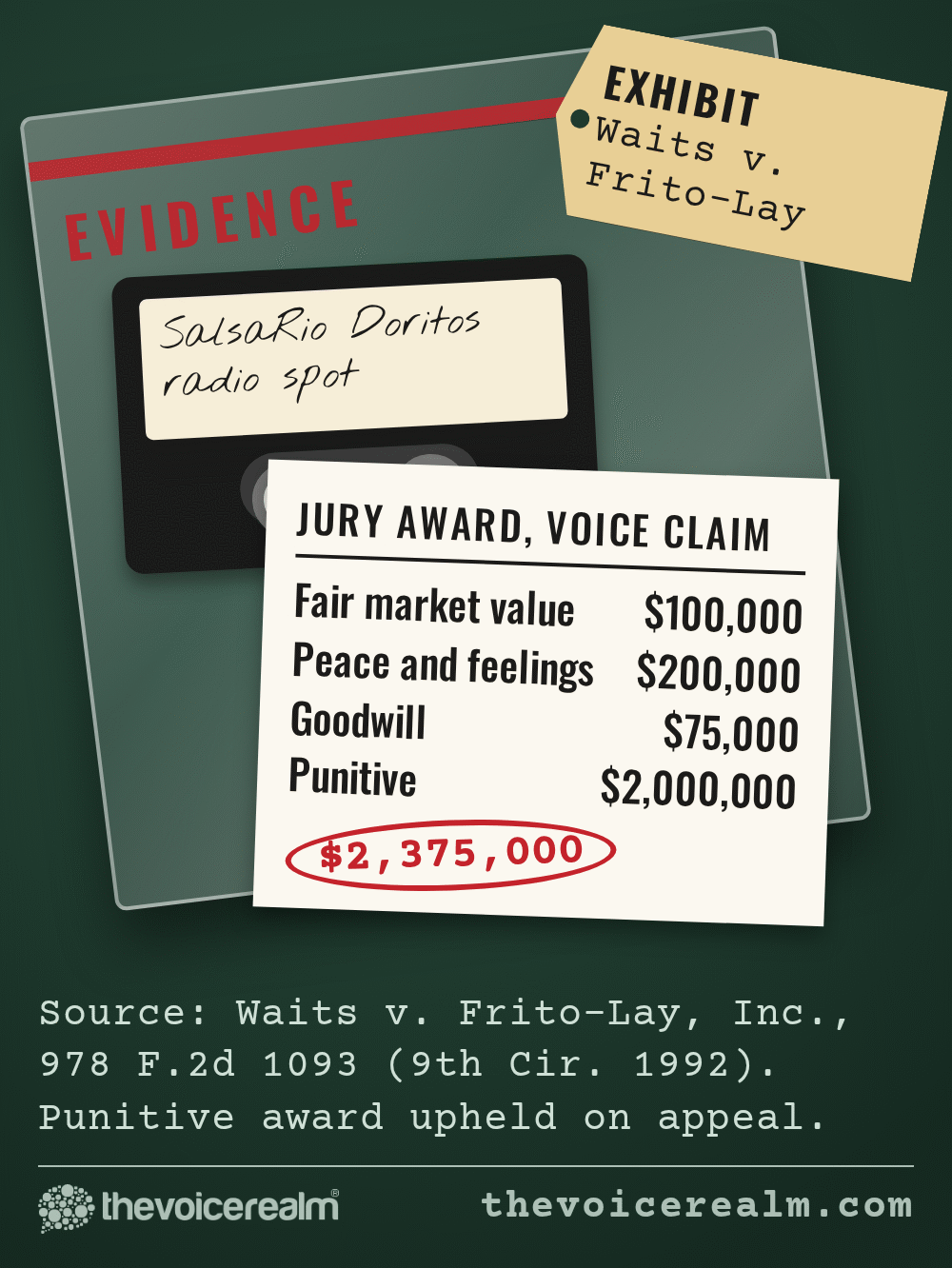
The second case is the one that turned a warning into a price tag. In the late 1980s, the agency Tracy-Locke was making a radio commercial to launch SalsaRio Doritos for Frito-Lay. The idea came from a 1976 Tom Waits song, “Step Right Up,” which is itself a send-up of advertising. Waits was well known for refusing to do commercials at all.
The agency auditioned singers who could do a gravelly style and found Stephen Carter, a professional musician from Dallas who, according to the 1992 appeal ruling, had spent ten years performing Waits songs and “had consciously perfected an imitation of Waits’ voice.” The court recorded that the creative team “did a double take” when they heard him.
Then come the warnings, one after another. The commercial’s musical director “warned Carter that he probably wouldn’t get the job because he sounded too much like Waits, which could pose legal problems.” At the session, the agency’s executive producer tried to get Carter to “back off” the imitation. The agency’s own lawyer flagged a “high profile” risk of a lawsuit. The agency recommended the Carter version anyway, offered to cover Frito-Lay if it was sued, and Frito-Lay chose it.
Waits sued. A jury awarded him $375,000 in compensatory damages and $2 million in punitive damages for voice misappropriation. In August 1992 the Ninth Circuit upheld the punitive award, noting the jury’s finding that the companies had acted “in conscious disregard” of Waits’ rights. Only a duplicated $100,000 on a separate claim was taken off.
© The Voice Realm
Style is free. Someone’s famous voice isn’t
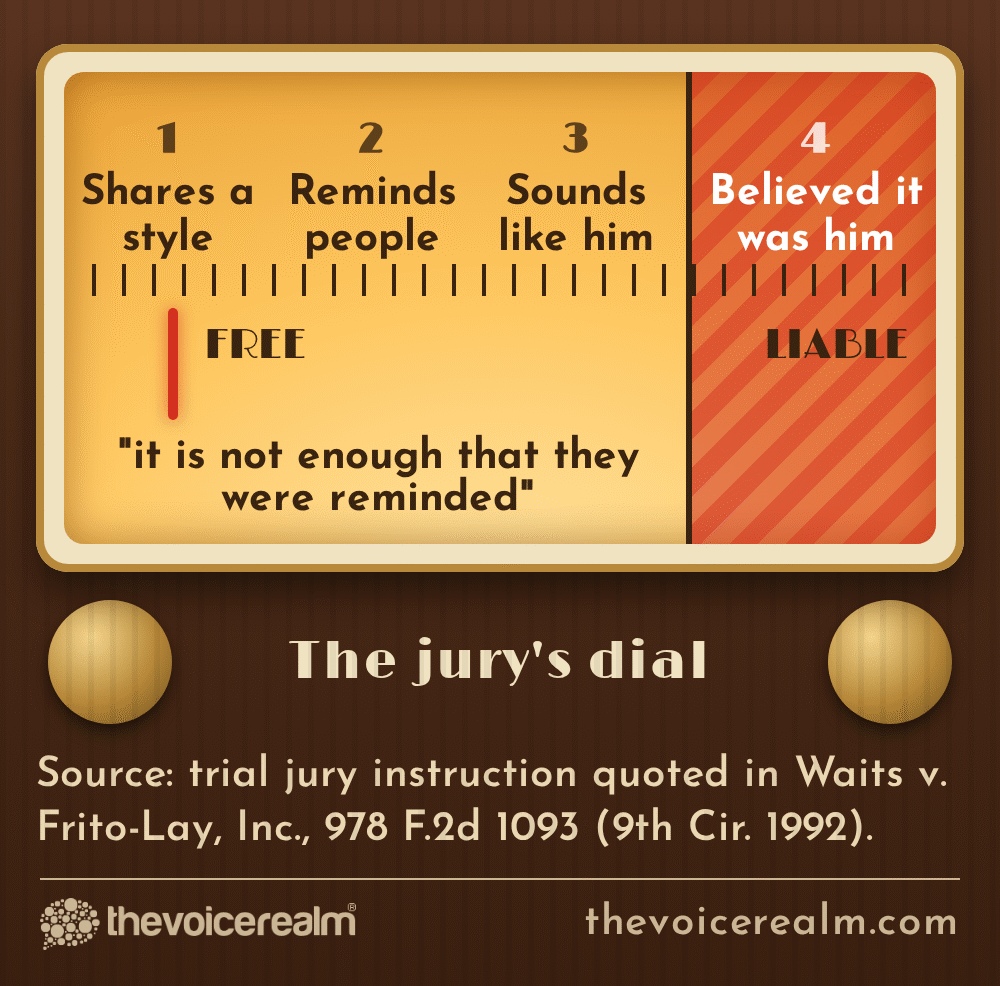
The most useful thing in the Waits case for a working voice actor is the instruction the trial judge gave the jury. Frito-Lay’s side argued that they had copied Waits’ style, which isn’t protected, rather than his voice. The judge told the jury that for the companies to be liable, the imitation had to be so good that “people who were familiar with plaintiff’s voice who heard the commercial believed plaintiff performed it.” And then: “it is not enough that they were reminded of plaintiff or thought the singer sounded like plaintiff.”
That’s a high bar, and it’s the reason so much ordinary work is fine. A read that’s warm and smoky, a gravelly late-night storyteller, a breezy surfer, a clipped newsreader from the 1950s: those are styles, and styles belong to everybody. Plenty of voices share a texture. A casting note that says “think gravel and whisky” is describing a sound, not a person.

 VoiceEditSuiteYour breath. Your pace. Your edit.Auto Clean Up learns your pace from every file and puts your own pause back wherever it cuts a mistake.See how it worksLearns from numbers, never your audio. Never used to train AI.
The trouble starts when three things line up. The voice belongs to a particular famous person. The job is to make listeners believe it’s them. And it’s selling something. Midler and Waits both turned on that combination, and both had said no before the imitation was made, which didn’t help the companies at all.
If you’re working on your range, the skills are the same either way. Our guide to learning an accent from the vowels up works just as well for building a character that suggests an era or a place without borrowing a real person.
© The Voice Realm
Newer laws reach further than the old cases
Those two rulings came out of California, and they were about singers. The law has moved since, mostly because voice cloning made the problem much easier to create.
Tennessee’s ELVIS Act, which took effect on July 1, 2024, is the best known example. The law firm Latham & Watkins, in its note on the Act, quotes its definition of a voice as “a sound in a medium that is readily identifiable and attributable to a particular individual, regardless of whether the sound contains the actual voice or a simulation of the voice of the individual.” The firm points out that liability under that wording “may extend” past real recordings and generated audio, “to humans who can imitate other artists (i.e., soundalike artists).”
In other words, a law written with AI in mind might also cover the human sound-alike in the booth. Other states and other countries are writing their own rules, and British voice artists have been pushing for theirs, as we covered when UK performers asked for their voices to be protected in law. The details differ from place to place, and they’re still changing. The safe working assumption is that imitating a recognisable person to sell something carries more risk today than it did when Waits sued, not less.
© The Voice Realm
Reading a sound-alike brief before you say yes
Most sound-alike requests aren’t sinister. A producer has a temp track with a famous voice on it and wants something similar. A client loved a celebrity ad and can’t afford the celebrity. Your job is to work out which kind of request you’re looking at, and the brief usually tells you.
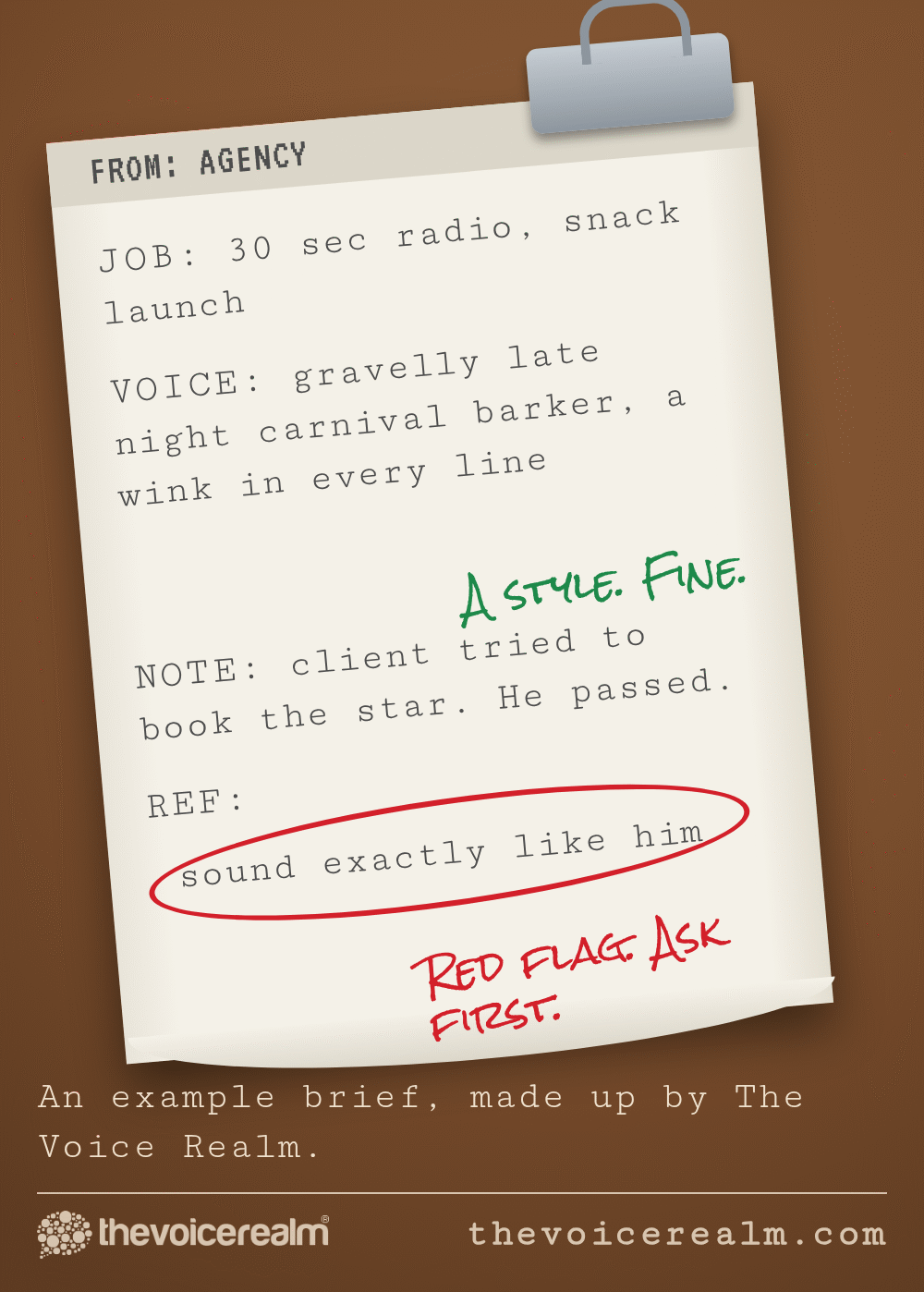
Start with the name. Does the brief name a real person, or does it describe a sound? “Gravelly, world-weary, a bit of a carnival barker” is a direction. A famous name followed by “exactly” is a request to be mistaken for someone.
Then ask what it’s for. A character in a sketch, a parody that’s obviously a parody, a tribute show the performer’s estate has licensed and an advert for a product are very different things. The two big cases were both adverts.
Ask whether the client tried to book the real person. If the brief or the producer mentions that the star turned it down, you’re standing exactly where Ula Hedwig and Stephen Carter stood. It’s a fair question, and a professional producer won’t mind you asking it.
Finally, ask who carries the risk. In both cases it was the companies that were sued, but a contract can say otherwise. If you’re asked to sign something, read the clauses about warranties and who covers whom, the way we walk through in reading a voice over contract before you sign. And remember that the way the recording is used later matters too; usage rights decide whether a harmless radio spot becomes a national campaign.
If the answers make you uneasy, it’s fine to offer your own take instead: the energy, the rhythm and the attitude the client loves, in a voice that’s recognisably yours. Many clients take it, and some prefer it.
© The Voice Realm
Impressions still have a place
None of this means you should hide your impressions. They’re great training. Learning to hear exactly what makes a voice that voice, its pitch, its rhythm, where it sits in the mouth, what it does at the end of a line, is the same listening that makes you good at character work and direction.
Impressions also have a long, honest life in comedy, parody and entertainment, where nobody is meant to think the real person turned up. How the law treats that kind of work varies a lot between countries and states, so if a project is built around a real person’s voice, it’s worth a short conversation with an entertainment lawyer where you live before it goes out.
What the cases warn against is narrower: using someone’s recognisable voice to make listeners think they’re endorsing a product they never agreed to. That’s the job to turn down, or at least to ask hard questions about.
Your own sound is the better bet
There’s a business case here as well as a legal one. A sound-alike is, by definition, the second choice. The client wanted someone else. That’s a hard place to build a career from, and the work tends to dry up the moment the famous voice falls out of fashion.
- Style is shared. A gravelly, smoky or old-time sound belongs to nobody.
- A famous voice isn’t. Deliberately imitating a well known person so listeners think it’s them is where both cases went wrong.
- Selling something raises the stakes. Both rulings were about adverts.
- A “no” from the star is a red flag. In both stories the agency went looking for a sound-alike after the real singer said no.
The voices that get rebooked are the ones clients can’t find anywhere else. Use your ear for impressions to sharpen your own instrument, then give clients the thing a sound-alike never can: a voice that’s only yours.
Sources: United States Court of Appeals, Ninth Circuit, “Midler v. Ford Motor Co., 849 F.2d 460 (1988)”; United States Court of Appeals, Ninth Circuit, “Waits v. Frito-Lay, Inc., 978 F.2d 1093 (1992)”; Latham & Watkins, “The ELVIS Act: Tennessee Shakes Up Its Right of Publicity Law and Takes On Generative AI”.
Ready to get booked?
See the jobs open right nowAbout Sarah Robbins
Sarah Robbins writes for The Voice Realm about finding voice over work, home studios, casting and the business side of voice acting.