Blog

Just as hard as it is to answer how much voice actors make, it’s another tough task to quote for your voice over services, as there are many factors that go into your rate.
Voice artists, being creatives, are rarely shrewd entrepreneurs who are driven to work by the big figures they see ahead of them. This is commonly why some novice voice actors make the mistake of underquoting. Because of a lack of confidence and industry knowledge, and a thirst for a return on investment, they fail to assess the considerations in establishing their minimum rate and just accept that below-fair-paying job right away.
Consider putting yourself in your client’s shoes, and the talent tells you this: “Alright, I’m giving you a discount because you have a low budget.” Perhaps you would feel good about being able to find a talent who’ll work for you at a cheap price. But later, if not at first impression, you will come to realize that you might be buying something not even second-rate because of how easy it is for the talent to cut down his price. So as much as you think setting a low rate would get you many clients, little do you know that you’re losing half of them in the background.
By the same token, because you are afraid to underquote your product, you may tend to overquote, and end up losing the job altogether. It’s downright difficult because as much as you want to reap the amount you want to get, you also want to make sure you are being fair and realistic.
So how do I know if I am setting the correct rate for me?
There are multiple factors. But the number one rule of thumb is that once you know how much you’re spending (money, time and effort), you’ll eventually know how much you should earn.
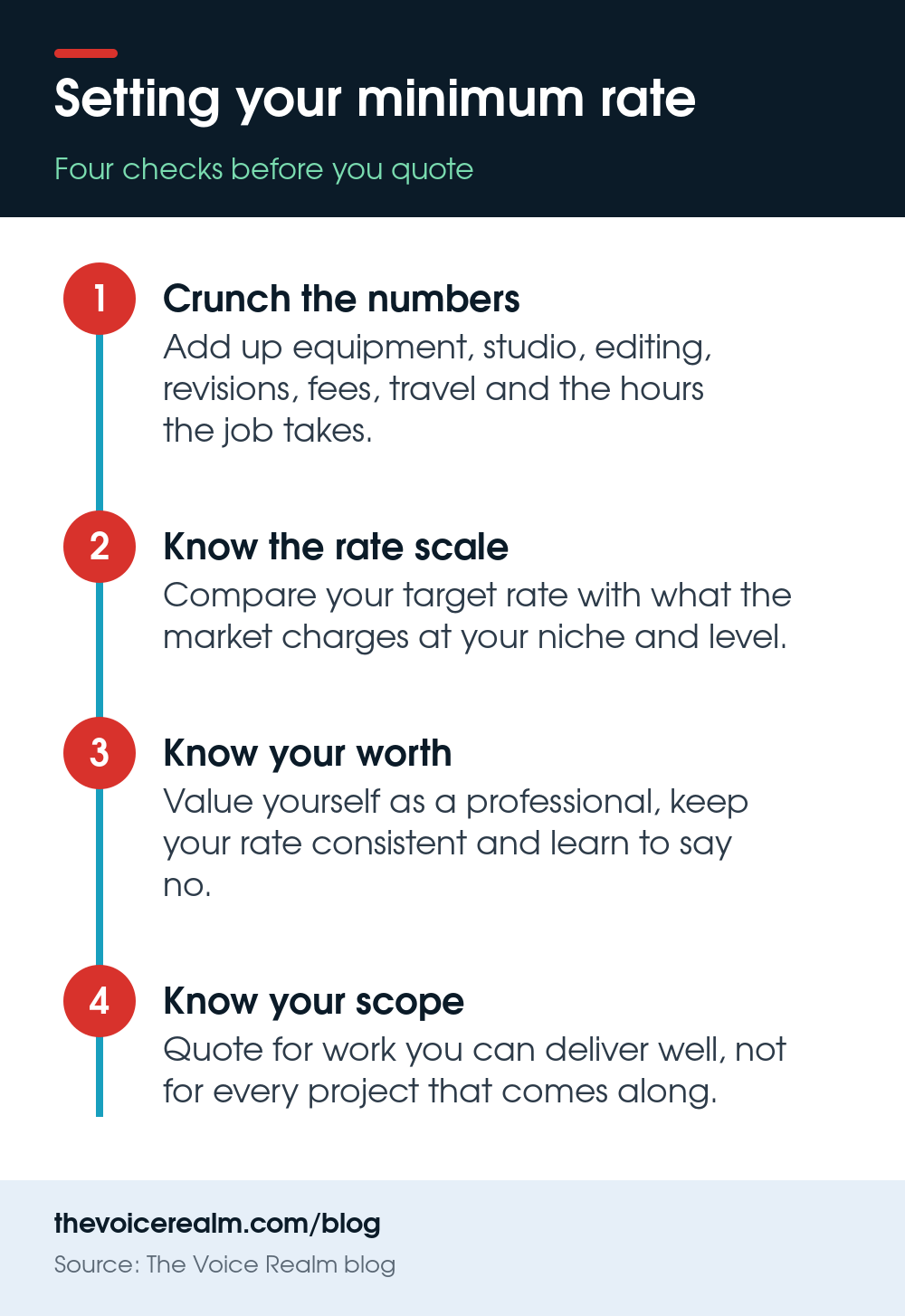
Four checks before you set your minimum rate © The Voice Realm
Key Guidelines In Quoting For Your Voiceover Product
-
Crunch the Numbers and Create an Equation
Before you come up with your final voice over rate sheet, make sure to take every variable involved in the equation into account. The following are the potential numbers to weigh so you can set an estimate for your service:
- Equipment and studio costs
- Overhead expenses (your own costs from personal spending)
- Per capita income of the country of the client
- How much your career costs per month
- The cost for revisions
- The cost of operating equipment and editing tools
- Union rate membership fee (if you are a unionized talent)
- Online casting site subscription fee (if you find your client from a freelancing site that offers bidding)
- Transportation expenses if you have to work in an agency studio or meet the client
- The hours you charge for the job
It is very important to be particular about how much time you charge for a job. You can use an hourly rate, a project rate, or both, depending on the size of the project.
Hourly Rate
From the word itself, you calculate your rate on a per-hour basis. You multiply your set rate by the number of hours it takes to get the job done. E.g., a 12-hour job at $40 per hour will give you $480 for 1 project done.
Project Rate
You can also use estimates and give individual quotes depending on the project. By this means, you should be smart enough to estimate how long it will take you to deliver the recordings. E.g., a project takes approximately half a day. You can set your rate per day and divide that into two for that project.
Once you have tallied the spending for your job to get done, it will be easier for you to set a realistic and fair quotation that makes your business profitable.
-
Know the Voice Over Industry Rate Scale and Compare Your Target Rate
Do your research. Once you have the numbers of your own investment, it is important to align them to what is realistic and achievable in the industry at your niche and level of experience.
 VOICEMASTERACADEMYLearn the craft in order.Module one is freeStart module oneTwenty modules, start to finish.
Explore how much the market is charging for both broadcast and non-broadcast voiceover projects at beginner, average, and seasoned levels and see what you think fits your worth by assessing your niche, experience level, popularity, and what your portfolio tells about you. The more experienced you are and the rarer your niche, the higher the pay you can demand, because people tend to pay a premium for products that are rare and worthy. For the top of the range, check current SAG-AFTRA scale too.
By then, you have the reliable data to create your rate sheet to consistently guide you in the quoting process.
-
Know Your Worth and Establish Your Business Goal
In setting your rate, it is very important to value yourself as a professional and keep it consistent. As mentioned earlier, clients will tend to either underestimate your capability or take advantage of your poor negotiation skills. If you let these clients low-ball your product, it will be hard to charge a higher rate because you will then be expected to give the same low rates from then on.
It is hard to turn down jobs, especially if you are a beginner, but you should also learn to say no if you are not going to earn at all. You should learn to keep your word and be firm about your rate so there is no room for the client to think that your voiceover products are no different from marginal-quality voiceovers.
-
Know Your Scope and Limits
At some point it is normal to ache for higher pay, especially if you have kept a record of happy clients. However, make sure your quoting is not way too far from your scope and skills. Because if you keep on accepting projects left and right without assessing whether or not you are capable of delivering exactly what your client wants, chances are you might fail in the long run and end up disappointed in both yourself and your clients.
Get all these factors proportional to one another and you’ll be able to set your minimum rate accordingly. However, it is also possible that one of these weighs more for you, according to what you value the most and what you think will work best for you.
For our readers who are experienced voice actors, what tips and advice can you give to help fellow actors build up their careers and earn a good living? Share it with us in the comments below!
Ready to get booked?
See the jobs open right now