Blog
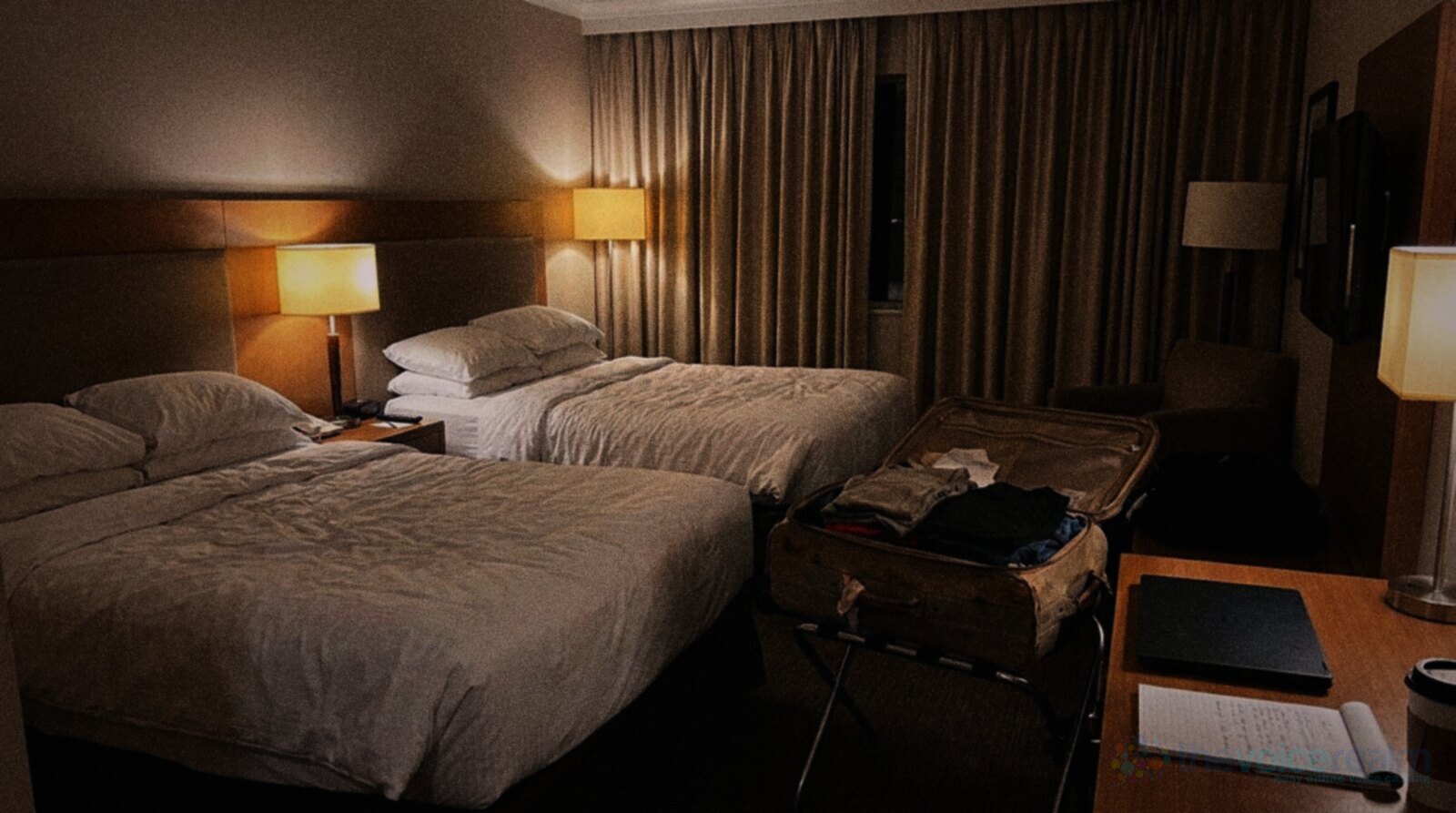
This guide is for voice actors who have to keep working while they’re away from home: a family trip, a conference, a long holiday week, or a job that drags you across the country while the auditions keep landing. A hotel room is never going to be your home studio. It can still give you clean, usable audio if you choose the room well, build a small soft space inside it, and know which noises you can kill and which you have to work around.
Here’s the whole process, from the booking form to the upload.
Start at the booking, not the check-in
Most of the battle is won before you arrive. Once you’re in a room above the ice machine, next to the elevator and facing the highway, no amount of pillows will save you.
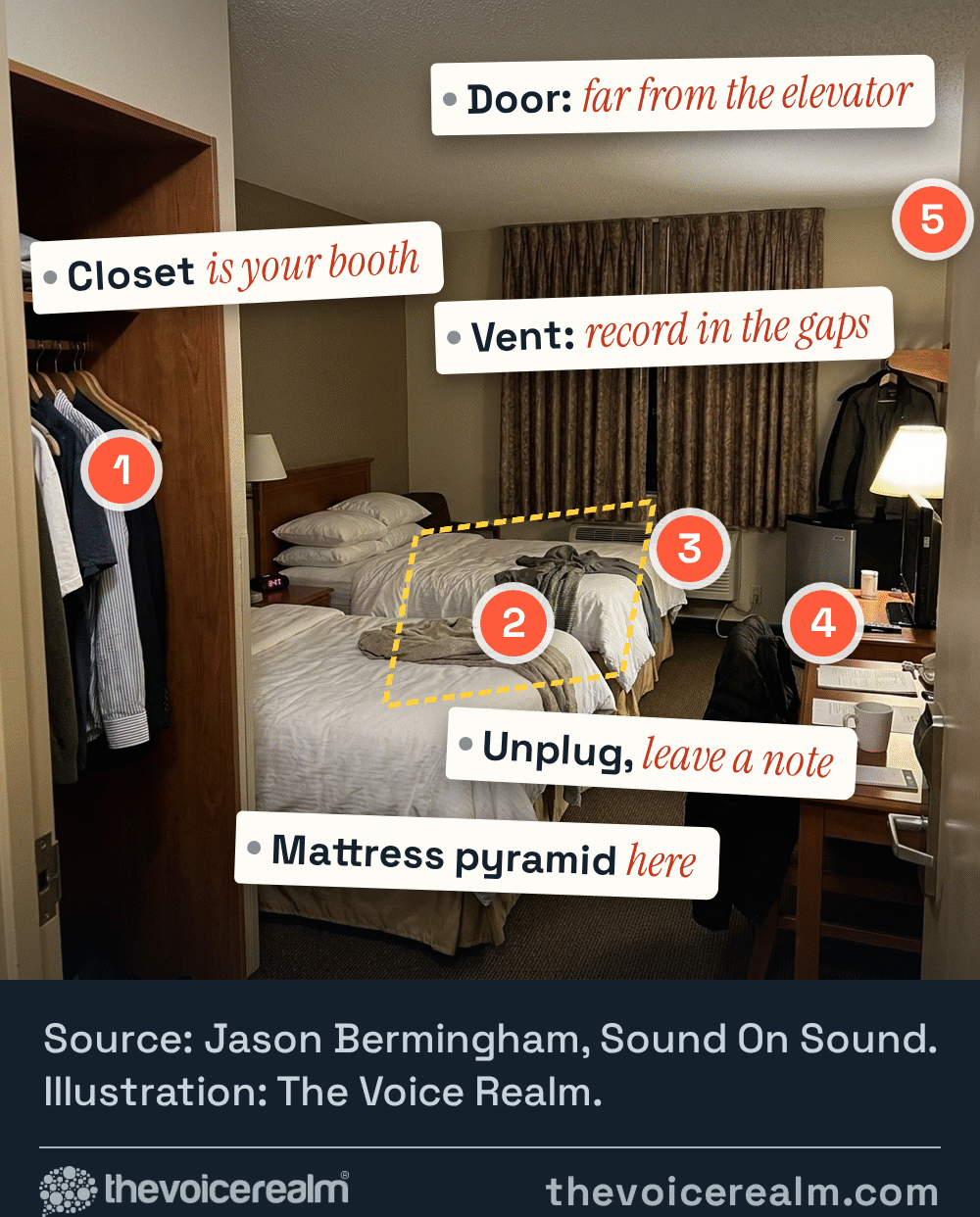
Jason Bermingham, a voice actor who wrote up a three-week recording trip for Sound On Sound magazine, made his requests at every hotel: “I asked for a room far from the elevators and at the end of a hallway, which would limit foot traffic outside our door.” He also asked for a room “facing away from the highway, the hotel pool, or any other obvious sources of noise,” and as high up as they’d give him.
He thought about the furniture too. He and his family “opted for rooms with two queen-size beds instead of a single king, because that would allow us to erect a ‘mattress pyramid’ over the space between the beds, if required.” That’s not a joke. Two beds give you two big soft surfaces close together, which is the nearest thing a hotel offers to booth walls.
Put your requests in the booking notes, then repeat them politely at the desk. Front desk staff hear stranger things than “I need a quiet room because I record audio for work” every day, and plenty of them will go out of their way to help.
Read the room in your first five minutes
Before you unpack, stand in the middle of the room and listen with your eyes shut. Then go round it like an engineer would, because you’re about to be one.
© The Voice Realm
Every hotel room has a few sounds that switch off and a few that don’t. The fridge usually unplugs. The bedside clock might hum. The lights on a dimmer can buzz. The big one is the heating and cooling unit under the window, and that’s where you’ll often lose.
Bermingham hit exactly this: “The refrigerator could be unplugged, but there was no way to switch off the air vents.” When that happens, find out when the system cycles. Many units run in bursts, so you can record in the gaps. Others can be set to fan off with the temperature turned right down or up so the compressor stays quiet for a while. Turn it off well before you record so the room settles, then put it back on afterwards, because a cold, stuffy room makes for a tired voice.
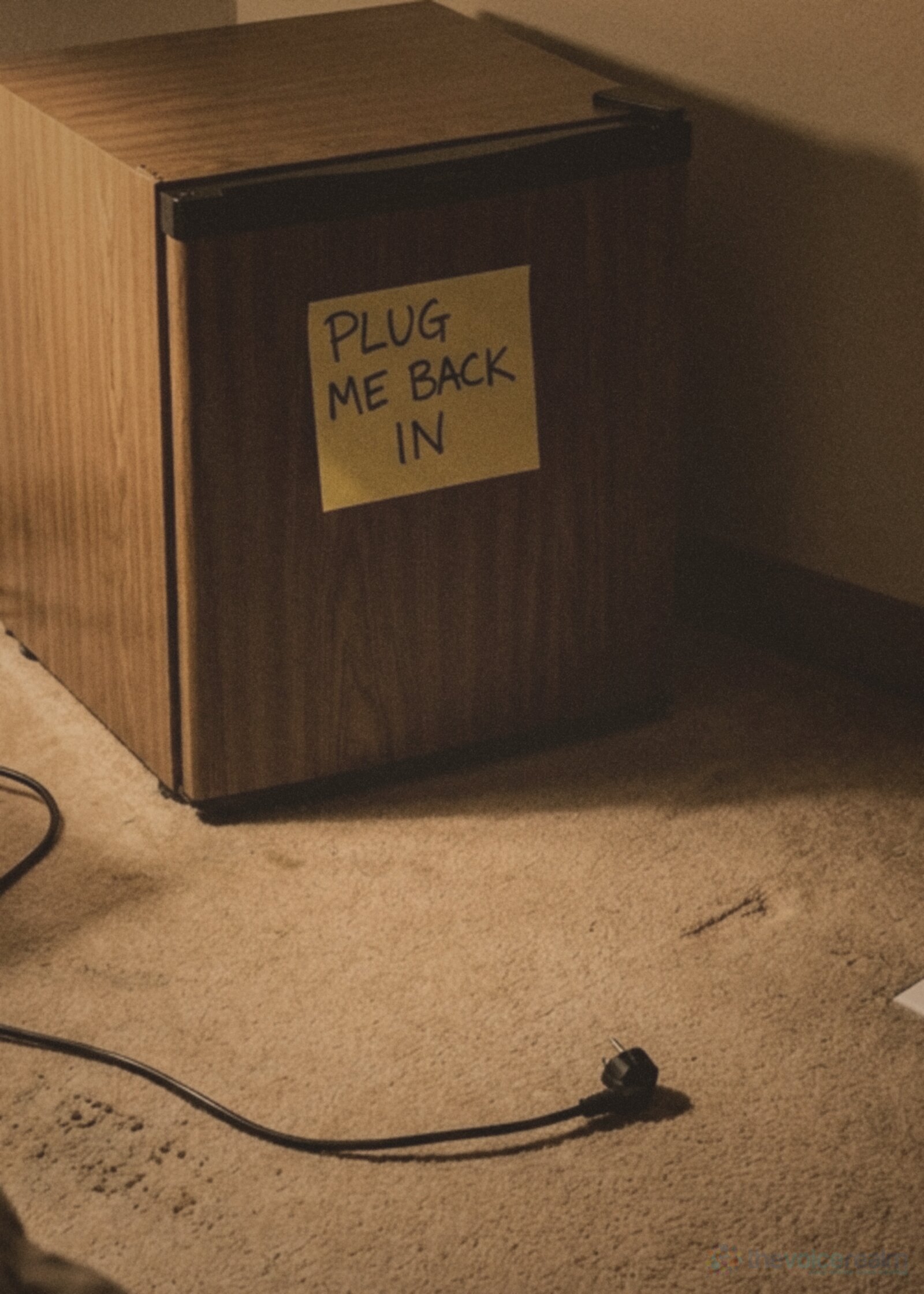
Unplugged for the session, with a note so it goes back on. © The Voice Realm
If you unplug the minibar, leave yourself a note on it. Hotels charge for spoiled stock, and it’s very easy to forget.
Build your booth from whatever the room gives you
A hotel room has hard walls, a hard ceiling, a big window and usually a hard desk. That’s an echo chamber. Your job is to put soft things close around the microphone, so your voice goes in and gets absorbed rather than bouncing back off the glass.
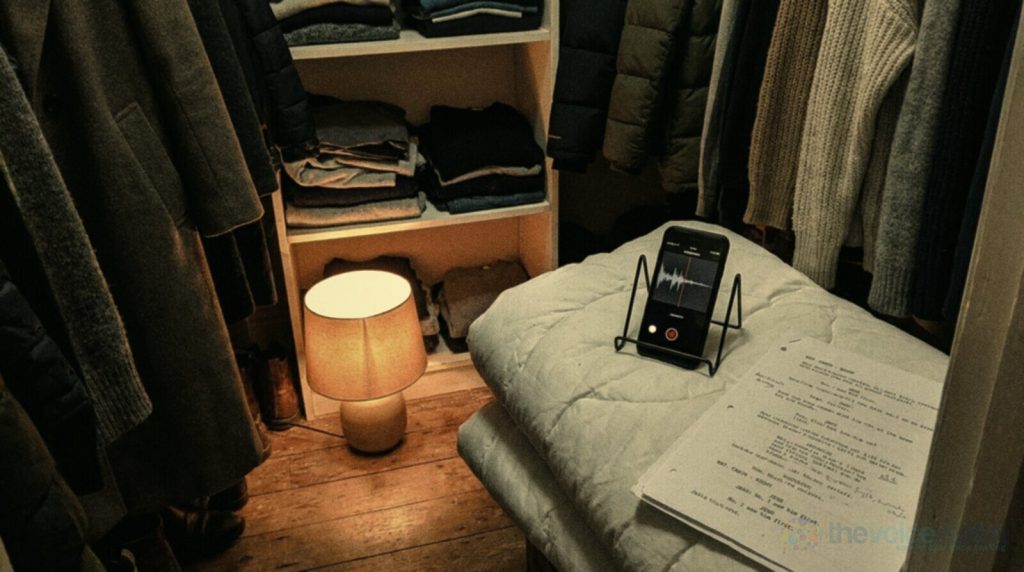
The wardrobe closet is usually the best spot. Clothes on hangers are already sound absorbers. Push them to the sides, stack spare pillows on the shelf and the floor, and drape a duvet over the top of the open door. You’re not trying to make the closet quiet from the outside world. You’re trying to make it dead around your mouth, so a little background noise is all that’s left to deal with.
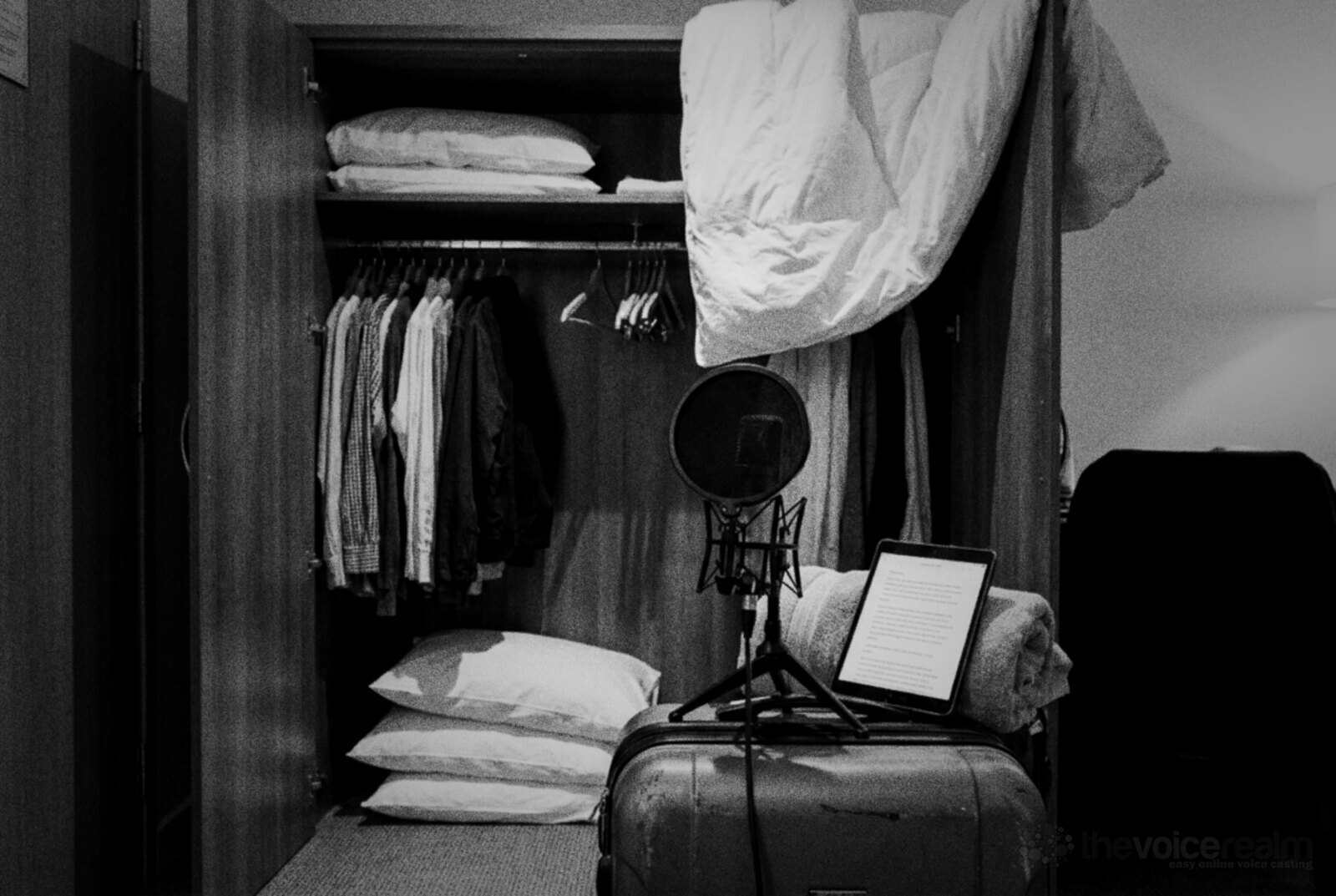
Clothes, pillows and a duvet: a closet booth built from what the room gives you. © The Voice Realm
No usable closet? Build the mattress pyramid. Stand the mattresses or the thick toppers up between the two beds, or lean them against the wall behind you, and throw the duvets over the top. Pull the desk chair into the gap, mic at mouth height, and you’ve got three soft walls and a soft roof.
 VOICEMASTERACADEMYFirst read to first booking.Twenty modules. The first one is free.Start free
A few rules make either version work better. Face into the soft stuff, never towards the window or a bare wall. Keep the mic close, a hand span or so from your mouth, so your voice is loud in the recording and the room is quiet. Put a towel over the desk if your script and laptop are sitting on it. And don’t pack the space so tight that you’re boxed in: a closet stuffed solid can sound muffled and boxy, so listen back and pull a pillow or two out if it does.
If you’re kneeling or sitting low in a closet, check your posture. A slumped body makes a slumped read. Our guide on whether to sit or stand to record has the details, and most of it applies on the road too.
Pack a small kit, and test it at home first
You don’t need much. A mic you trust, a small interface, closed-back headphones, two cables, a short desk stand and a laptop will do almost every job. Some people travel with a USB mic to save space. Whatever you pick, set it up at home before you leave and record something with it, all the way through to an edited file.
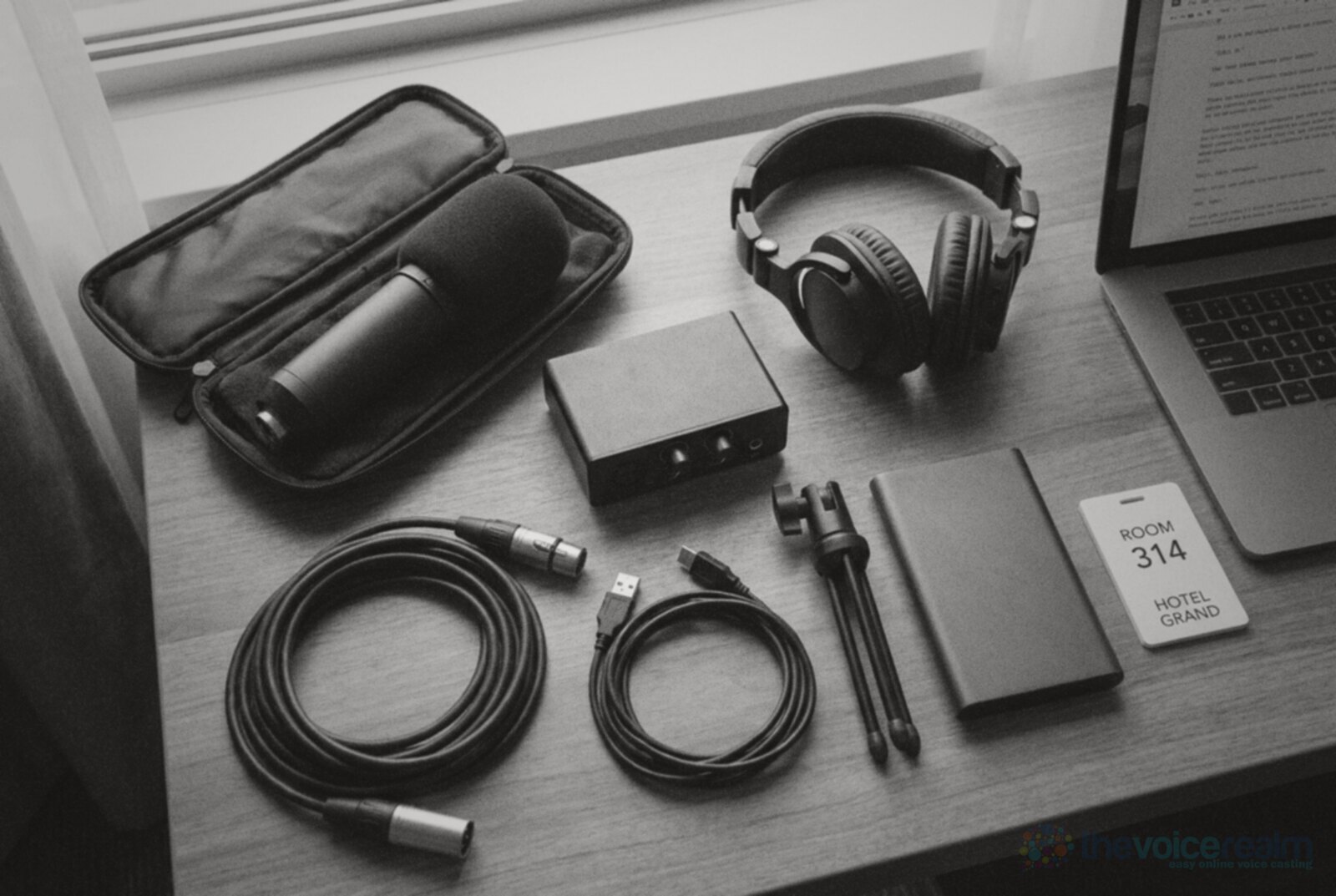
A road kit that fits in a cabin bag. © The Voice Realm
Bermingham’s tip here is a smart one. When you’re recording a job at home before a trip, “consider using the same mic that you will be taking on the road, or at least set up your ‘road mic’ next to your studio microphone and record the job with both.” Then, if the client asks for pickups while you’re away, you already know how your road mic sounds against the original, and matching is far easier. We’ve written about that whole problem in making pickups nobody can hear.
If you want ideas for a kit that fits in a cabin bag, the voice over travel kit page on the main site lays out options at different sizes.
- Record a test job on the road kit. Edit it and listen on two sets of speakers, not just headphones.
- Save a road template. Same sample rate, same file format, same names you always deliver.
- Pack spare cables. A bent pin at midnight in a strange city is a long night.
- Check your audition and invoice logins work on the laptop. Password resets at the airport are no fun.
Batteries and flying with your gear
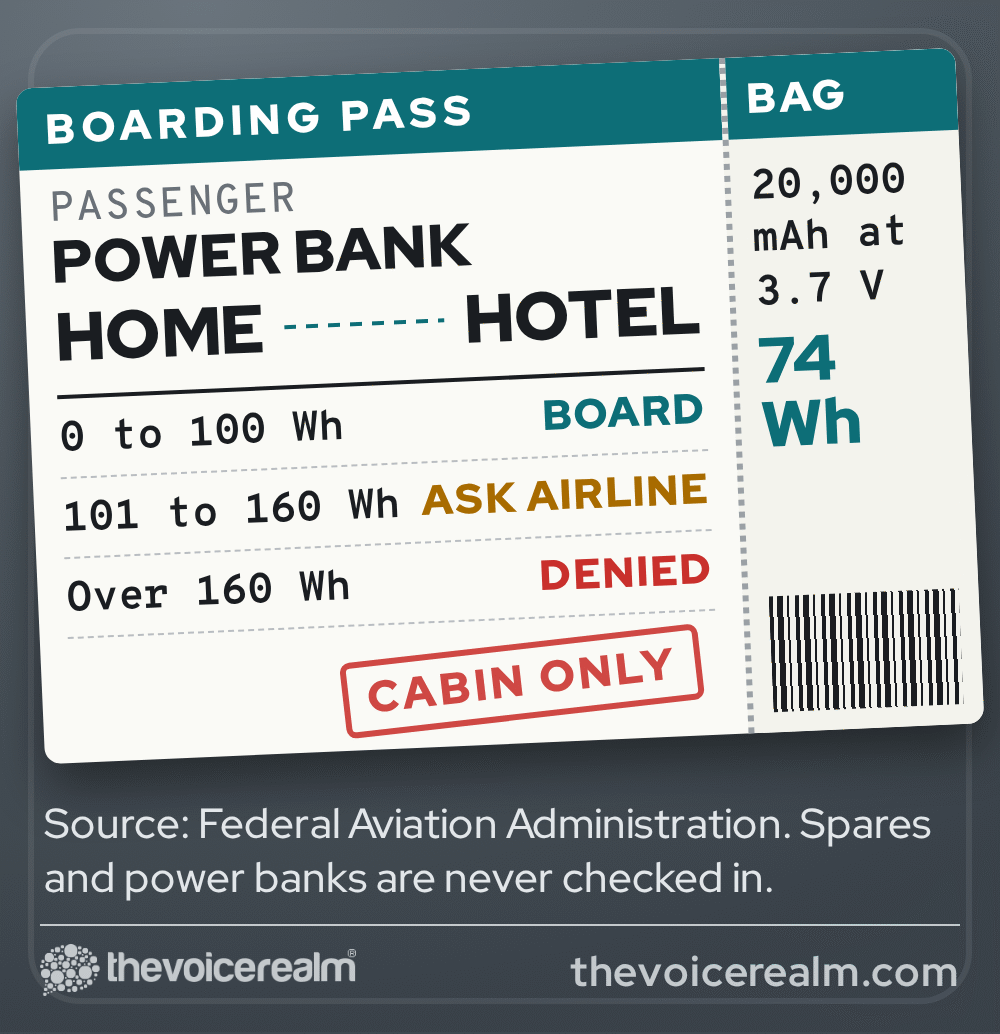
If you’re flying, the big one is power banks and spare batteries. The United States Federal Aviation Administration is clear: “Spare lithium batteries (including power banks and portable chargers) must be carried on and cannot be checked.” So the power bank lives in your cabin bag, not the suitcase.
There’s a size limit too, measured in watt hours, and the boarding pass below shows where each size of battery stands. The rating is usually printed on the battery. If it only shows milliamp hours, divide by 1,000 and multiply by the voltage, the way the stub on the pass works it out. Most power banks sized for a phone come in well under the first limit.
Airlines can be stricter than the FAA, and rules outside the United States vary, so check with your carrier before you fly. Pack the mic in its padded case in your cabin bag as well. Checked bags get thrown about, and a mic with a cracked capsule is a very expensive paperweight.
© The Voice Realm
Record smart, then check the file before you send it
When you’re ready, do a short test first. Record ten seconds of silence in your booth with nobody talking and look at it. If you can see a hum or a fan in the waveform, find it before you go any further. Our guide to hunting down background noise walks through the usual suspects, and most of them live in hotels.
Record at quiet times. Early morning before housekeeping starts and late evening after the corridor settles are usually best. Put the Do Not Disturb sign out, silence your phone, and switch off the room phone’s ringer if you can.
Bermingham also suggests you “give the engineer a few seconds of room tone at the start of the recording.” That’s good practice anywhere, and doubly useful on the road, because the person editing your file needs to know what the room sounds like when you’re not talking. If you want the full story on why, we’ve covered it in why every voice over needs room tone.
Before you send anything, listen back on headphones at a sensible volume, all the way through. Hotel noises sneak in: a door closing down the hall, an elevator chime, a neighbour’s shower. If you’ve got a few minutes, the free Home Studio Analysis from Voice Edit Suite will tell you how your temporary booth measures up, which is a good sanity check when you can’t trust your own ears in a strange room.
When to say no
Sometimes the room just won’t play. Building work next door, a nightclub downstairs, a ventilation system you can’t switch off. Be honest with yourself about it. An audition recorded in a noisy room is still an audition; a booked job that comes back for retakes costs you more than a polite note asking for a day’s grace.
Most clients would much rather hear “I’m travelling until Thursday, can I deliver Friday morning?” than get a file with an elevator chime in the middle of it. Tell them early, give them a real date, and then deliver something you’re proud of.
Sources: Jason Bermingham, Sound On Sound, “Session Notes: Recording Voiceover On The Road” (December 2017); Federal Aviation Administration, “Airline Passengers and Batteries”.
Ready to get booked?
See the jobs open right nowAbout Sarah Robbins
Sarah Robbins writes for The Voice Realm about finding voice over work, home studios, casting and the business side of voice acting.