Blog
Next Tuesday the country stops for three minutes and change, and for the first time in its history Triple M will be at Flemington when it does. The rock and footy network has gone racing this spring, and that makes this a good week to talk about the people who describe a horse race for a living. This piece is for Australian voice over artists, and for the brands booking them through the busiest fortnight on the Melbourne calendar. Race callers have a lot to teach anyone who earns a living with a voice and a script, and a few of those lessons are worth having before the Cup Day ads start landing in your inbox.
Triple M has gone to the races
Triple M began its first racing season on TAB Turnbull Stakes Day at Flemington on 3 October, starting at midday on 105.1 Triple M Melbourne. As TV Central reported, the network takes the official race call and wraps its own trackside programme around it: track conditions, mounting yard news, expert analysis, interviews and stories from the course. The audio streams on LiSTNR, and coverage moves into the network’s other metropolitan markets on the big carnival days.
The team is three-time Melbourne Cup winning jockey Glen Boss as expert commentator, broadcaster Michael Felgate hosting from the track, and racing presenter Caty Price reporting on the field. Boss rode Makybe Diva to all three of her Cup wins, so he knows what the last 400 metres feel like from the saddle. “There’s an undeniable electricity before a big race, and I’m looking forward to bringing listeners all the excitement with Triple M,” he said when the coverage was announced.
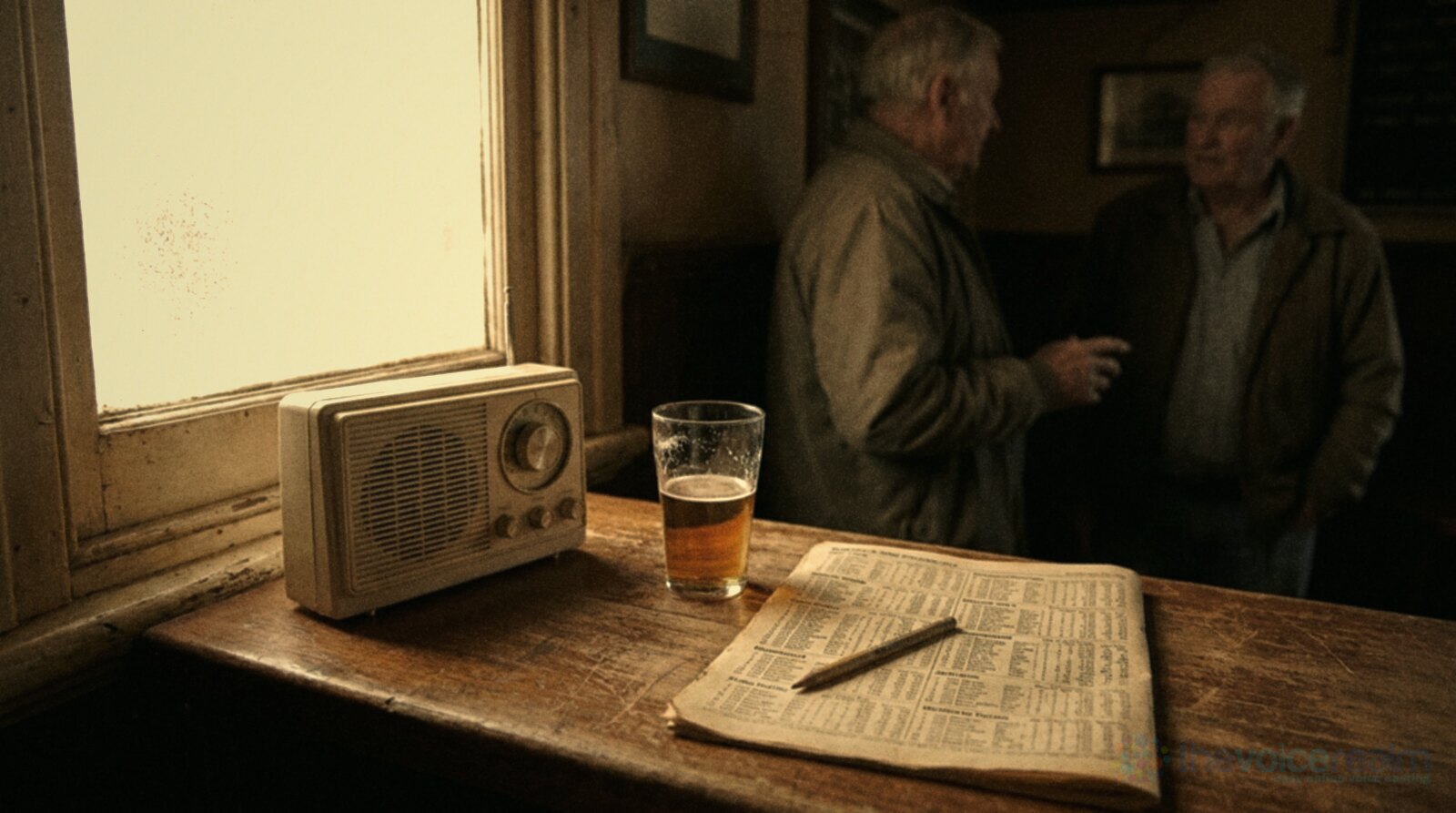
Not everyone in the trade sees it purely as a sports decision. Writing in Radio Today this week, reporter Sarah Patterson remembered her dad’s Saturday ritual with the racing station, the form guide and a portable radio, and wondered whether the new coverage is about bringing younger ears to the station or about catching the mood of the city in Cup week. Her conclusion was a vote of confidence in the medium itself: “In 2026, radio is still a very handy weapon to have in your media armoury.”
Here’s our read: spring is a voice season too
Whatever the network’s reasons, the effect is the same for voice over artists. More hours of live radio around the carnival means more breaks to fill, and every one of those breaks needs promos, sponsor tags, station imaging and ads. The Spring Racing Carnival has always been a busy patch for the people who voice them. Retailers run Cup Day sales, car dealers run spring clearances, hotels and restaurants push their marquee packages, and fashion brands sell the outfit for the members’ lawn. If you have voiced a Cup Day radio spot before, you know the brief: excited, local, quick, and finished by Friday.
A lot of that work wants to sound like Melbourne. A city that gets a public holiday for a horse race likes to hear its own voice on the radio that week, which is good news for any voice over artist from Melbourne who can turn a script around the same afternoon. It also means the race call itself turns up in ads all spring. The “and they’re racing” parody read is one of the oldest tricks in Australian radio advertising, and it only works when the voice actually knows how a call is built.
So it’s worth listening properly to the people who do it for real.
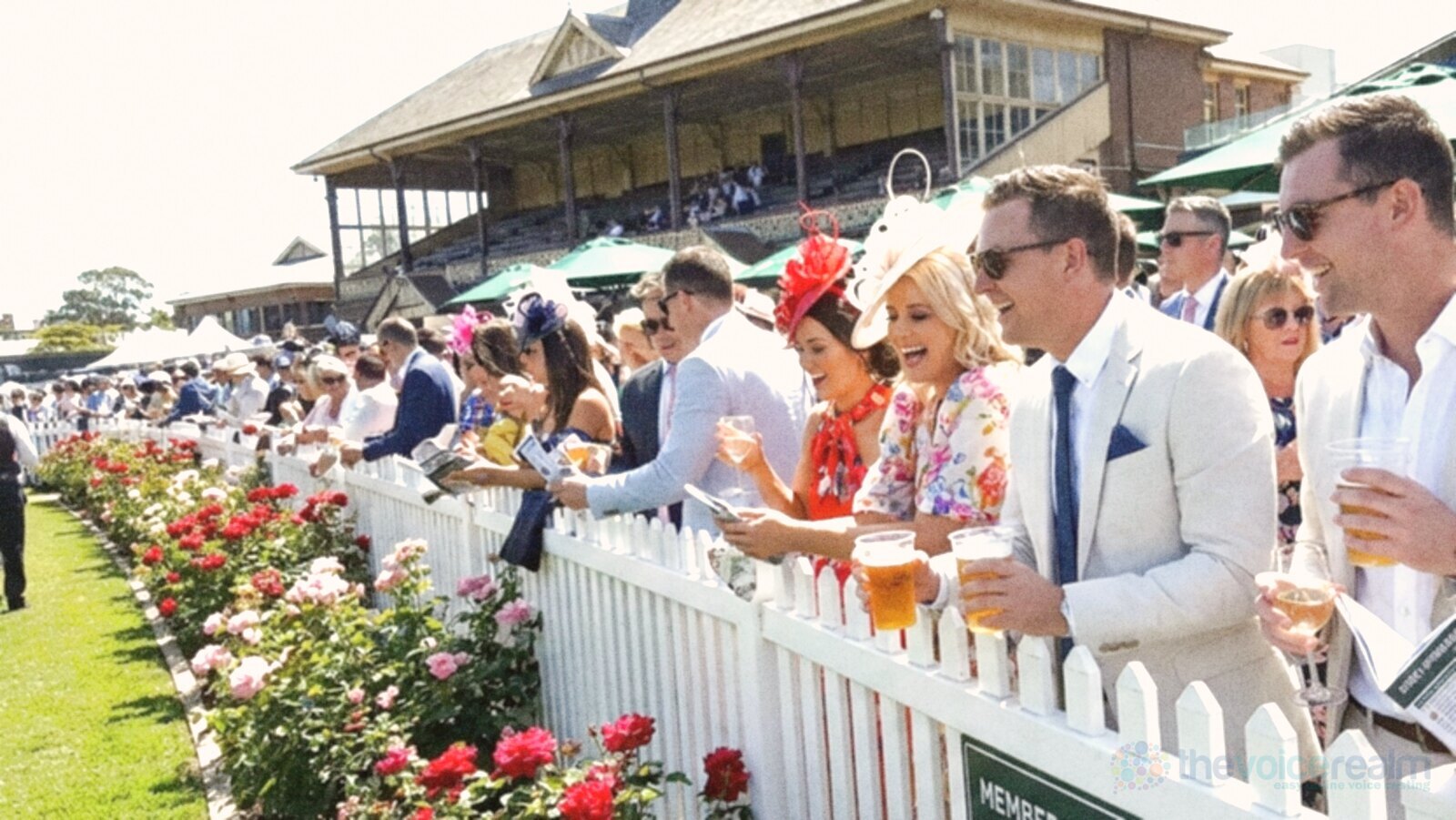
© The Voice Realm
The loneliest job in broadcasting
Matt Hill is the voice of the Melbourne Cup, and has called it from the Flemington box since he took over from his idol Greg Miles in 2017. Speaking at a Victoria Racing Club event in 2023, he described what makes the Cup different from the football or the Olympics:
“It’s a very lonely job. You don’t have a producer telling you anything. You don’t have a sidekick that you can just ask, ‘who’s in front?’, you know, you’re on your own. And for that reason, it’s the most satisfying job in the world.”
Any voice over artist who works from a home booth will recognise that. Most of our sessions have nobody on the other side of the glass. There’s no director to tell you the second paragraph dragged, no engineer to say you popped a P, nobody to ask whether the client meant “Cup Day” or “Cup day” in the tag. You are the producer, the sidekick and the talent, and the first person who hears the read with fresh ears is the client.
That’s the case for building your own checks into every session. Read it once cold, record it, then listen back as if somebody else had sent it to you. Race callers get one take; we usually get as many as we like, which makes a sloppy file harder to excuse.
Learn the colours before the jump
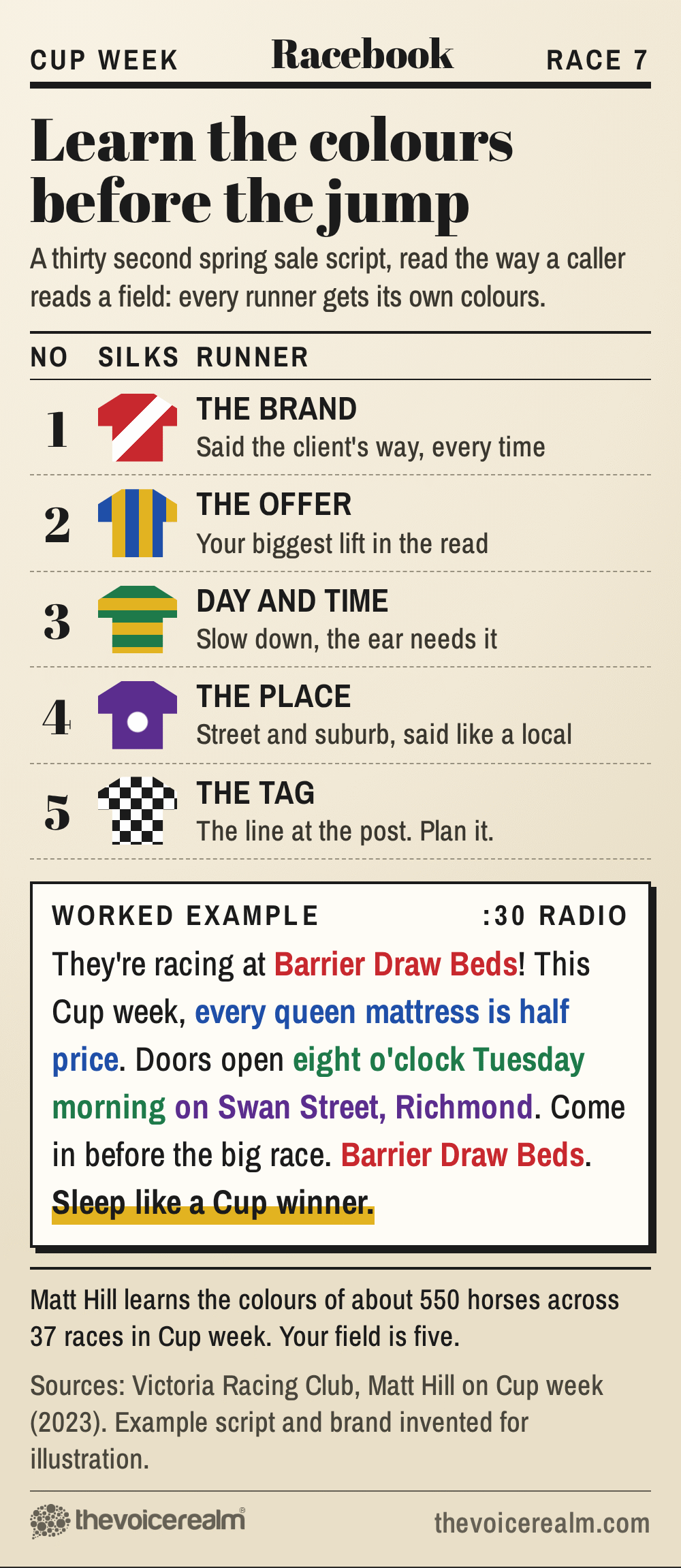
The most useful part of that talk was how Hill keeps hundreds of horses straight in his head. “I tend to concentrate on the colours. It’s a photographic memory thing,” he said, and he doesn’t stop studying even once he knows the field: “I’ll get up at 3:00 in the morning for the regular trip to the loo and have a look at the colours again, just to make sure.” Across Cup week the club says he has to learn the colours of around 550 horses over 37 races. He also agrees cap colours with the judge before the race so riders from the same stable can be told apart at a glance.
Swap horses for words and that’s exactly what script preparation is. Before the red light goes on, you should know every “runner” in the copy: the brand name and how the client says it, the product names, the street address, the phone number, the dates, the offer and the one line the client cares about most. Mark them so you can see them at speed. Some artists use a highlighter for names, a box round numbers and an underline for the tag. The method doesn’t matter. Knowing which word is which colour before you start does.
Hill also had a line about memory that every busy voice over artist will appreciate: “They reckon that race callers have good memories, but I reckon we’ve got bad ones, because we’ve got to call the first race and then completely forget the existence of the second one!” Clearing the last job out of your head before the next one is a skill. The energy you gave a furniture sale at nine o’clock has no business turning up in a hospital explainer at ten.
© The Voice Realm
Pace is not the same as speed
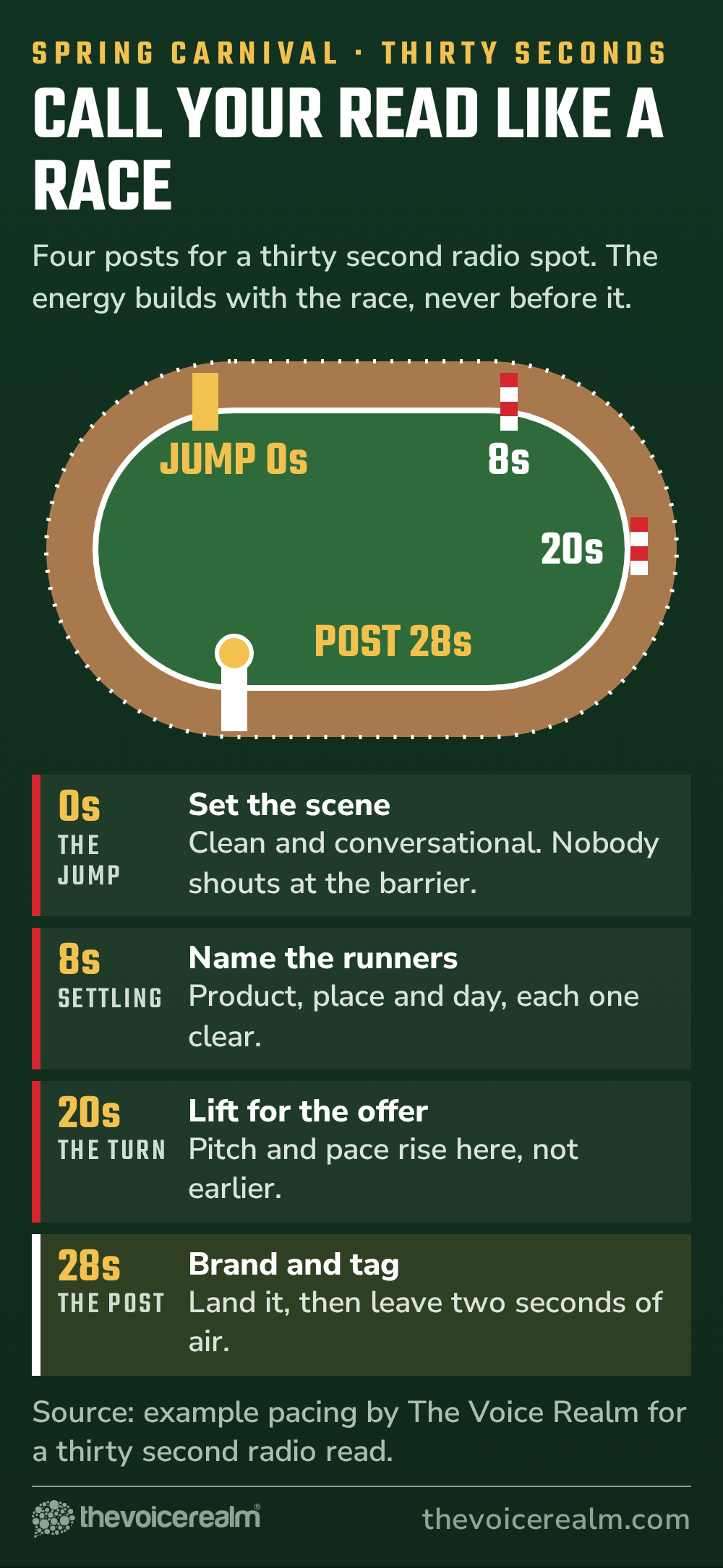
People think of race calling as fast talking. Listen to a good call from the jump, though, and it starts almost conversational. The caller sets the field, names the leaders, tells you where the favourite has settled. Speed and pitch build only as the race does, and the biggest lift is saved for the straight. If a caller started at full volume, there’d be nowhere to go when it mattered.
A thirty second radio read works the same way. The common mistake in a hyped retail ad is to hit the first word at maximum and stay there, which leaves the offer and the brand name sounding exactly like the bit about free parking. Plan the climb. Keep the set-up clean, lift for the offer, and land the name so it sounds like the finish line. Clear consonants are what make speed listenable, so a few diction drills before a fast session pay for themselves, and long, climbing reads need good breath control more than they need volume.
 VOICEMASTERACADEMYTwenty modules, one at a time.Breath controlHome studioCommercial techniqueAuditionsStart module oneNo experience needed.
Then check the numbers. A script that “should fit” in thirty seconds often doesn’t once the legal line is added. Time the script first and you’ll know whether the client needs to cut words before you’ve wasted a take trying to beat the clock.
© The Voice Realm
The one-liner at the line
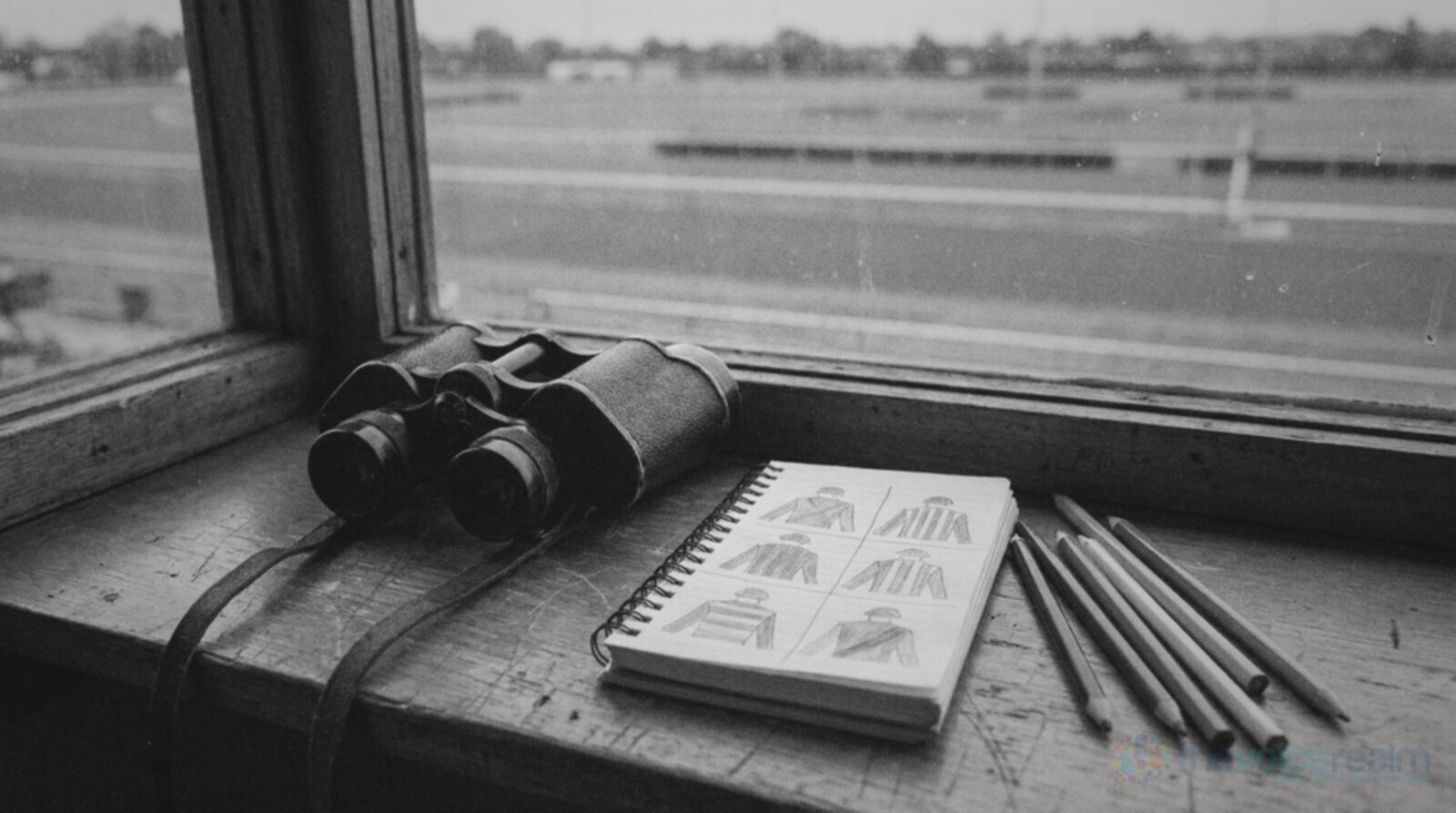
Every big race leaves one sentence behind, the line the caller says as they cross. Hill was asked whether he plans those, and his answer was honest. “One-liners are very interesting. I was asked this before the Cox Plate, and there were a few juicy ones there, but I didn’t have any time to say anything!” He was still working out who’d won. He admitted, though, that “you do have a little ideas.”
In a radio ad the one-liner is the tag: the brand name, the slogan, the call to action. It’s the one sentence the client will judge you on, and it’s always the last thing in a tight script, which is exactly where readers run out of time and rush. Have your idea ready, like Hill does. Decide before you record how the last line will sound, and protect the half second of air it needs, even if it means trimming the energy earlier in the read.
- Learn the field. Mark every name, number and date before you record, the way a caller learns the silks.
- Build the call. Start clean and climb. Save your biggest lift for the offer and the brand.
- Time it first. Run the full script, legal line included, through a timer before the first take.
- Plan the line. Decide how the tag will sound and leave it room to land.
- Be your own producer. Listen back cold before anything goes to the client.
Practise a call, even if you never voice one
Hill learned the craft as a teenager by rolling snooker balls down his grandfather’s crooked table in the garage and calling them home. You can do the same thing with any moving list. Call the cars at a set of lights, the dogs at the beach, the trams going past your window. The point isn’t the comedy. It’s learning to keep track of several names at once, to describe and decide in the same breath, and to raise the energy without losing your diction.
Then record a short mock call for a made-up local product and listen back. You’ll hear quickly whether your names stay clear as you speed up, whether your pitch climbs or just your volume, and whether you have anything left at the line. If it works, you have a fun spring piece for your reel. If it doesn’t, you’ve found the thing to fix before a paying client finds it for you.
© The Voice Realm
For the brands booking Cup week voices
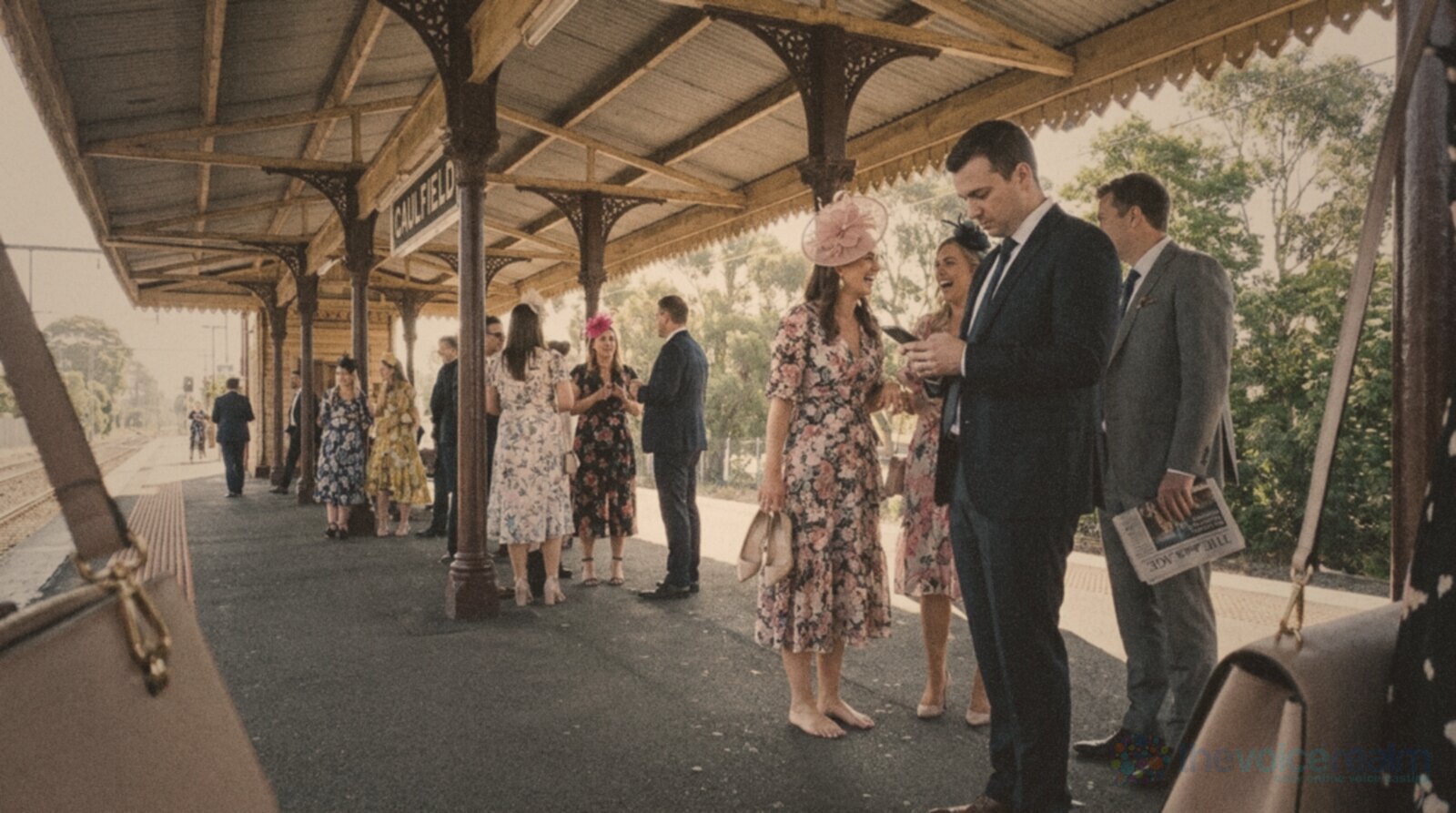
If you’re writing a spring racing ad this week, write it for the ear. Give the voice fewer words than you think, because an excited read needs air. Put the brand at the end of the race, not buried in the middle. And if the spot leans on a race call parody, cast someone who can genuinely call, or at least describe, a race. Listeners in this country grew up with the real thing on the kitchen radio, and they hear a fake straight away.
Ask for a short custom audition on your actual script rather than judging a demo. The difference between a voice that can shout and a voice that can build is obvious in thirty seconds of your own copy.
© The Voice Realm
Our take
Triple M’s move into racing is a bet on a very old idea: that a live voice describing something you can’t see is still one of the most gripping things radio can do. We think the bet is a good one. It’s also a reminder that the skills behind a great race call are the same ones behind a great ad read. Know your field before the jump. Build instead of shouting. Save something for the line. Check your own work, because in the booth there’s often nobody else to ask who’s in front.
Cup Day falls on 3 November this year. Whether you’re calling it, voicing the sale that runs beside it, or just listening from the pub, enjoy the race that stops a nation, and spare a thought for the bloke in the box with 550 sets of colours in his head.
Sources: Aaron Ryan, TV Central, “Triple M Racing launches for 2026 Spring Racing Carnival” (3 October 2026); Sarah Patterson, Radio Today, “Radio’s latest gamble” (27 October 2026); Celia Purdey, Victoria Racing Club, “Matt Hill: just how does he remember 550 racehorses across Cup Week?” (1 November 2023).
Ready to get booked?
See the jobs open right nowAbout Sarah Robbins
Sarah Robbins writes for The Voice Realm about finding voice over work, home studios, casting and the business side of voice acting.