Blog
This one’s for every voice actor who spends more of the day in headphones than out of them. You record in them, you edit in them, you take directed sessions in them, and then you put earbuds in for the walk to the shops. Your voice gets all the attention, the warm-ups and the honey. Your ears just get used.
Here’s how loud is too loud, where a voice actor’s day quietly gets loud, the habits that cost you nothing, and what ringing ears are trying to tell you. It’s a guide, not a diagnosis. If your hearing has changed, an audiologist or a doctor is the person to see.
Your ears are part of the kit, and they can’t be replaced
You can buy a new microphone. You can’t buy new ears. Deep inside each one sit thousands of tiny sensory hair cells that turn sound into signals for your brain. Loud sound, or ordinary sound for too long, wears them out.
The US National Institute on Deafness and Other Communication Disorders (NIDCD) doesn’t soften what happens next: “Unlike bird and amphibian hair cells, human hair cells don’t grow back. They are gone for good.”
That’s the whole case in two sentences. Noise damage builds slowly and doesn’t hurt while it’s happening. NIDCD calls noise-induced hearing loss “the only type of hearing loss that is completely preventable,” which is the good news hiding inside the bad.
For a voice actor it’s also a work problem. You make a living hearing tiny things: a lip smack under a word, a fan humming under the room tone, a plosive that thumps on one syllable. Clicks, hiss and sizzling S sounds live high up in the frequency range, and that’s detail you can’t afford to lose.
How loud is too loud, in plain numbers
Sound is measured in decibels, and the scale isn’t a straight line. Every few decibels up is a big jump in how much energy hits your ear. That’s why the safe time shrinks so fast as the level climbs.
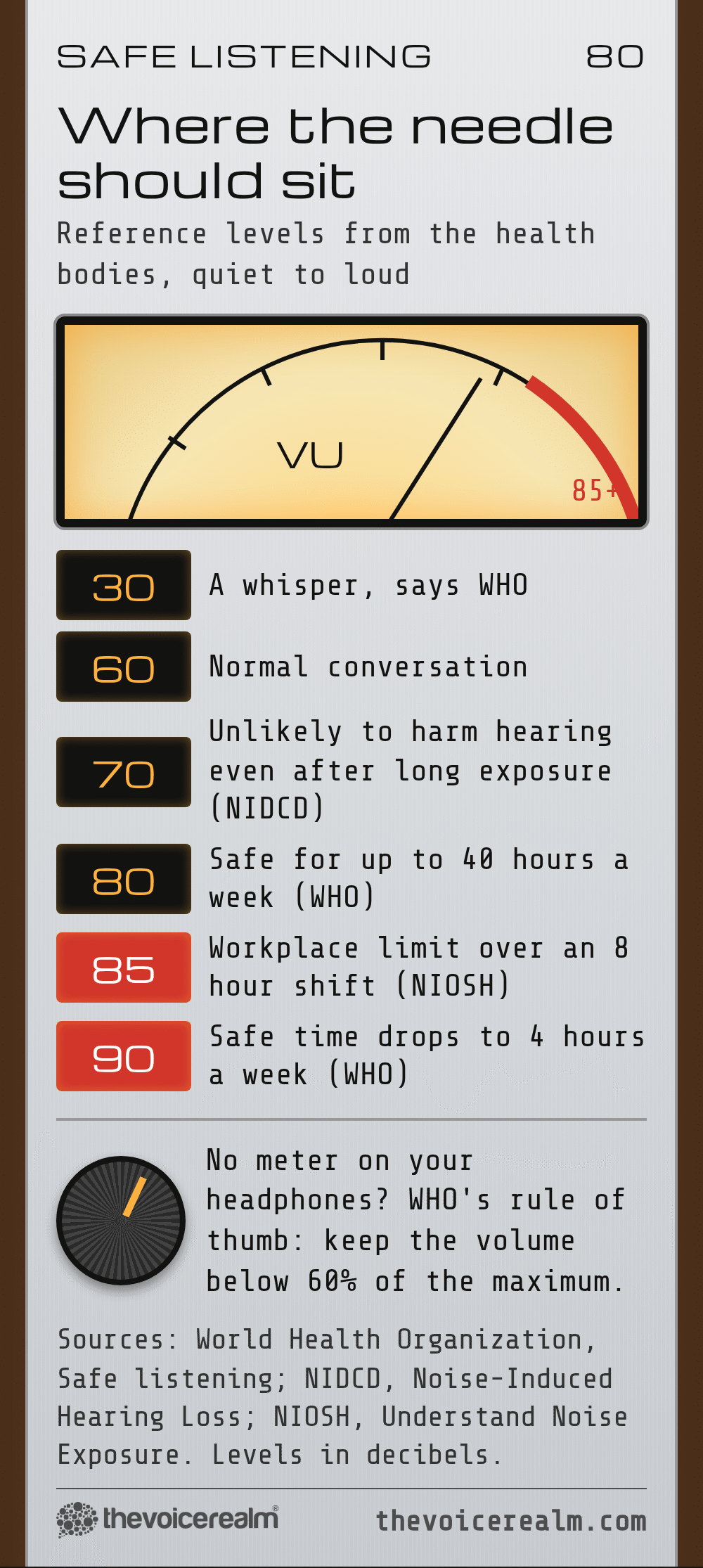
The World Health Organization puts it like this: “For example, you can safely listen to a sound level of 80dB for up to 40 hours a week. If the sound level is 90dB, the safe listening time reduces to four hours per week.” Ten decibels louder, and a full working week of safe listening becomes one afternoon.
Workplace safety bodies use the same idea. The US National Institute for Occupational Safety and Health (NIOSH) sets its recommended limit at 85 dBA averaged over an eight-hour shift, and recommends halving the time for every 3 dBA you add. It calls that halving the exchange rate. At the quiet end, NIDCD says sounds at or below 70 dBA “even after long exposure, are unlikely to cause hearing loss.”
For reference, WHO puts normal conversation at about 60 dB and a whisper around 30 dB. Most of us have no idea what our headphones are putting out, which is exactly the problem.
© The Voice Realm
Where a voice actor’s day quietly gets loud
Nobody in a home studio is standing next to a jet engine. The risk for us is hours, not blasts. A few habits push the level up without you noticing.
Editing for detail. You crank the volume to hunt for mouth clicks and breaths, then forget to bring it back down for the next three hours. The edit that started at a sensible level ends a lot louder, because ears adapt and everything starts to sound quiet.
Hearing yourself over yourself. When you record with headphones on, part of your own voice reaches your ears through your skull. To hear the mic over that, people turn the monitoring up. Loud talkback is common in long character sessions, where you’re shouting and the director keeps saying “one more.”
Remote sessions. A director’s laptop mic, a producer who leans in, a client who claps when they like a take. The level jumps around and you leave the volume wherever the quietest person needed it.
The commute. On a train or a busy street, earbuds fight the noise around you, so you turn them up to win. Then you get home and start editing on ears that have already done a shift.
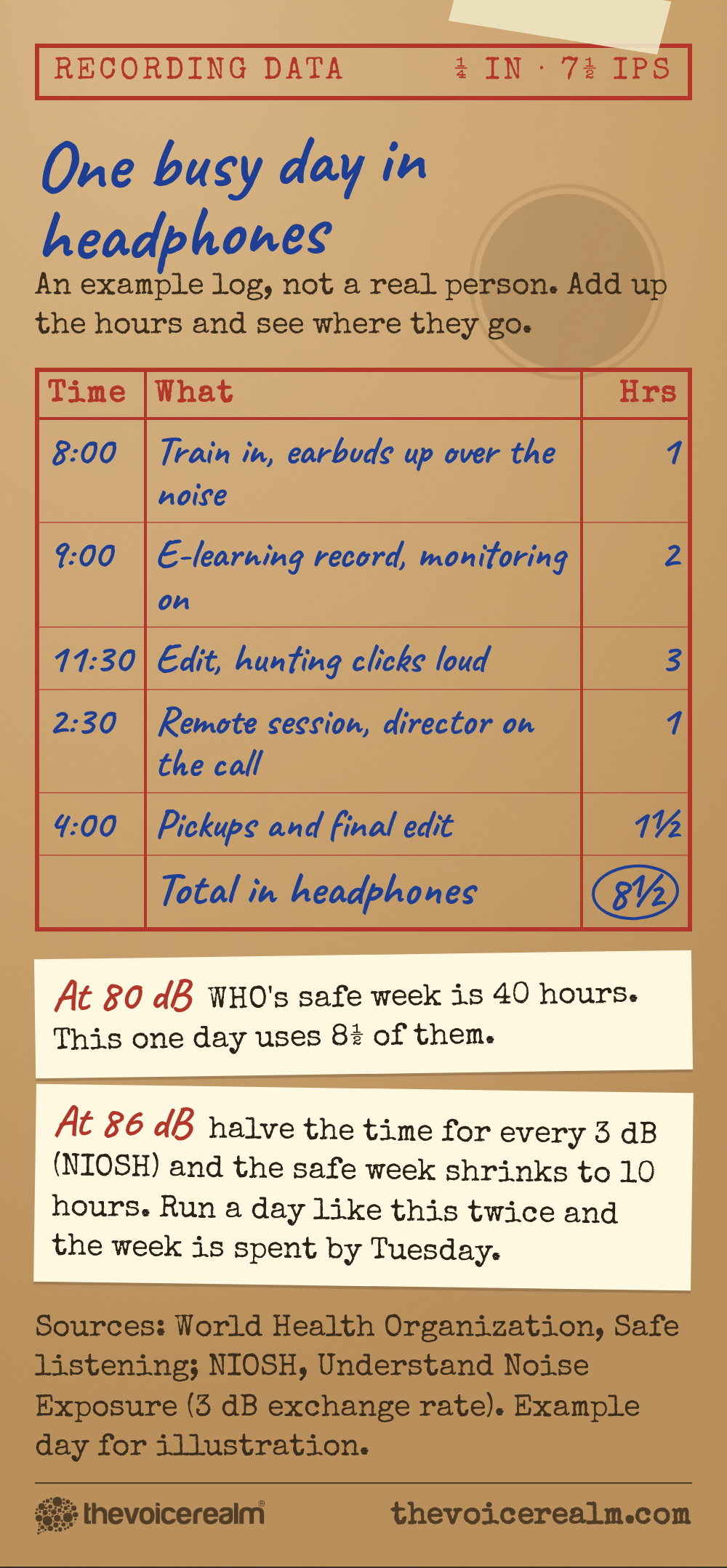
Add it up and a busy day can be eight or more hours of headphones, often at a level you’ve never measured. If you’ve ever wondered how much of that your body can take on the voice side, we looked at how long you can record in a day; your ears need the same kind of budget.

© The Voice Realm
The 60 percent rule and other free habits
The fixes here cost nothing, and they don’t make your work worse. Most of them make it better, because rested ears hear more.
WHO answers this exact question for people who spend the day on calls in headphones. Its list includes “Keep the volume at a level below 60% of the maximum” and “Take breaks between calls, preferably in a quiet environment to allow your ears to rest.” Swap “calls” for “takes” and you’ve got a voice actor’s version.
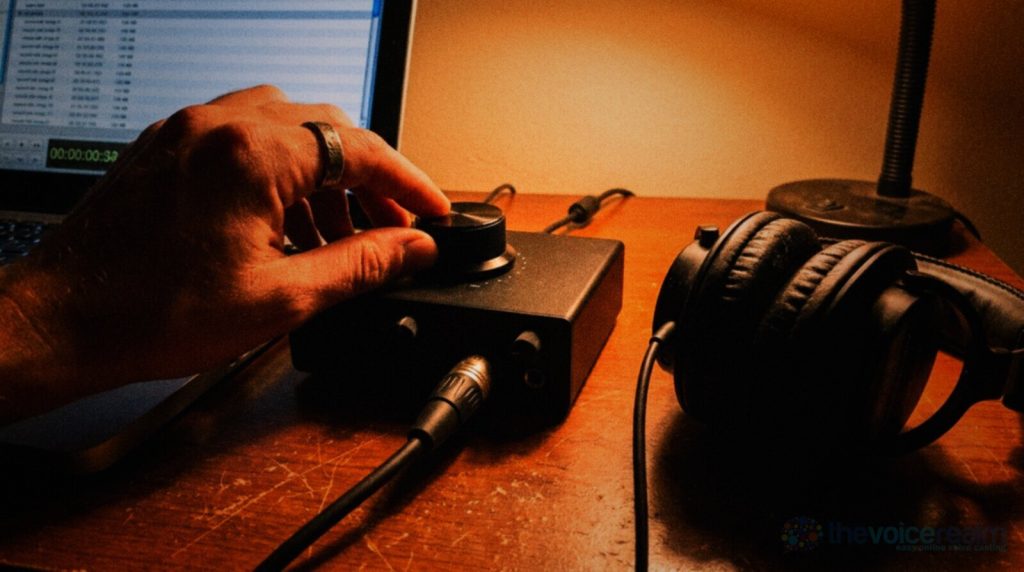
- Set it, then mark it. Find a comfortable editing level at the start of the day and put a dot of tape on the knob or a note of the slider number. Come back to it after every loud check.
- Turn up the detail, not the whole file. When you’re hunting clicks, solo the short section, listen, then go back to normal. Don’t edit a whole chapter at hunting volume.
- Break every hour. Ten quiet minutes. Make tea, stretch, read your next script on paper.
- Quiet commute on studio days. Leave the earbuds out or keep them low on the way to a long session. Your ears will thank you at four o’clock.
That hourly break comes from people who listen for a living. Mastering engineer Alexander Wright, writing in Tape Op, puts it in one line: “Short predictable breaks: Ten minutes of silence every hour beats pushing through.” WHO gives the same reason in its own words: breaks help “the sensory cells inside the ears to recover.”
There’s a sneaky bonus. Tired ears start to hear everything as a bit dull, so you start boosting the top end of your edits to compensate. Your files then sound harsh to everyone else. A rested ear makes better decisions.
© The Voice Realm
Monitor smart: let the headphones do the work, not the volume
The right headphones let you listen quieter. A good closed-back pair seals around your ear, so less room noise gets in and you don’t need to push the level to hear what’s going on. That seal also stops your monitoring leaking into the mic. We covered what to look for in choosing headphones that seal and stay comfortable.
 VoiceEditSuiteKnow what to charge before you reply.Rate Calculator works out project type, usage and add-ons, then writes a quote email with low, mid and high pricing you can send straight away.See how it worksYour recordings are never used to train AI.
WHO makes the same point about everyday listening: well-fitted headphones, and noise-cancelling ones where they suit you, mean you don’t need to turn things up to drown out the world. Noise cancelling is great on a train. In the booth, most voice actors stick with plain closed-backs so they hear exactly what the mic hears.
A few small set-up habits help too:
- Record at a healthy level. A quiet recording tempts you to turn the headphones up to hear it. Get your gain right at the source, as we explained in setting your recording levels, and playback sits at a sensible volume.
- Turn down the director, not just yourself. In remote sessions, set the call app volume separately from your own monitoring, so a loud producer doesn’t spike your ears.
- Check on speakers at low volume. Quiet speakers give your ears a different listen and a rest from pressure on the ear.
© The Voice Realm
Ringing ears: what they’re telling you
Ringing, buzzing or hissing that doesn’t come from anywhere is called tinnitus. NIDCD says surveys put it at 10 to 25% of adults, so if you’ve noticed it, you’re far from alone.
Ringing after a loud day is a warning, even when it fades. NIDCD says a temporary hearing loss after loud noise can disappear “16 to 48 hours later,” and then adds: “Recent research suggests, however, that although the loss of hearing seems to disappear, there may be residual long-term damage to your hearing.” Feeling back to normal in the morning doesn’t mean nothing happened.
WHO says the same about ringing that sticks around: “Persistent tinnitus can indicate that your hearing has been damaged. However, there are many other health conditions that could lead to or be associated with tinnitus. In case of persistent tinnitus it is important to seek medical advice.”
Some signs can’t wait. The NHS tells people to get urgent help for sudden hearing loss in one or both ears, and for tinnitus that comes with sudden hearing loss, weakness in the muscles of the face, or a spinning feeling. Don’t sit on those until after the next job.
For ringing that comes and goes, NIDCD’s first step is ordinary: “If you have tinnitus, first see your primary care doctor, who will check for earwax or fluid from an ear infection that could be blocking your ear canal.” Sometimes the fix really is that simple.
© The Voice Realm
Get a baseline hearing test while your ears are good
The best time for a hearing test is before anything feels wrong. A baseline gives you something to compare against, so a small change shows up years before you’d notice it yourself.
WHO suggests that people who spend a lot of time listening on headphones “should check your hearing every year to self-monitor your hearing levels.” Wright, in Tape Op, gives the version for people who work with sound: “Get a proper audiogram (baseline, then annually) and ask for extended high frequency testing.”
That last bit matters. A standard test checks the frequencies speech needs. Extended high frequency testing goes higher than that, up where crisp S sounds and mouth clicks live. Ask for it by name.
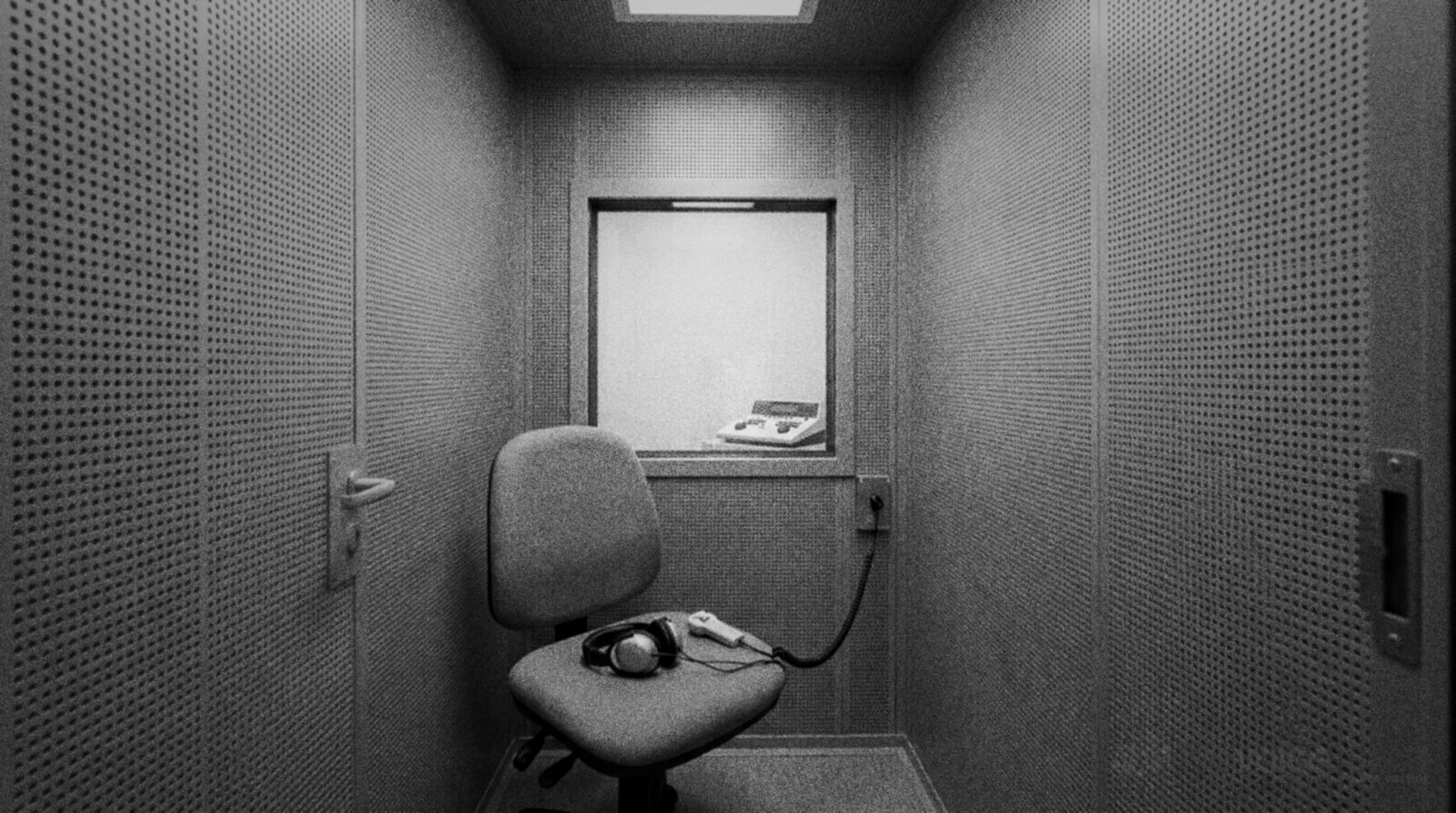
A test is short and painless. You sit in a quiet booth with headphones on and press a button each time you hear a tone, however faint. Treat it like servicing the car. You book it before the long drive, not after the warning light comes on.
A quieter habit pays you back
None of this asks you to work less. It asks you to work at a level your ears can keep up with for the next forty years. Set your volume once and come back to it. Take ten quiet minutes every hour. Seal out the room instead of shouting over it. Get a baseline test this year.
The payoff shows up in your files long before it shows up in a hearing test. Rested ears catch the click, the hum and the harsh S. If your room noise is what’s pushing you to listen louder, start by tracking down the hum under your voice. Turn it down a notch today, and your ears will still be doing the job long after this year’s mic is in a drawer.
Sources: World Health Organization, “Deafness and hearing loss: Safe listening”; National Institute on Deafness and Other Communication Disorders, “Noise-Induced Hearing Loss” and “Tinnitus”; National Institute for Occupational Safety and Health, CDC, “Understand Noise Exposure”; NHS, “Tinnitus” and “Hearing loss”; Alexander Wright, “Listening for a Lifetime”, Tape Op.
Ready to get booked?
See the jobs open right nowAbout Sarah Robbins
Sarah Robbins writes for The Voice Realm about finding voice over work, home studios, casting and the business side of voice acting.