Blog

Here’s a number that should make every podcast producer and every voiceover artist who records ad reads sit up. Only about a third of brands that sponsored a podcast in the first three months of this year were heard on the same show in the next three. That’s from a new study reported by RadioToday last week, and it lands just as Britain’s radios fill up with Christmas adverts that brands will happily run again next year. This piece is for UK voiceover artists, podcast hosts and producers, and the brands paying for the airtime.
We don’t think the headline means podcast advertising is broken. We think it’s telling us something about why some ads earn a second booking and others don’t, and a lot of that comes down to the voice.
What the study found
The research comes from Podmerse, a database for podcast publishers, advertisers and media buyers that went public at the end of October. It looked at 125,429 pairings of a brand and a show. RadioToday’s summary puts it plainly: “Only 34% of podcast brand and show pairings from the first quarter of 2026 reappeared in the second quarter.”
The method is worth knowing. Podmerse says it finds sponsors by analysing the episodes themselves rather than relying on media kits, and it left out shows that stopped running ads altogether in the second quarter, so the figure isn’t dragged down by podcasts that simply went quiet. The company says it covers more than two million sponsored episodes across nearly 44,000 podcasts. It also admits automated detection can throw up the odd false positive, and it’s a vendor reporting on its own data, so treat the exact figure with a little caution.
The co-founders were clear about what they think matters. Vineet Agarwal put it this way: “The useful question is not which brands sponsor podcasts. It is which brands came back to a show a second and a third time.” His fellow co-founder Anuj Agarwal described the problem from the publisher’s side: “A podcaster can name three shows like their own in a second.” Finding out which brands are buying on those shows, he said, is “a week of listening.”

© The Voice Realm
A third isn’t the whole story
RadioToday was careful to note that a brand not reappearing doesn’t necessarily mean the campaign failed. Plenty of sponsorships are built as a short burst: a product launch, a sale, a seasonal push. A brand might move to a different show with a similar audience, or pause for the summer and come back in autumn. Three months is also a short window for anything that runs on quarterly budgets.
Still, two thirds of pairings not repeating inside a quarter is a lot of one off relationships. For a show, every sponsor who doesn’t return is a new sale to make. For the brand, it’s a new script, a new read, and a new audience who’ve heard them once and then never again. Advertising generally works through repetition. A listener who hears the same sponsor, in the same voice, on the same show for months starts to treat it as part of the furniture. A listener who hears it once may not remember it by Tuesday.
That’s where voiceover artists come in. On many podcasts the host reads the ad, and that’s a large part of why it works. But a growing number of shows and networks run produced spots, voiced by a professional, slotted into the break. Those spots live or die by whether they feel like they belong in that show.

© The Voice Realm
Meanwhile, a bakery on the radio
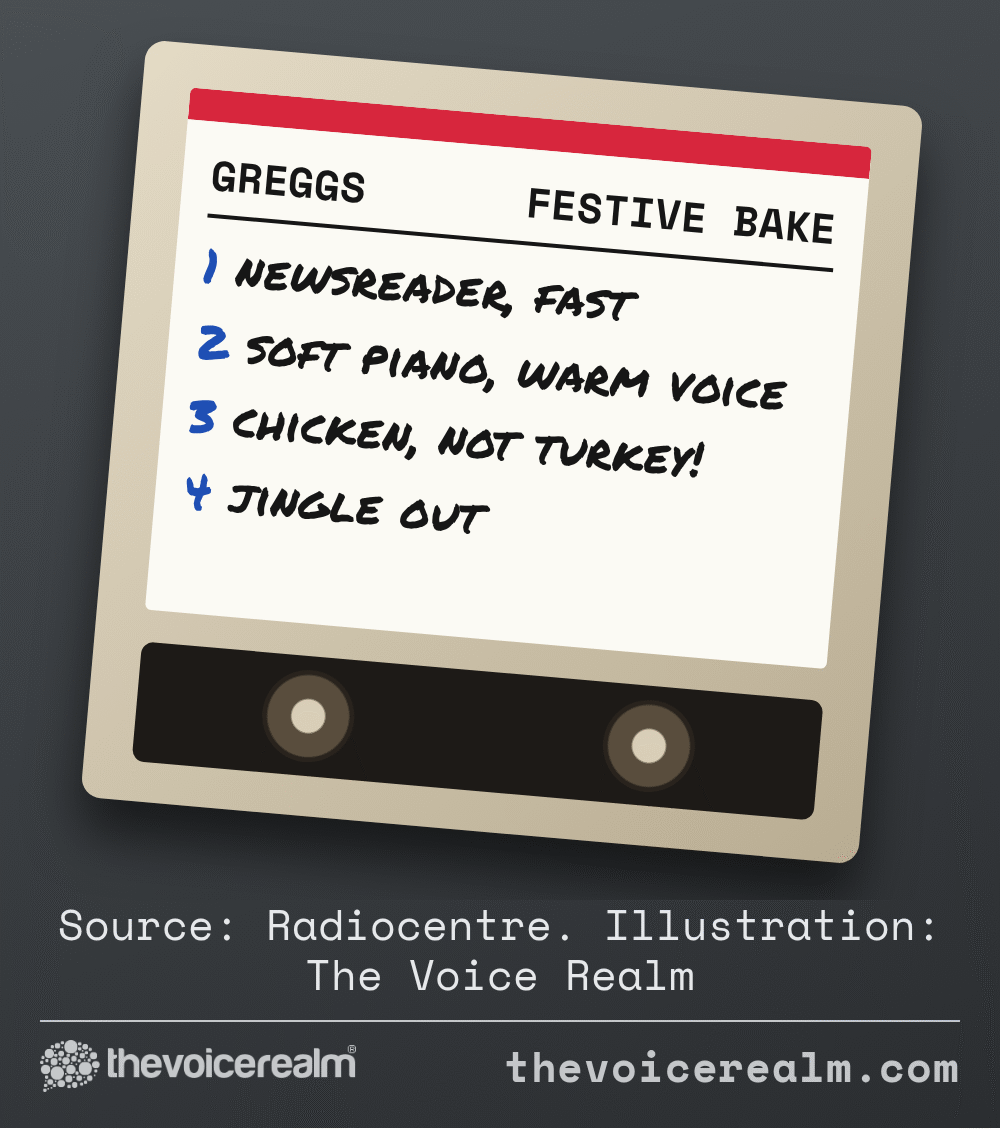
While the podcast numbers were doing the rounds, Radiocentre picked a seasonal Greggs advert for its November Creative Spotlight, and it’s a nice example of the opposite instinct. The trade body wrote that “Greggs have launched their newest radio campaign showcasing their seasonal treat”, in a spot made by the agency Quiet Storm.
Radiocentre describes the ad opening with a fast paced news reporter giving updates on the nation’s festive snack choices, before it slows down for soft piano while the narrator talks through the flavours. Then the twist, which Radiocentre sums up as “Most important is the distinction of chicken rather than turkey”, before the whole thing lands on a new sonic jingle. It’s two reads in one spot: a brisk newsreader for the joke and a warm, slow voice for the food.
What we like about it is how ownable it is. A jingle, a recognisable tone, a format you could run again next December with a new bake and the audience would know it in two seconds. That’s the thing a lot of one off podcast spots are missing. They’re written for one flight and forgotten, so there’s nothing for a listener to recognise when the brand does come back.

© The Voice Realm
What makes a brand come back
Nobody outside a brand’s marketing team knows every reason a sponsorship gets renewed. Budget, results and timing matter most. But from the voice side, a few things come up again and again in the work we see.
The ad sounds like it belongs. A podcast about gardening doesn’t want a booming car showroom read in the middle of a chat about compost. The best produced spots match the show’s pace and warmth, so the listener doesn’t reach for the skip button. If you want the long version, we’ve written about how a podcast ad read differs from a radio spot.
“The useful question is not which brands sponsor podcasts. It is which brands came back to a show a second and a third time.”
Vineet Agarwal, Podmerse co-founder, via RadioTodayPost this quote
The voice stays the same. Brands that keep the same voice across a run build familiarity fast. When they switch voices every flight, they throw some of that away. This is why plenty of advertisers on the radio side keep the same artist for years, and why radio and TV commercial voiceovers are often cast with the long run in mind rather than one campaign.
 VOICEMASTERACADEMYLearn the craft in order.Module one is freeStart module oneTwenty modules, start to finish.
There’s something to come back to. A tagline, a sound, a sign off, a running joke. The Greggs jingle is the obvious version. A podcast spot can do the same thing more quietly: the same opening line every episode, the same music bed, a reveal that changes each week. Give the listener a pattern and they’ll notice when it returns.
The read is honest. Podcast listeners are a loyal, slightly protective bunch. They’ve invited the hosts into their ears on the bus and in the kitchen, and they can smell a hard sell from three episodes away. A spot that talks to them like a friend with a recommendation lands. A spot that shouts at them like a clearance sale gets skipped, and a skipped ad is an ad nobody renews. For a voiceover artist, that means pitching the read a notch lower and a touch more personal than you would for the same script on commercial radio, unless the show itself is loud and fast, in which case match it.
© The Voice Realm
Practical steps for voiceover artists
If you record podcast spots or would like to, the study is a useful reminder that your client’s next booking depends partly on whether the first one sounded right in context. A few things worth doing.
Listen to the show before you read. Ten minutes of the actual podcast, in the actual break, will tell you more about pace and energy than any direction. If the producer can send you the episode the spot will sit in, even better.
Hear the brand’s other ads too. If the sponsor already runs on radio or has spots on social, listen to a few. You’ll learn the words they always stress, the tone they’ve settled on and the sign off they like. Fitting into a brand’s existing sound, while still suiting the show, is the sweet spot.
Think in series. When you deliver a spot, offer to record two or three alternate openings or tags in the same session. Brands that come back want freshness without changing the voice, and alternates make that easy. It also makes you the obvious person to book for the next flight.
Keep notes on your sound. Write down the mic, the distance, the room and the processing for every regular client. When a brand returns six months later, your read should sound like the same person in the same place. That consistency is quietly one of the best tools for keeping clients coming back.
Ask how it went. A short, friendly email a few weeks after a campaign, asking whether the spot did its job, tells the client you care about results, not only the invoice. Sometimes it’s the nudge that puts you on the next brief.
© The Voice Realm
For brands and producers
If you’re buying podcast sponsorship, the study is a reason to plan for the second and third flight before the first one airs. Pick a voice you’d be happy to hear for a year, not just a week. Brief them on the show they’re going into. Ask for alternates so you can refresh the spot without starting again.
If you’re making the shows, think about how produced spots sound next to your hosts. A professional voice that matches your show’s warmth will annoy fewer listeners and keep more sponsors. Plenty of British shows are made well outside the capital, and plenty of networks book voiceover artists in London or right across the country, because the session happens online and the only thing that travels is the file.
And whoever you are, keep your sound. A brand that changes voice, music and tone every quarter is starting from zero each time, and then wondering why listeners don’t remember it.
Our take
Here’s our read. The 34% figure isn’t a crisis, but it is a warning that a lot of podcast advertising is being bought and made as a one-off fling. The ads that get renewed tend to be the ones that sound like they belong, use the same voice, and give the listener something to recognise next time. The Greggs spot did that on radio in about the time it takes to queue for a sausage roll.
For voiceover artists, the opportunity is to be the reason a brand comes back. Read for the show, not just the script. Make yourself easy to rebook with consistent sound and alternates. And talk to clients about the second flight before the first one has even gone out.
For brands, it’s simpler still. Find a voice you love, and keep it.
Sources: RadioToday, “Only 34% of podcast sponsors return to same show” (16 November 2026); Radiocentre, “November’s Creative Spotlight: Greggs” (19 November 2026).
Ready to get booked?
See the jobs open right nowAbout Sarah Robbins
Sarah Robbins writes for The Voice Realm about finding voice over work, home studios, casting and the business side of voice acting.