Blog

This one’s for voice actors in their forties and fifties who’ve noticed their voice isn’t quite behaving the way it used to. Maybe the top of your range has gone a bit shy. Maybe a long narration day leaves you croaky by three o’clock when it never used to. Maybe your throat just feels dry all the time. If you’re in perimenopause or past menopause, your hormones are a likely part of the story, and you’re far from the only one. Here’s what’s going on, what actually helps, and how to keep working through it.
A quick note before we start: none of this replaces a doctor. If something about your voice worries you, get it looked at. We’ll come back to when that matters most.
Your vocal folds run on hormones too
It’s easy to think of the voice as muscle and breath, and stop there. But the tissue of your larynx responds to hormones all through life. The University of Glasgow’s guidance on menopausal voice change, written by voice coach Dr Kathleen Cronie, puts it plainly: “Hormones affect the voice throughout life, causing changes to how the voice sounds and feels during puberty, pregnancy, menstruation, perimenopause and post-menopause.”
Menopause is simply the biggest of those shifts for most women. A 2025 paper in the journal Menopause, from a team at the University of South Florida led by Dr Yael Bensoussan, an otolaryngology professor who runs the university’s voice centre, looked at the research so far. The university’s summary opens: “Falling estrogen and progesterone during menopause can cause hoarseness, vocal fatigue and instability, with major impact on singers, teachers, actors and other voice professionals.” The authors wrote that “hormonal fluctuations play a critical role in maintaining the structural integrity of laryngeal tissues.”
In plain terms, the folds can get a little thicker, a little drier and a little less flexible. None of that is dramatic on its own. But voice actors live in the details, so you’ll often notice it long before anyone else does.
What voice actors tend to notice first
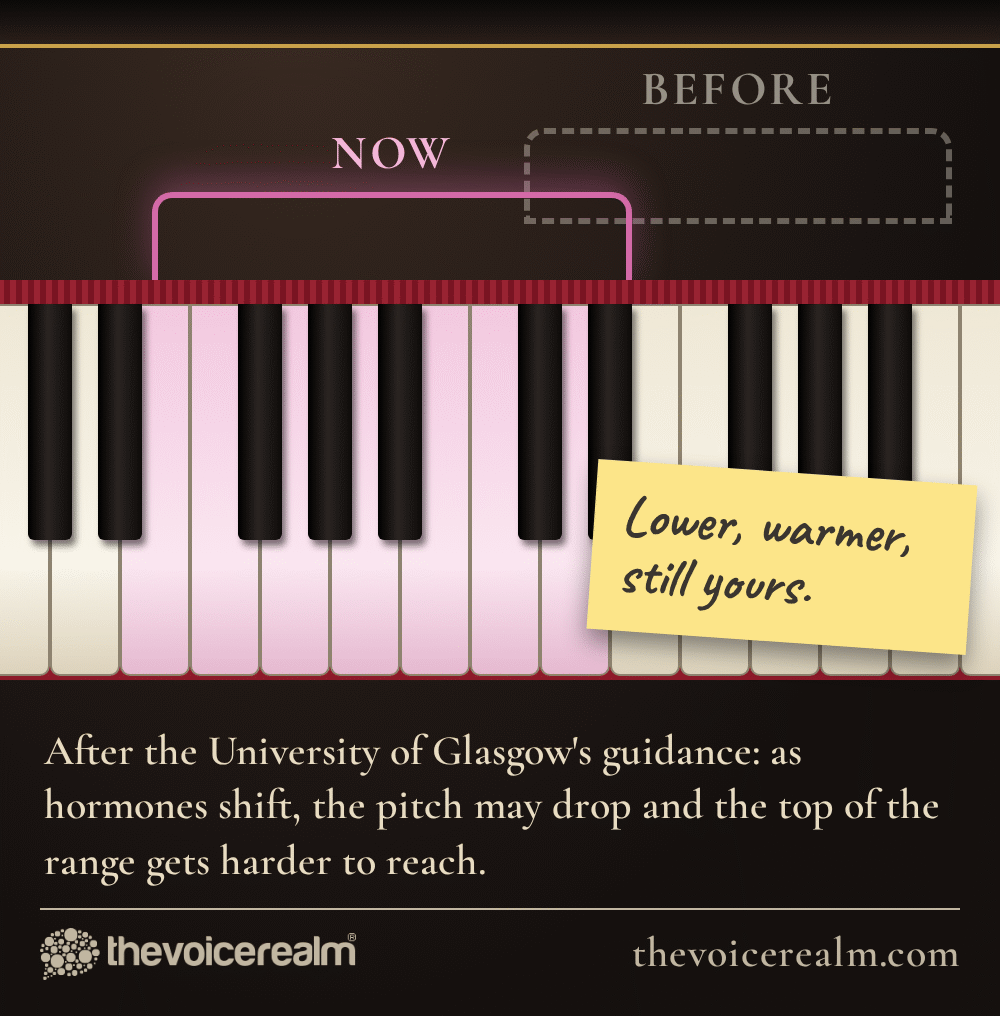
The Glasgow guidance describes the changes from the speaker’s side, which is exactly how they show up in a booth. Your voice may become “rougher, making it harder to project your voice as loudly as you have done previously.” The pitch may drop, “making it harder to access the higher range of the voice.” Stamina may go, “leaving you vocally tired after shorter periods of speaking time.” And you might get “a dry throat and experience rasping or coughing.”
Here’s how that tends to play out at the mic:
- Bright, smiley commercial reads take more effort to land than they used to.
- Your character voices that live up high, the kids and the excitable sidekicks, feel strained or thin.
- Your first hour sounds great and your fourth sounds like someone else.
- Mouth noise and throat clearing creep up in the edit.
How common is it? Hard to pin down, but the Glasgow guidance says it’s “estimated that over two-thirds of female professional voice users will notice significant change to their voice around midlife.” So if you’ve been quietly wondering whether it’s just you, it almost certainly isn’t.
“And hopefully there will be more awareness to refer patients with these symptoms to a voice specialist, rather than saying, ‘Oh, it’s normal, don’t worry.’”
Dr Yael Bensoussan, USF HealthPost this quote
A lower voice isn’t a broken voice
Before we get to fixes, it’s worth saying this out loud. A voice that’s settled a little lower and gained a bit of grain hasn’t gone wrong. It’s changed, and plenty of work wants exactly that sound.
Think about who gets cast for documentary narration, for a bank that wants to sound like it’s been around for a century, for the wise mentor in a game, for the calm voice in a guided meditation. Warm, lower and a touch textured is a sound people trust. Many actors find that the reads which got harder are balanced by new ones that suddenly come easily.
So treat it like any other change in your instrument. Spend a week recording the kinds of scripts you’d normally avoid. Listen back with fresh ears. You may find your sweet spot has simply moved, and the smart move is to follow it rather than fight to get the old one back.
That also means your demo might be out of date. If clients book you off a reel recorded ten years ago and then hear something different in the session, nobody’s happy. Our piece on knowing when it’s time for a new demo covers the signs.
© The Voice Realm
Dryness: get moisture to the folds
Of all the changes, dryness is the one you can do the most about, day to day. “The vocal folds need regular hydration,” says the Glasgow guidance, which suggests steam inhalation or a nebuliser for a dry throat.
The USF team lists the same thing among its treatments. “Steaming and hydration,” their summary says, “treats dryness of mucosal tissues through daily hydration with small amounts of water during the day, or inhaling steamed water.”
Notice the “small amounts during the day” part. Downing a litre before a session doesn’t do much for the folds themselves. Sipping steadily all day keeps your whole system topped up, and steam gets moisture onto the surface directly. A cheap handheld nebuliser with sterile saline is quick and quiet enough to use right before you record. A bowl of hot water and a towel works too.

A handheld nebuliser and sterile saline: moisture straight onto the folds. © The Voice Realm
Then look at your room. Heating, air conditioning and long flights all pull moisture out of the air you breathe. We’ve gone through humidity targets and how to keep a humidifier clean in our guide to dry air and humidifiers for voice actors.
Stamina: plan your sessions around it
If your voice tires sooner, the answer isn’t to push harder. It’s to work smarter with the energy you’ve got.
 VOICEMASTERACADEMYFirst read to first booking.Twenty modules. The first one is free.Start free
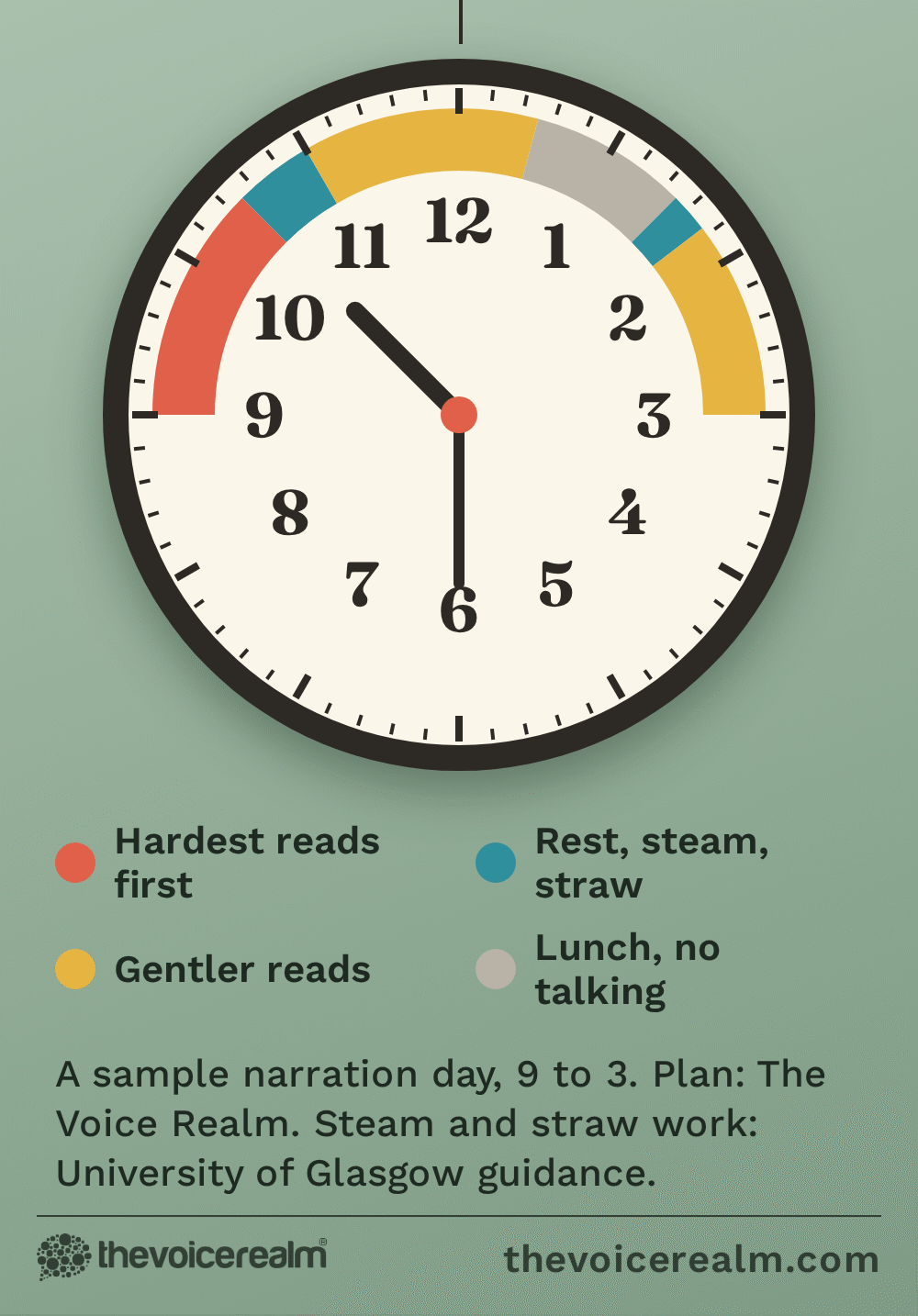
Start your day with a proper warm-up, gentle and short, rather than going straight into a full read. Straw work is one of the simplest tools there is. The Glasgow guidance recommends semi-occluded vocal tract exercises, and humming or sliding through a straw into a glass of water lets your folds vibrate easily with very little effort. We’ve written a full routine in the straw and water reset.

A glass, a straw and five minutes before the first read. © The Voice Realm
Then break the work into blocks. Two shorter sessions with a proper rest between them will almost always sound better than one long slog. Put your hardest material first, while your voice is freshest: the shouty promo, the high character, the long run of technical copy. Save the gentler reads for later in the day.
When you finish, don’t just stop and start chatting on the phone. A few minutes of easy humming and sighs helps your voice come down gently.
And talk less when you’re not working. It sounds obvious, but a loud dinner, a long phone call and a day of recording all draw from the same account. On a big narration week, protect it.
© The Voice Realm
Voice therapy, hormone therapy and the testosterone catch
If the changes are getting in the way of your work, there’s real help available, and it starts with a voice specialist. The USF summary lists several approaches.
The first is voice therapy. The summary describes it as “Overseen by a trained therapist, with the goal of a patient learning to vocalize with less effort.” For a professional, this is often the most useful single step. A speech and language therapist who works with voices can spot the little compensations you’ve started making, like pushing from the throat to get the old brightness back, and help you find the same result more easily.
The Glasgow guidance makes a similar point about coaching: “One or two sessions with a vocal coach, exploring your voice use and focusing on your specific symptoms and needs can make a world of difference.”
The second is hormone therapy. The USF summary says this “is conducted in collaboration with the laryngology team and the patient’s gynecology team.” That’s worth knowing, because a hormone plan made with your voice in mind may look a little different from one that isn’t.
Which brings us to the catch. Some menopause treatments include testosterone, and for a voice actor that’s a conversation to have before you start, not after. Dr Bensoussan put it directly: “Unfortunately, testosterone is a male hormone and one of the side effects is a ‘more masculine’ voice.” Tell whoever prescribes your treatment that your voice is your work, and ask how each option might affect it.
Another option the team describes is a procedure to plump up the vocal folds where they’ve thinned. That’s very much a specialist decision, but it’s good to know it exists.
When it isn’t just menopause
Here’s the important bit. Hoarseness, a rough voice and a dry cough can come from menopause, but they can also come from reflux, nodules, muscle tension, infection and, rarely, more serious things. Midlife is also when a lot of those turn up. So don’t diagnose yourself.
The NHS says laryngitis “usually goes away on its own after 1 to 2 weeks,” and advises seeing a GP if “your symptoms do not improve after 2 weeks” or “you keep getting laryngitis or voice problems.” For someone who talks for a living, that’s a sensible line to draw. If your voice has changed and it isn’t settling, or if it hurts to talk, see a doctor and ask about a referral to an ear, nose and throat specialist or a voice clinic.
At a voice clinic they can put a small camera in through your nose or mouth and actually watch your folds moving. It takes a few minutes and it’s the only way to know what’s really going on. Ask specifically for someone who sees professional voice users, because a hint of roughness that wouldn’t bother most patients can matter a lot to you.

At a voice clinic, a small camera lets the specialist watch your folds move. © The Voice Realm
If you’re told it’s “just your age,” it’s fine to ask for more. The USF researchers make the same point, noting that many women with vocal changes are dismissed or misdiagnosed. Tension can build up as you compensate too, which is one more reason to get it checked.
Do you tell clients?
You don’t owe anyone your medical history. What clients care about is that the voice they book is the voice they get, and that it holds up through the session.
So the practical moves are the ones we’ve covered. Make sure your demos sound like you do today. Book long jobs with breaks built in, and be honest about how many finished minutes you can do well in a day. If a job asks for something that now sits outside your comfortable range, it’s fine to pass it on and say why in a sentence: “That one wants a younger, brighter read than mine.”
Plenty of voice actors do some of their best work after fifty. Look after the instrument, follow where your voice has gone, and get help early when something doesn’t feel right.
Sources: University of Glasgow, “Guidance: Menopausal Voice Change” (Dr Kathleen Cronie); University of South Florida, “Menopause can disrupt women’s vocal tone and quality, says USF Health vocal researcher” (10 September 2025); EurekAlert, “USF study reveals how menopause impacts women’s voices, and why it matters” (10 September 2025); NHS, “Laryngitis”.
Ready to get booked?
See the jobs open right nowAbout Sarah Robbins
Sarah Robbins writes for The Voice Realm about finding voice over work, home studios, casting and the business side of voice acting.