Blog
Blog

This guide is for voice actors who’ve been offered their first medical script, or who keep seeing healthcare jobs on the boards and wonder whether they could do them. Medical narration covers a lot of ground: training modules for nurses, patient education videos, pharmaceutical explainers for doctors, and the television and radio ads that end with a long list of side effects. It’s steady, well-organised work, and it rewards a particular kind of preparation.
Below you’ll find what medical clients actually want to hear, how drug names are built and how to work out how they’re said, how to put together a pronunciation sheet before the session, and what US rules say about the side effects read in a drug ad. None of it needs a medical degree. It needs patience, a pencil and a willingness to ask.
Where medical voice over work comes from
Most medical voice over isn’t broadcast at all. It lives inside hospitals, universities and drug companies, and it’s heard by people who have to learn something from it.
The biggest slice is training. Hospitals and care providers run compliance courses, equipment walkthroughs and clinical refreshers for their staff, and medical schools use narrated modules alongside lectures. Then there’s continuing education for doctors, nurses and pharmacists, which is often built by specialist agencies for pharmaceutical clients. Patient education is another strand: the video a clinic plays before a procedure, the animation that explains how an inhaler works, the narrated app that walks someone through their first injection at home.
Pharmaceutical companies also commission mechanism of action videos, short animations that show a drug reaching its target in the body, usually for conferences and sales teams. And at the broadcast end, there are the consumer drug ads on television and radio, which carry their own legal requirements and which we’ll come back to.
If you already do corporate training work, you’re closer than you think. Our guide to breaking into e-learning narration covers the module structure, file delivery and pacing that medical courses share with every other kind of course.

© The Voice Realm
What medical copy asks of your voice
The listener in a medical piece is trying to understand and remember. A nurse doing a mandatory refresher at the end of a twelve hour shift doesn’t want to be sold to, and a patient watching a video about their new medicine may be anxious. So the read sits somewhere between a good teacher and a calm clinician: clear, warm, unhurried, and confident with every word.
That last part matters more than anything. A narrator who slows down and hesitates before a drug name is telling the listener they don’t know what it means. A narrator who says it plainly, at the same pace as the words around it, sounds like they’ve said it a hundred times. Clinicians notice a mispronounced term at once, and it undermines the whole module.
Medical copy is also dense. Sentences carry clauses about dosage, conditions and exceptions, and you can’t skip or soften any of it, because the wording has usually been through a medical and legal review. The job is to make that dense sentence sound like a person explaining it, without changing a word.
Drug names follow a system you can learn
Long drug names look frightening on the page, but most of them are built from parts, and the parts repeat. In the United States, generic drug names are adopted by the USAN Council, which assigns them using shared word endings called stems. Drugs in the same family end the same way. Beta blockers end in olol, as in metoprolol. ACE inhibitors end in pril, as in lisinopril. Monoclonal antibodies end in mab, as in adalimumab. Once you can hear the stem, a new name breaks into a familiar ending and a short front section, and that’s far less to learn.
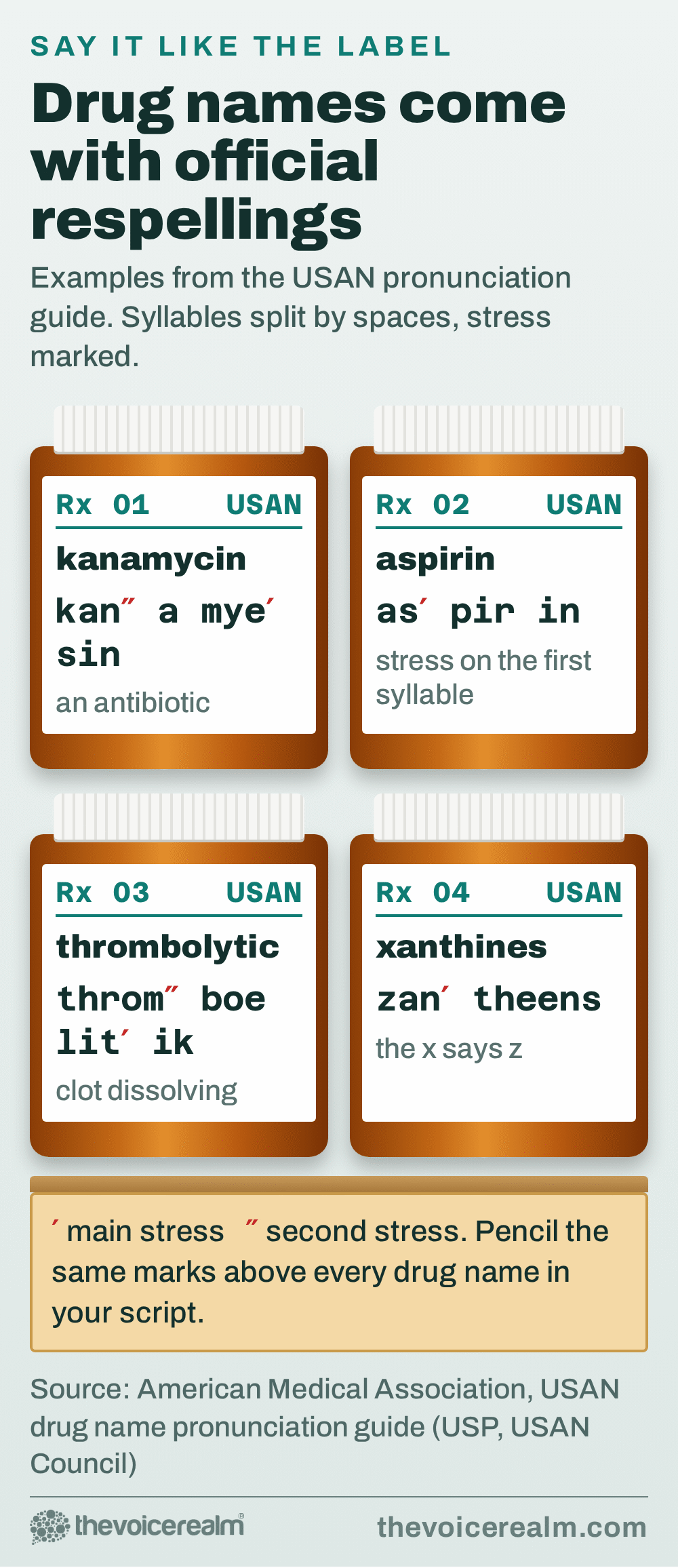
The USAN Council also publishes an official way of writing out how names are said. Its pronunciation guide, developed by USP and approved by the council, respells each name syllable by syllable and marks the stress: “A prime mark (′) follows the primary accent syllable; a double prime mark (″) follows any secondary accent syllable.” It’s the same idea as the marks you’d pencil above a tricky word in any script, just standardised.
Brand names are a different matter. A brand name is the client’s property, and the company decides how it’s said. Never guess one. The pronunciation will almost always be in the script notes, in a reference video, or in the producer’s head, so ask before the session if it isn’t written down.
Medical terms that aren’t drugs, like anatomy, conditions and procedures, have their own traps. Many have accepted variations between US and UK English, and a few have more than one acceptable form even within one country. When there’s a choice, follow the client’s audience: a course for British nurses wants British pronunciation, whatever you’d normally say.
© The Voice Realm
Build a pronunciation sheet before you record
The single best habit in medical work is to prepare the words before you prepare the read. Go through the script with a highlighter and mark every term you wouldn’t stake your fee on. Then work through the list one by one.
For generic drug names, the USAN respelling is the most authoritative source you’ll find. For brand names, check the manufacturer’s own consumer site, which often has a video or a “say it like this” line near the top, and the brand’s own ads if any are online. Pharmacist and medical school channels often have short clips saying a term aloud. For anatomy and conditions, a good medical dictionary with audio helps. When two reputable sources disagree, write both down and ask the client which they want.
Write each word on a simple sheet: the term, how it’s said in plain respelling with the stressed syllable in capitals, and where you got it. Send that sheet to the client before the session if you can. It takes ten minutes, it catches the one word where the client has a house preference, and it shows them you’re careful in a way no demo can.
On the script itself, pencil the respelling above each term so you aren’t flicking between pages mid-take. We’ve written about researching pronunciation for any script in more depth, and the same steps work here with a heavier word list.
Then say the words out loud, in their sentences, ten times each, before you record. A name you’ve read silently is still a stranger. A name you’ve said in context a dozen times sits in your mouth like any other word, and that’s what makes it sound confident on the take.
© The Voice Realm
Pharma ads and the side effects read
If you voice a television or radio ad for a prescription drug aimed at US consumers, you’ll meet the part of the script that lists the major side effects and reasons not to take the drug. US regulations call this the major statement, and they don’t leave its delivery entirely to taste.

 VoiceEditSuiteRaw take in, clean take out.Breaths, dead air and room noise, gone.Show me
Federal rules require broadcast drug ads to include “information relating to the major side effects and contraindications (‘major statement’) of the advertised drugs in the audio or audio and visual parts of the presentation.” Since a rule from the Food and Drug Administration that took effect in 2024, with compliance required from November 2024, that statement has to be presented “in a clear, conspicuous, and neutral manner” in consumer ads on television and radio.
- Plain language. The regulation says it must be “presented in consumer-friendly language and terminology that is readily understandable.”
- Your read. Its audio, “in terms of the volume, articulation, and pacing used,” must be “at least as understandable as the audio information presented in the rest of the advertisement.”
- Words on screen too. On television, the same information appears as text at the same time as your audio.
- Readable text. Font, size, contrast and placement have to let viewers read it easily.
- No distractions. Nothing in the sound or picture is allowed to get in the way of understanding it.
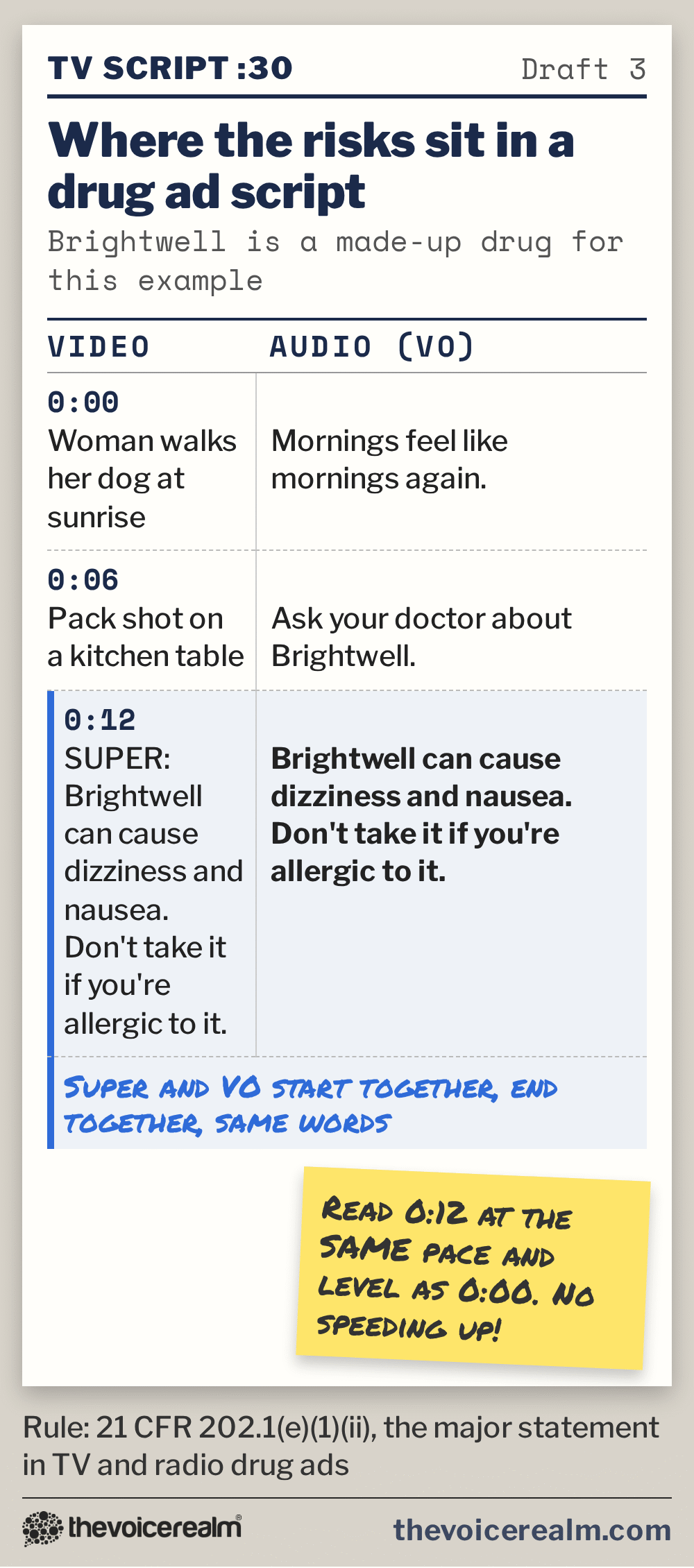
The second test is the one that lands on the voice actor. The side effects can’t be the bit you rush, mumble or drop in volume. Whatever pace, clarity and level you give the happy opening of the ad, you give the risks too.
The rules apply to the advertiser, not to you, and the client’s legal and regulatory team will make the final call on every take. But knowing what they’re listening for makes you the actor who gets it right first time, and in pharmaceutical work that’s a big part of why clients book the same voice again.
© The Voice Realm
Recording the major statement so it’s understood
The side effects section is usually the hardest part of a drug ad to read well. It’s long, it’s packed with conditions, and the instinct is to speed up and get through it. Resist that. Read it at the pace of the rest of the ad, and treat each item as a separate thought the listener needs to catch.
Neutral doesn’t mean flat. A cold, clipped read of the risks sounds alarming, and an overly cheerful one sounds like you’re hiding something. Aim for the tone of a pharmacist explaining what to watch for: calm, direct and on the listener’s side. Keep your energy level with the rest of the spot so there’s no audible switch into “legal mode”.
On television, remember that your words will match on-screen text, so the wording has to be exact. If a line is awkward to say, flag it, but don’t fix it yourself. A single changed word can send the whole ad back through review.
Timing helps too. If the spot is tight, the place to find time is in the producer’s edit or the copy, never in a faster major statement. Our guide to working out script length and words per minute will help you show the client early, and politely, when a script simply won’t fit its slot at an understandable pace.
© The Voice Realm
Pace, tone and the person on the other end
Outside of ads, medical narration gives you more room, and the same principle runs through all of it: the listener is trying to learn. Leave a little more space than you would in commercial work after a new term, a number or a dose. That beat is where understanding happens.
Stress the word that carries the meaning, which in medical copy is often a small one. “Do not take this medicine with alcohol” lives or dies on “not”. “Take it twice a day” is about “twice”. A quick pass with a pencil, underlining the word each sentence hangs on, saves takes.
Match the warmth to the audience. A module for surgeons can be brisk and peer to peer. A video for parents of a child starting treatment needs more care in every line. Many clients will tell you who’s listening. If they don’t, ask, because it changes the read more than any other note.
And keep your mouth sounds under control. Dense, quiet copy shows up every click and lip smack, and medical clients often play their modules through laptop speakers in silent rooms. Water, a green apple slice before the session, and a gentle de-click pass in the edit go a long way.
Getting your first medical jobs
You don’t need a medical background to do this work, though if you have one, say so: former nurses, pharmacists and paramedics bring a fluency clients value. What you do need is a short sample that proves you can handle the words. Record sixty seconds of training style copy with three or four real generic drug names and a couple of anatomy terms, said cleanly and without slowing down. Add a short patient education piece with a warmer read. That pair tells a medical producer more than any commercial reel.
When you audition, check every term before you hit record, even under time pressure. A casting for a pharma client is often screened by someone who’ll stop listening at the first wrong stress. Then keep an eye on the voice over jobs board for healthcare, e-learning and corporate training castings, because medical work often hides under those labels.
The narrators who do well in this field aren’t the ones with the most impressive voices. They’re the ones who arrive with a pronunciation sheet, read the risks as clearly as the benefits and treat every listener like someone who needs to understand. That’s a skill anyone can build.
Sources: “21 CFR Part 202, Prescription Drug Advertising”, Electronic Code of Federal Regulations; US Food and Drug Administration, “Direct-to-Consumer Prescription Drug Advertisements: Presentation of the Major Statement in a Clear, Conspicuous, and Neutral Manner in Advertisements in Television and Radio Format”, Federal Register, 21 November 2023; American Medical Association, “USAN drug name pronunciation guide”.
Ready to get booked?
See the jobs open right nowAbout Sarah Robbins
Sarah Robbins writes for The Voice Realm about finding voice over work, home studios, casting and the business side of voice acting.