Blog
Every voiceover artist who has ever been asked to read a radio script “with a bit more feeling” has wondered whether anyone can actually measure the difference. This week, the advertising industry put some numbers on it.
A new study from the Institute of Practitioners in Advertising and Bauer Media looked back over hundreds of award-entered campaigns and found that ads using audio, outdoor posters and print together reported stronger results than those that used none of them. It also found that emotional creative did especially well in those channels. Here’s our read on what it says, what it doesn’t say, and what British voiceover artists can do with it.
What the study looked at
The report is called Winning The Great Brand Race. RadioToday’s Roy Martin reported on 3 November that it analysed 569 campaigns from the IPA Effectiveness Databank, running from 2010 to 2024. That databank is made of campaigns that brands and agencies entered for the IPA’s effectiveness awards, so these are ads with a track record and paperwork to back it up.
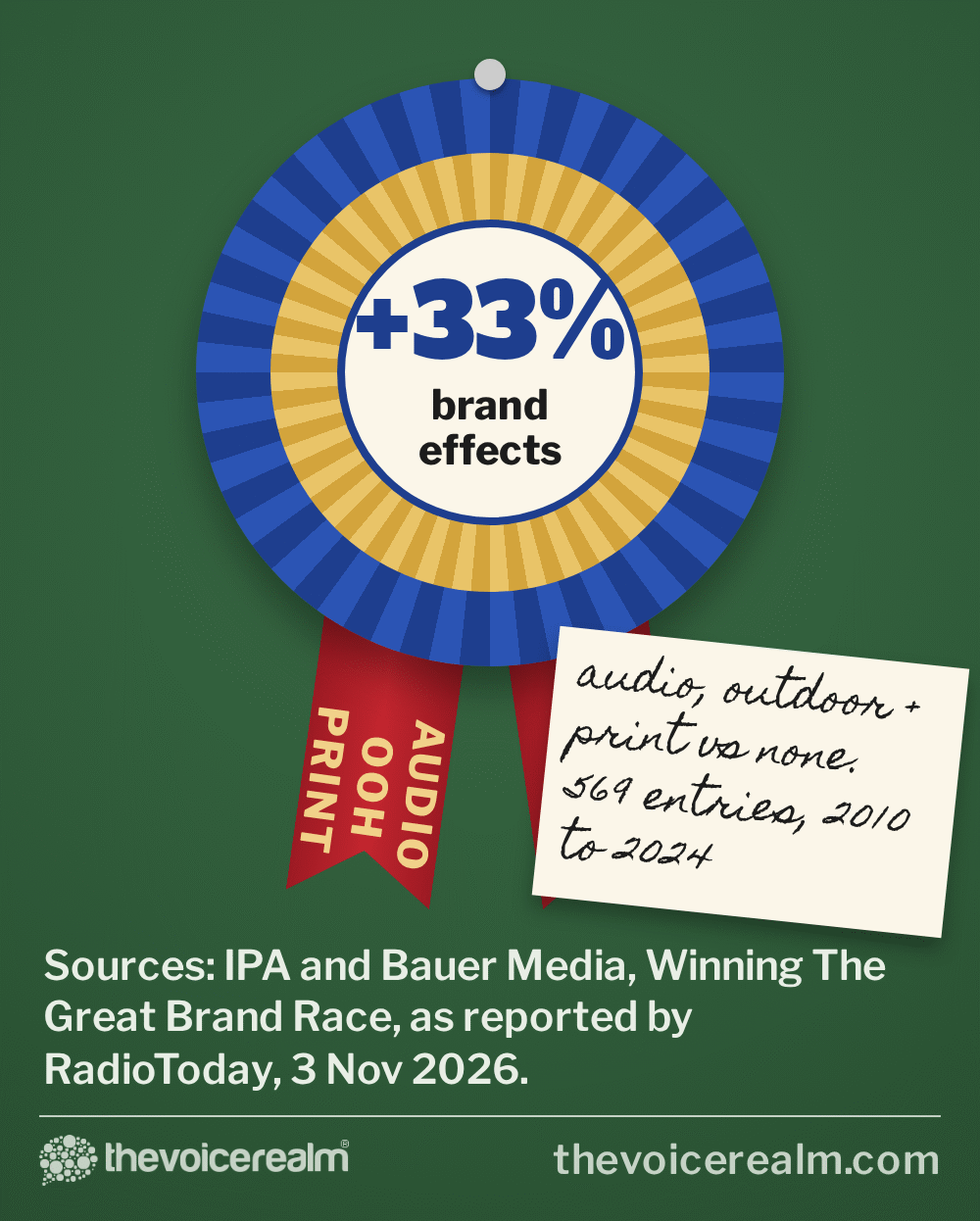
The study split them into campaigns that used audio, out of home and publishing together, and campaigns that used none of those three. The combined group reported 33% more brand effects and 8% more business effects, a category that covers sales, profit, market share and new customers. RadioToday also reported that 45% of the combined campaigns saw large or very large activation effects, compared with 15% of those that skipped all three channels.
Simon Kilby, UK managing director of Bauer Media Advertising, picked out trust as the headline: “The finding that campaigns combining all three channels are 69% more likely to deliver very large gains in brand trust…” Richard Bon, who runs Bauer Media Outdoor in the UK, put it more simply. “Audio, outdoor and publishing each bring distinct strengths,” he said.

© The Voice Realm
The line that matters for voices
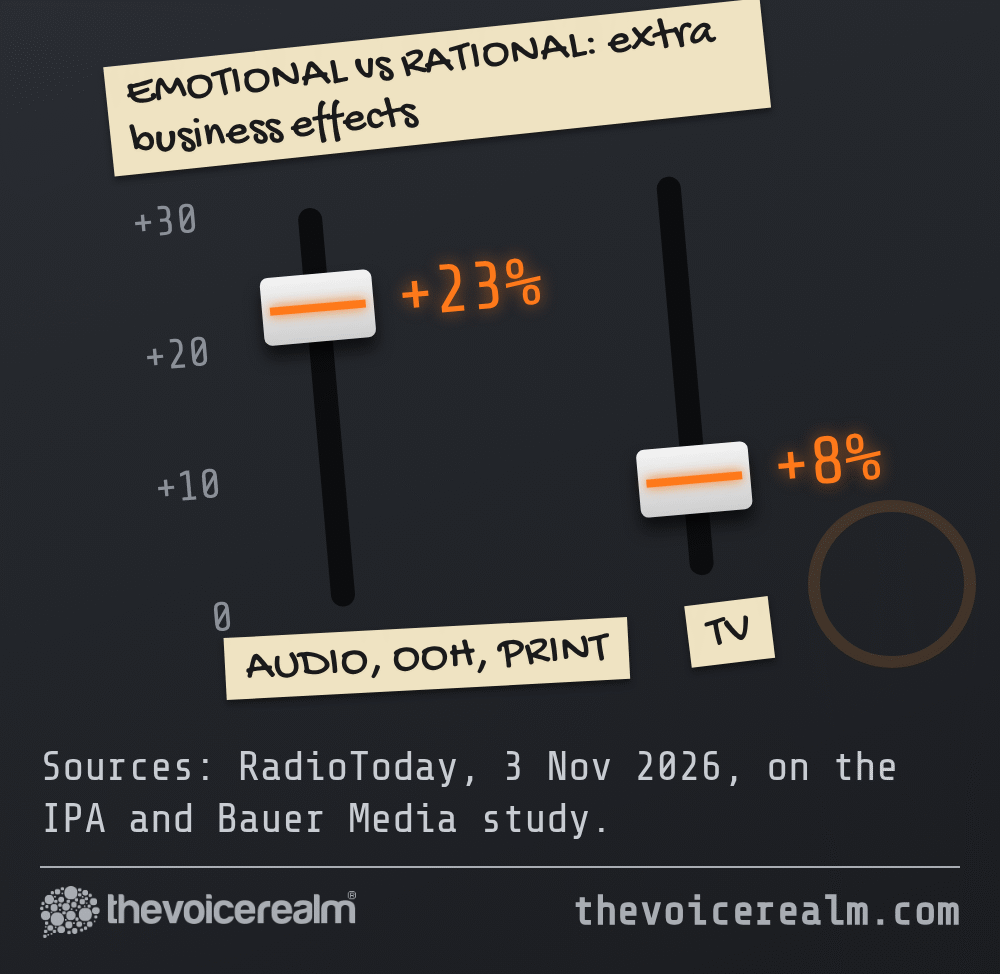
For anyone who earns a living behind a microphone, the most interesting part isn’t the channel mix. It’s the creative. According to RadioToday, within audio, outdoor and publishing campaigns, emotional advertising reported 23% more business effects than rational advertising. On television, the same gap was 8%.
Bauer’s own summary of the report says emotionally led creative “delivered more business effects when audio, OOH and publishing ran together.” It doesn’t break that down by voice, music or script, and we won’t pretend it does. But think about what an emotional radio ad is made of. There are no pictures. There’s a script, some music, maybe a sound effect, and a human voice carrying the feeling from start to finish.
That makes the voice the main delivery system for the emotion in audio. On TV, a smile, a face or a beautiful shot can do the heavy lifting. On radio, on a podcast ad or in a smart speaker spot, it’s mostly you.
© The Voice Realm
A fair word of caution
Before anyone prints this on a mug, it’s worth being clear about what kind of evidence this is. RadioToday notes that the report describes associations between media choices and results. It doesn’t prove that adding radio and posters caused the gains. Campaigns good enough to be entered for effectiveness awards may also simply be better planned, better funded or better written.
Bauer, of course, sells radio, outdoor and magazine advertising, so it has a stake in the answer. The IPA’s involvement and the size of the databank give the work weight, but a sensible reader takes it as strong support for something people in audio have long believed, not as the final word.
None of that changes the practical lesson for voiceover artists. Clients will read this study. Media planners will quote it in pitches this winter. If it nudges a few more brands towards radio and towards warmer, more human creative, the voice is where that money lands.

© The Voice Realm
What “emotional” actually sounds like
“Emotional” gets misread in the booth all the time. Producers rarely mean big, tearful or dramatic. Most of the time they mean the listener should feel something specific: reassured, amused, a bit nostalgic, quietly proud, curious. The best emotional reads are often the smallest.
 VOICEMASTERACADEMYLearn the craft in order.Module one is freeStart module oneTwenty modules, start to finish.
A few things help. Decide on the one feeling the ad is selling before you read a word. Picture one listener, not a crowd. Let the warmth live in the vowels and the pace rather than in pushed volume. And don’t underestimate the smile. We’ve written before about the smile you can hear in a read, and it’s one of the cheapest emotional tools you have.
- Name the feeling. Write one word at the top of the script before you start: relief, pride, mischief. Read to that word.
- Give them a choice. Send a warmer take and a lighter take of the key line. Planners now have research telling them feeling matters, so offer them some.
- Protect the end line. The brand line has to keep the mood the script built. Don’t switch into announcer mode for the last five seconds.
- Keep it quiet. Emotion on radio usually means closer, slower and softer, not louder.
It’s also worth remembering that the study’s winning mix includes posters and print. A radio campaign that runs alongside a billboard on the high street often borrows its line and its tone. Ask the client whether there’s outdoor artwork, and look at it before the session. If the poster is playful, your read probably should be too.
© The Voice Realm
One line, two ways
It helps to hear the difference in your head. Imagine a local bakery’s radio ad that ends on the line “Fresh bread, every morning, from six.” Read rationally, it’s information: a product, a frequency, an opening time. You’d hit “fresh”, hit “six”, and move on.
Now read it to one person. Someone who walks past on the school run, smells the ovens and has never quite gone in. The words don’t change, but the job does. “Fresh bread” gets a little more air. “Every morning” becomes a small promise. “From six” sounds like an invitation, not a timetable. It’s still a thirty second commercial with an opening time in it. It just lands as a feeling first and a fact second.
The script is the same in both versions, and so is the fee. The only difference is what the listener remembers afterwards, and on radio, where there’s no shop front on screen to help, that memory is most of what the client is paying for. Try it with any script on your desk this week. Record the line both ways, play them back an hour later, and notice which one you believe.
If you’re working from home, the room matters here too. Small, close, emotional reads expose every bit of echo and hum, because you’re pulling back on volume and leaning into detail. A clean, quiet booth is what lets a soft read sound intimate rather than thin.
Where this could show up in your inbox
Research like this tends to travel. Media agencies use it in planning decks, radio sales teams use it in pitches, and brand managers use it to justify a budget line. Over the next few months, that could mean more brands testing radio for the first time, regional campaigns that pair local radio with local posters, and more requests for reads that sound like a real person rather than a sales pitch.
Regional work is the part we’d watch most closely. A building society running posters across Greater Manchester and ads on local radio will often want a voice the area recognises as its own. Plenty of brands in the north west already look for a voiceover artist from Manchester for exactly that reason, and the same is true of Glasgow, Birmingham and Cardiff. Local warmth is emotional creative too.
If you’re newer to this kind of work, now is a good time to learn the shape of a commercial read. Our guide to breaking into commercial work walks through the basics, and it’s worth keeping an eye on voiceover jobs online for radio and audio briefs as planners start acting on what they’ve read.
© The Voice Realm
For the brands listening
If you’re a marketer weighing up where to put next year’s money, here’s our honest view. The study gives you a reason to look at audio and outdoor together. It doesn’t tell you to make the cheapest radio ad you can and hope the channel does the work. The emotional advantage it describes comes from creative, and in audio a large part of that creative is the voice.
So cast it properly. Ask for custom auditions on your actual script rather than choosing from a reel. Brief the voice on the feeling you want, not only the words. Send the poster artwork if there is one. And budget for it like you mean it. Published UK voiceover rates make it easy to see what a regional or national radio read costs before you commit, so there’s no reason to guess.
One more thing: give the voice time. Emotional reads take a few passes to find. A session booked with enough room for three or four different takes will almost always produce something better than one rushed read at the end of the day.
Our take
We like this study, with the usual caveats about who paid for it and what associations can and can’t prove. It lines up with something every good radio producer already knows. When there’s nothing to look at, the listener believes what they feel, and what they feel comes mostly through the voice.
For British voiceover artists, the takeaway is practical. Brands are about to be told, with fresh numbers, that feeling sells in audio. Be the voice that can deliver it in thirty seconds without overdoing it. Warm, specific, close and believable, from the first word to the brand line.
The ads you feel do better. On radio, that starts with you.
Sources: RadioToday, “Bauer study links audio campaigns with stronger results” (3 November 2026); Bauer Media Outdoor, “Media Mix Effectiveness: Winning the Great Brand Race”.
Ready to get booked?
See the jobs open right nowAbout Sarah Robbins
Sarah Robbins writes for The Voice Realm about finding voice over work, home studios, casting and the business side of voice acting.