Blog

Ask working voice actors what training helped them most, and a surprising number won’t name a voice class at all. They’ll say improv. The kind with folding chairs, a handful of strangers and a teacher shouting “scene!” before anyone feels ready.
This piece is for anyone building a voice career, especially if you’re early on and wondering where to spend your training money. It covers why improv matters for voice work, where it turns up in real sessions, what the research says about the nerves side of it, how to pick a class that’s worth paying for, and a few things you can practice alone in your booth this week.
A script can’t cover everything that happens in a session
Dee Bradley Baker, the voice behind a long list of animated creatures and characters, has spent years writing free advice for newcomers on his site, I Want To Be A Voice Actor. He doesn’t hedge on this one: “Strong improv skills are particularly important to a good voice actor, or any actor, really.”
His reasoning is practical. For animation, games and ADR, he writes, “the ability to invent and add material on the fly, to recover from flubs as well as the ability to make others laugh are essential skills.” That’s the stuff that never appears on the page but always appears in the room.
Think about what a script actually is. It’s a set of words someone else chose. It doesn’t tell you how your character breathes before a line, what they mutter when they trip, or what they’d say if the director asks for “one more, but you’ve just been told a secret.” Improv is how you fill those gaps with something alive instead of something polite.
It also changes how you read the scripted lines. Actors who’ve done a lot of improv tend to listen harder, commit faster and stop protecting a “right” way to say things. That’s exactly what a director wants to hear in a booth.

© The Voice Realm
Where improv actually turns up in voice work
Animation sessions run on it. Directors often ask for an ad-lib at the end of a line, a reaction under someone else’s dialogue, or a few alternate takes where you change the wording to suit the character. The best of those end up in the show.
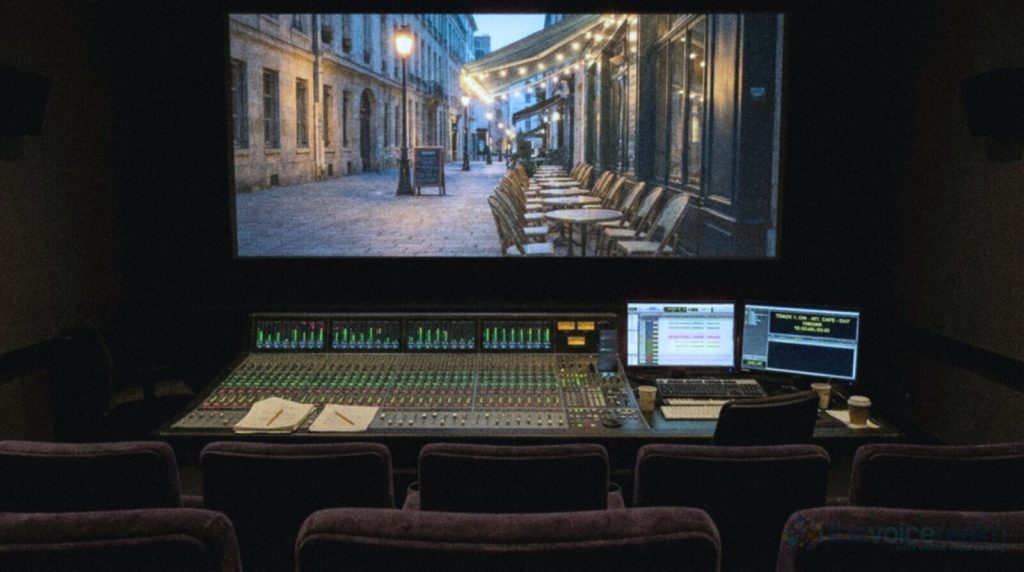
Games need it too. A character might need dozens of short reactions, battle cries and idle mutters that nobody wrote out in full, and our guide to what game voice work really asks of you goes into how long those sessions can run. Crowd work is pure improvisation: loop groups invent the chatter of a whole restaurant or battlefield on the spot, and the art of playing the crowd is a skill in its own right.
Commercials use it in a quieter way. A producer might say “that’s great, now give me a version where you’re telling a friend,” or ask you to add a natural word at the start to make a line feel less read. You’re not rewriting the copy. You’re finding the person who’d say it, and improv is where you practice finding people fast.
Even a straight corporate session can turn on it. When a line doesn’t work and the writer isn’t on the call, the actor who can calmly offer two natural alternatives becomes the actor they book again.

© The Voice Realm
It’s about listening, not being funny
A lot of people avoid improv because they think it’s stand-up without a script. It isn’t. Baker describes it as “collaborative, spontaneous, unscripted team storytelling,” and he’s firm that laughs aren’t the goal. “You’re not trying to be funny,” he writes. “You’re trying to help your team tell a good story.”
The famous rule is “yes, and”: accept what your partner offers, then add something. In a voice session, your “partner” is often the director, the other actor on the line, or the script itself. Accept what’s there, build on it, and don’t fight it.
The guarded take
You decide how the line goes before you open your mouth, then defend that choice. Direction feels like correction. Every take sounds like the last one.
The open take
You know who you are and who you’re talking to, then let the moment decide the shape. Direction feels like a new offer. Each take has something different in it.
That second actor isn’t more talented. They’ve just practiced being comfortable without a plan, and improv is the gym for exactly that. Our guide to taking direction well in a live session picks up the same idea from the director’s side.
What the research says about the nerves
Plenty of people come to voice work partly because they’d rather not be seen. If the idea of improvising in front of a room makes your stomach drop, there’s some encouraging science here.
© The Voice Realm
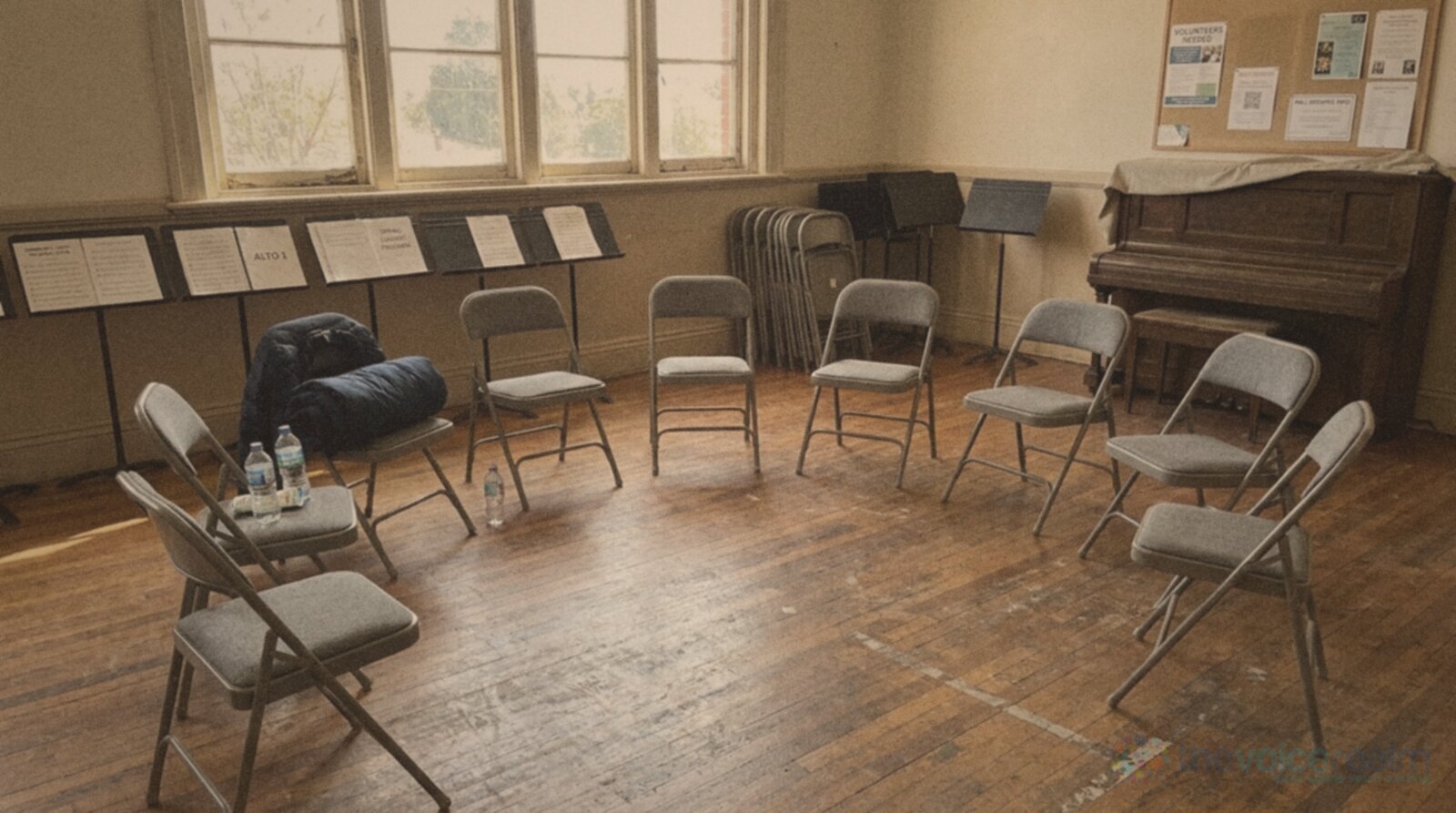
Peter Felsman, an assistant professor of social work at Northern Michigan University, led a study with colleagues at the University of Michigan that followed 350 students in grades 8 to 12 from low-income Detroit neighborhoods through ten weekly improv sessions run in their classes. The students filled in surveys before and after, measuring their discomfort with uncertainty and their social anxiety. According to the university’s report on the work, published in the journal The Arts in Psychotherapy, both “decreased substantially” by the end of the program.
 VoiceEditSuiteMarked-up scripts, ready to record.Drop in the script and the casting brief. Audition Director marks the emphasis, breaths and pauses, and gives you three ways to read it.See how it worksYour recordings are never used to train AI.
Felsman’s explanation is the part that matters for actors: “Uncertainty can’t be totally eliminated from our lives, but dealing with it more effectively by embracing the unknown, confronting fears and creating new associations with feared situations can have a positive impact.”
He’s careful not to oversell it. “Like all interventions, improv doesn’t immediately work for everyone, and some people benefit more than others,” he said. And these were teenagers in school, not voice actors. Still, an audition is a small dose of uncertainty you choose to step into, over and over. If your nerves get in the way, working with audition nerves instead of against them pairs well with a few months of improv.
© The Voice Realm
Choosing a class that’s worth the money
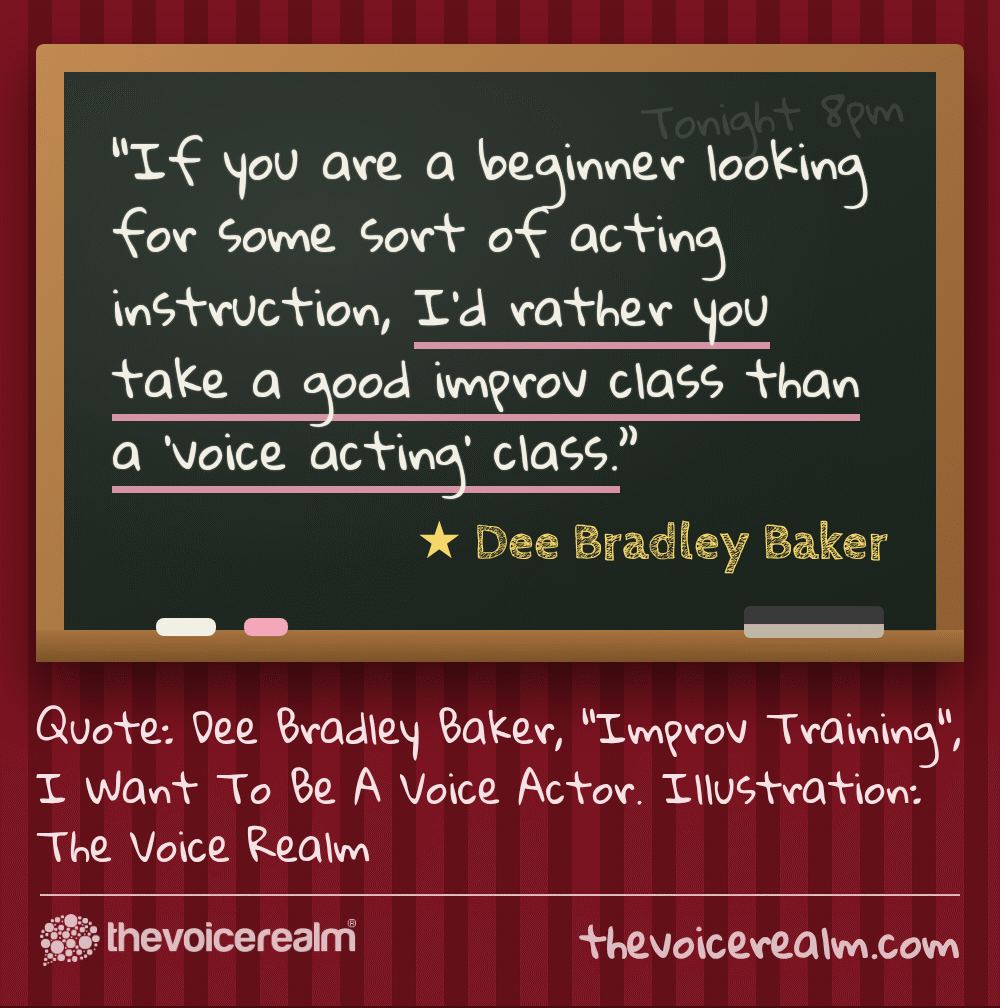
Most cities have something, from community troupes to big-name theaters with long course ladders. Quality varies a lot, and so does value. Baker warns readers to make sure a program is “not just an endless ‘comedy mill’ money-pit or a mediocre program.”
His test is simple: “Check their results: Ask around, audit classes and see their shows.” If the shows are fun and the performers listen to each other, the teaching is probably good. If the shows are a parade of people doing their best bits, keep looking.
A few other things to look for. Small classes, so you’re on your feet more than you’re watching. Teachers who still perform. A chance to play in front of a real audience at the end, because a room full of strangers teaches you more in one night than a month of exercises. And a group that feels kind, because you’ll only take risks where you feel safe to fail.
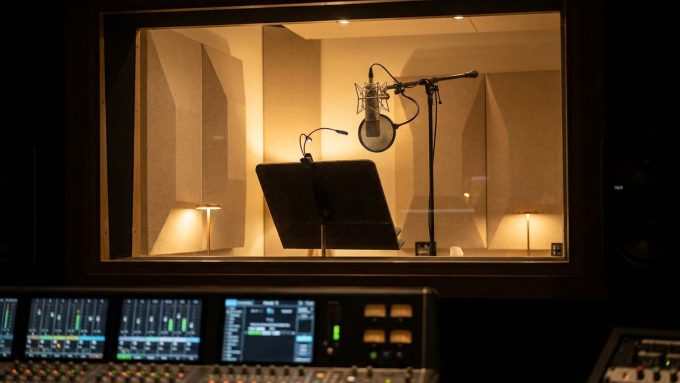
Improv isn’t a replacement for learning the craft of the mic. If you’re starting from scratch and want structured voice training alongside it, Voice Master Academy covers the studio side while your improv class works on the instincts.

© The Voice Realm
Improv you can practice alone in the booth
A class is best, because improv is a team sport. But you can build some of the muscles on your own, and a few minutes a day makes a difference.
Draw a prompt and go. Make your own stack of cards and add a new one whenever an odd idea strikes you; the strange ones are the best. Record every run, and don’t stop to fix anything.
Three ways, no thinking. Take a single line from any script and record three quick versions with a different reason behind each: a secret, a deadline, a crush. Then three more where you change the first word. That’s exactly the kind of alternate a director asks for.
Fill the gaps. Read a scene and improvise what your character says in the ten seconds before the first line and after the last one. It forces you to know who they are, and your scripted read gets more specific straight away.
Narrate the room. Describe what’s in front of you as a nature documentary host, then as a nervous real estate agent, then as a villain. It’s silly, and that’s the point: you’re training yourself to commit before you feel ready.
Listen back once a week, not every day. You’re looking for moments that surprised you, because that’s what improv sounds like when it’s working.
Bringing it back to the script
One word of caution. Improv skills are for when they’re wanted. On a medical narration, a legal tag or a carefully approved brand script, the words are the words, and an unasked-for ad-lib can cost a client a round of approvals. Read it as written first, every time.
Then, if the session has room, offer something. “Want one where I play with it a bit?” is a lovely question for a director to hear, and most will say yes. That’s where your improv training pays off: not in showing off, but in having a second idea ready when the first one isn’t quite it.
Baker sums up his own view on another page of his site: “Learning good improv instincts may be the most useful training you’ll ever get as an actor and voice artist.” Find a class, get on your feet, and see what happens when you stop planning every line.
Sources: Dee Bradley Baker, I Want To Be A Voice Actor, “Improv Training” and “Start doing improv!”; Northern Michigan University, “Improv Training Can Ease Social Anxiety”, 7 July 2023, on Felsman and colleagues in The Arts in Psychotherapy.
Ready to get booked?
See the jobs open right nowAbout Sarah Robbins
Sarah Robbins writes for The Voice Realm about finding voice over work, home studios, casting and the business side of voice acting.