Blog

One narrator, a dozen people. That’s the job in most fiction audiobooks: you’re the storyteller, the hero, the villain, the hero’s grandmother and the barman who gets one line in chapter nine. This guide is for narrators, new and experienced, who want their characters to be clear without turning the book into a cartoon. We’ll cover how much difference a character voice really needs, how to build a cast list before you record, the handful of things you can change to separate one voice from another, how to voice the opposite sex without a falsetto or a growl, and how to keep everyone sounding the same from chapter one to the last page.
Listeners need a hint, not a costume
The most common mistake isn’t too little difference between characters. It’s too much. A narrator who gives every character a big, separate “voice” wears the listener out, and wears their own voice out too, long before the book is done.
ACX, Audible’s audiobook production platform, puts it simply in its advice to authors choosing a narrator: “When in doubt, understated is best. Narration that hints at a new character speaking is better than a jarring change in tone.” Its post plays the same passage two ways, recorded by narrator Victor Bevine, and describes the better one as a read where the narrator “subtly hints at a change in tone, trusting the reader to pick up on the change in character.”
That last phrase is the whole craft. The author has already told the listener a lot: who’s in the room, who’s angry, who just walked in. Your job is to make each speaker easy to follow, not to perform them as if the words weren’t there. If you’ve worked in animation, this is a different muscle from the one in our guide to building a character voice from the person outward. The person still comes first. The sound is just smaller.

© The Voice Realm
Build a cast list before you record a word
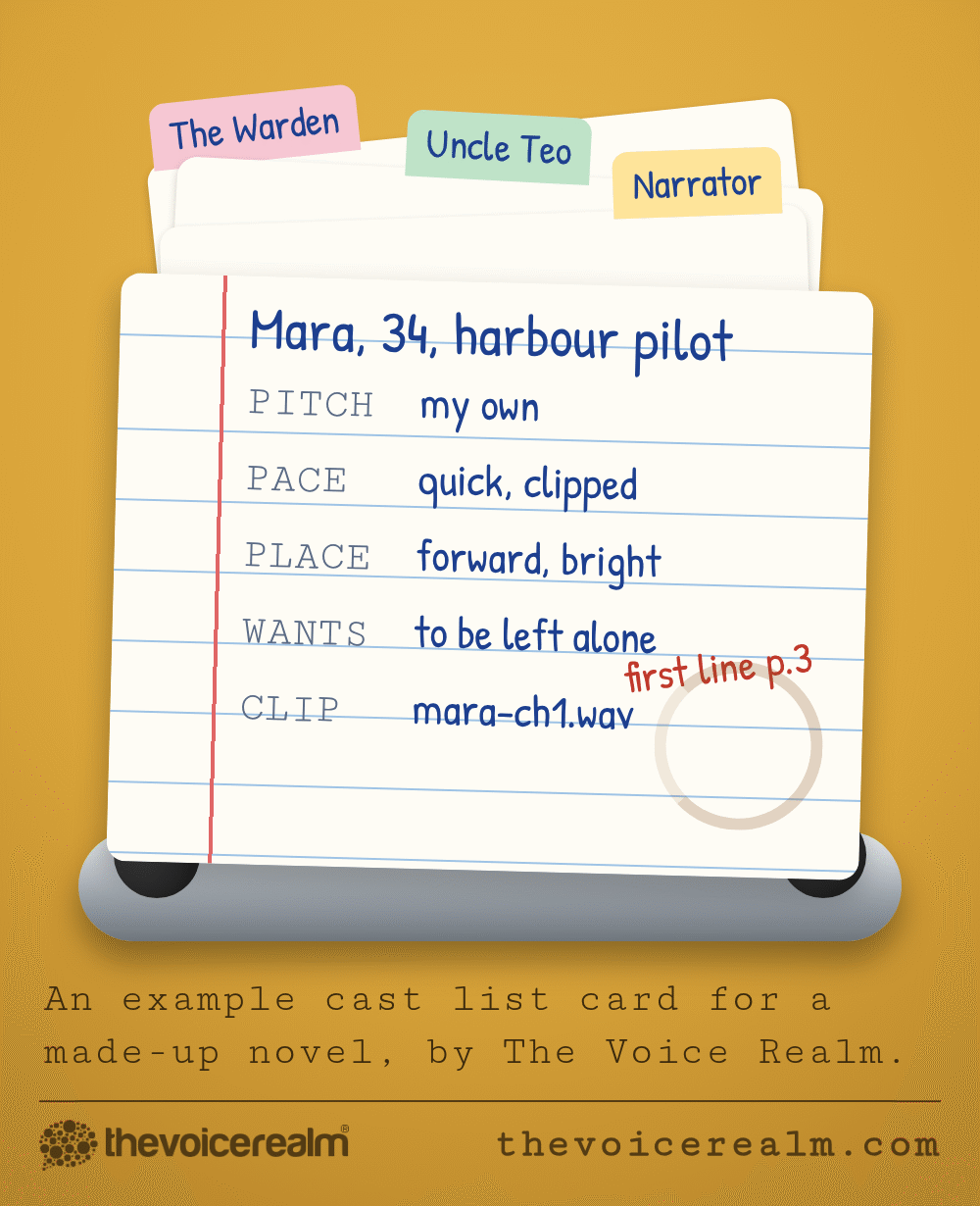
Experienced narrators prep the whole book before the first take, and the most useful thing to come out of that prep is a cast list. ACX’s “Director’s Notes” template asks authors for exactly this: “make a list or chart of significant characters with names and accent notes, and offer character notes for each.” If the author sends one, brilliant. If not, make your own as you read.
For each character with more than a line or two, note the basics the text gives you: age, where they’re from, how they talk about themselves and how others describe them. Then add your choices: how high or low they sit compared with your own voice, how fast they talk, where the sound lives, and one word for their attitude. Note the page where they first speak, because that’s the line you’ll come back to.
Read ahead for surprises. Nothing hurts like giving a minor character a thick accent in chapter two and finding out in chapter twenty that the author describes them as “softly spoken.” The author knows things the listener doesn’t yet, and a good cast list does too.
Names and places go on the list as well. A made-up fantasy city or a surname with three possible readings needs one settled pronunciation before you start, not halfway through.
© The Voice Realm
Four dials that separate one voice from another
You don’t need a new voice for every character. You need a small, repeatable change, and there are only a handful of things to change.
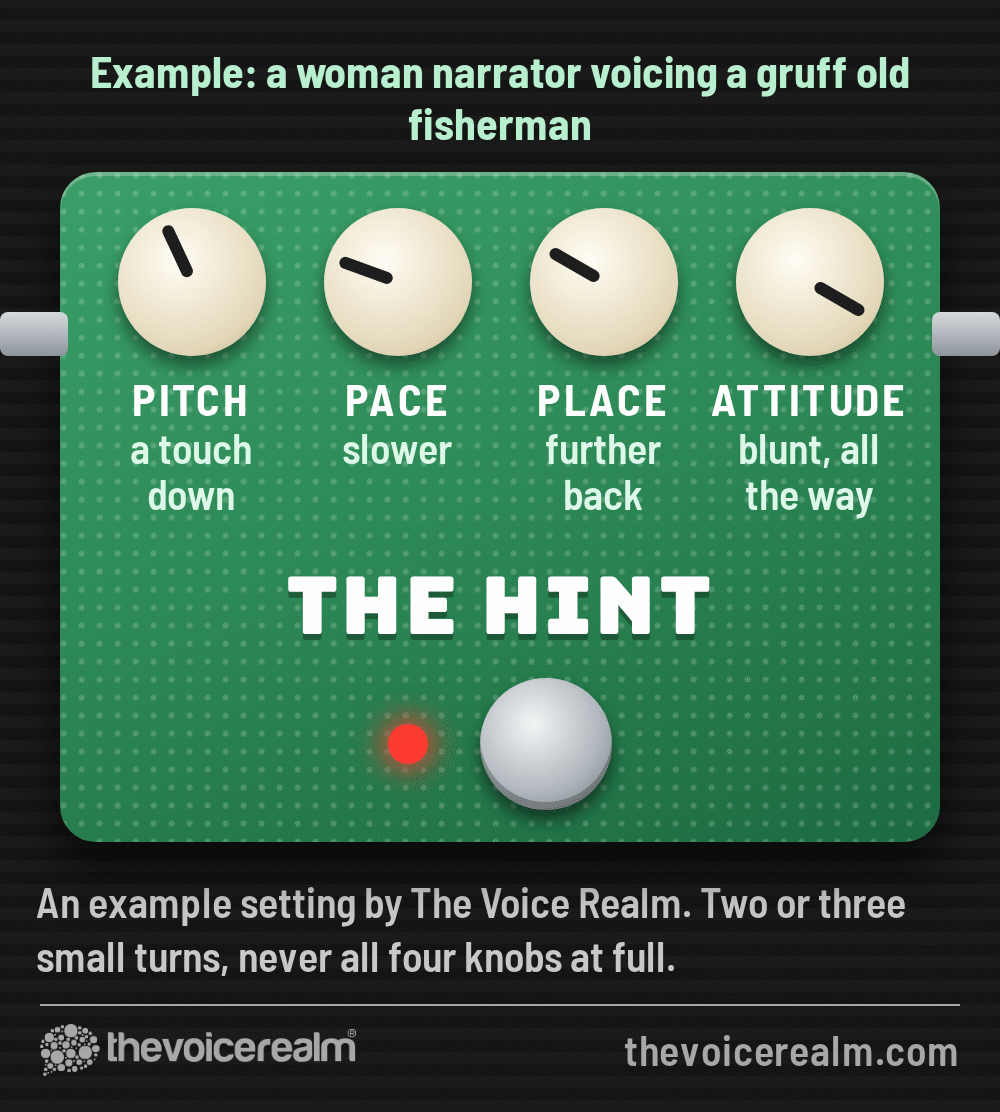
Pitch. Where the voice sits, higher or lower than your own. This is the dial people reach for first and the one that’s easiest to overdo. A few notes is plenty. Push it far and you’ll strain, and the character will sound like a joke.
Pace and rhythm. How fast someone talks, where they pause, whether they rush to the end of a sentence or take their time. A nervous teenager and a retired judge can sit at the same pitch and still sound nothing alike.
Placement. Where the sound seems to come from: forward in the mouth and bright, back in the throat and dark, a little through the nose, warm in the chest. Small shifts here are very recognisable and very easy on the voice.
Attitude. What the character wants from the person they’re talking to. Someone who always needs to win the argument hits the ends of their lines. Someone who’s always apologising lets them fall away. Attitude often does more to separate two characters than any change in sound.
Pick two dials per character, not all four, and turn them gently. Then you can find each voice again on a bad day, when you’ve had a cold, or six weeks later for pickups.
Voicing the opposite sex without the falsetto or the growl
This is the question narrators ask most, and it’s where listeners are least forgiving. Book Riot’s Jessica Tripler, writing about romance on audio, describes the problem from the listener’s chair: “sometimes narrators go overboard: men using a high or breathy voice for women characters, women adopting a monotone mumble or angry growl for male characters.”
The fix is the same in both directions. Don’t try to sound like a different body. Change the rhythm, the placement and the attitude, and move the pitch only a little.
The costume
A man’s voice pushed up into falsetto and made breathy, or a woman’s voice pushed down into a growl. It’s tiring to hold, it turns the character into a type, and it pulls the listener out of the scene every time they speak.
The hint
A few notes up or down from your own voice, then the rest done with rhythm, placement and attitude: how directly they speak, how much melody they use, how they finish a line. The listener hears a person, not an impression of one.
If you’re a woman voicing a man, try slowing down, using a narrower range of pitch and letting the voice sit a touch lower and further back, without pressing down on it. If you’re a man voicing a woman, try a lighter, more forward placement, a little more movement in the melody and a slightly quicker rhythm, without pushing into falsetto. In both cases, play the character’s intentions first. A tough, impatient woman shouldn’t sound sweet just because she’s a woman, and a gentle man shouldn’t sound gruff just because he’s a man.
Children and older characters work the same way. Children often speak with more energy and less control of rhythm than adults, and older characters with more weight and space, but neither needs a squeaky voice or a crackling one.

© The Voice Realm
Keeping a voice the same for ten hours
A book is recorded over days or weeks, and your voice changes through that time. It’s lower in the morning, tired by late afternoon, different after a weekend off. Characters drift with it, and listeners notice when the villain in chapter thirty sounds younger than he did in chapter three.

 VoiceEditSuiteNewYour breath. Your pace. Your edit.Learns from numbers, never your audio. Never used to train AI.See how it works
The simplest fix is a reference clip. When a character first speaks, save a short clip of their best line in a folder with their name on it. Before you record a scene they’re in, listen back to the clip and match it. It takes seconds and saves hours of pickups.
Your cast list helps too, if you’ve written your choices down in plain words: “low, slow, back in the throat, never raises his voice.” Notes like those will get you back to a voice even when your memory of the sound has faded.
Pace yourself across the day as well. Characters that sit far from your natural voice are tiring, so record their heavy scenes when you’re fresh, and take proper breaks. Our guide to working as an audiobook narrator covers how real recording days are paced.
© The Voice Realm
Dialogue tags and quick exchanges
“She said” and “he muttered” belong to the narrator, not the character. Drop back into your narrating voice for the tag, then into the character for the next line. It sounds fussy written down, but it’s what keeps listeners from getting lost, and it gives your voice a rest between characters.
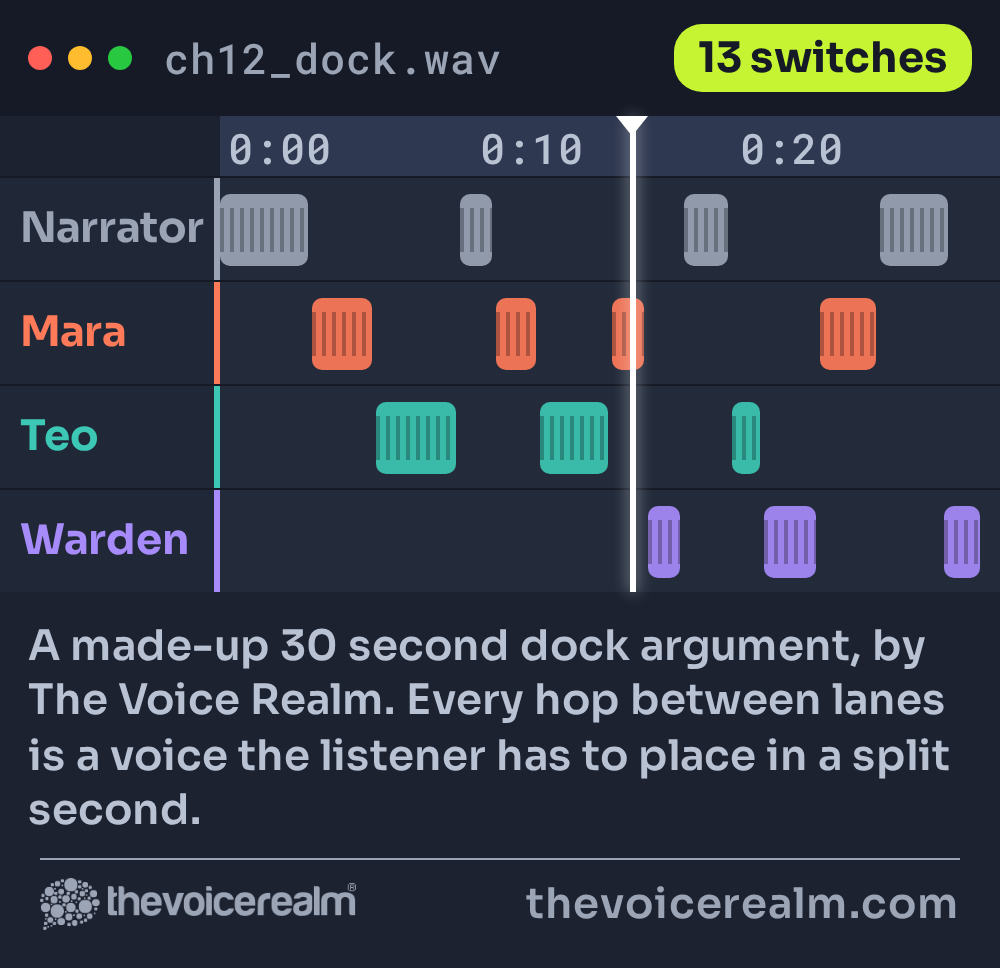
Fast back-and-forth scenes are where small, clear choices pay off. When two characters trade short lines without tags, the listener has only your voice to tell them who’s talking. That’s why placement and attitude are worth more than pitch: you can switch them instantly without straining.
Mark the script before you record those scenes. A colour or a letter for each speaker over every line saves you from reading the wrong voice and having to go back. If you don’t already have a system, our guide on marking up a script before you read it shows one you can adapt for a book.
© The Voice Realm
Let the author help
On many books you’ll be working with the author, and they know these people better than anyone. ACX’s guide for authors on casting and collaboration shares character notes from an Audible Studios production as an example, including one for a villain: “Strong, deep, dark, old voice; he’s been around for a while (20,000+ years).” Notes like that are gold. Ask for them.
Agree the main voices early. On ACX productions there’s a first fifteen minutes checkpoint, and the same guide warns authors that “Requesting a complete change to a character voice you approved in the 15 Minute Checkpoint is probably not a reasonable expectation at the final audio stage.” So make sure the important characters speak in those first fifteen minutes if you can, or send the author a short sample of each.
Authors sometimes ask for a voice like a famous actor’s. ACX’s template gently advises them that “you’ll get a better performance if you allow your narrator to make their own dramatic choices rather than insisting on replicas of other characters or performers.” Take the note for what it tells you about the character, then make the voice your own.
Practise on short scenes first
Find a novel with a lot of dialogue and record one busy scene, three or four characters, a page or two long. Build a mini cast list, pick two dials per character, and record it. Then listen back with your eyes closed. Could you tell who was speaking without the tags? Did anyone sound like a cartoon? Could you find every voice again tomorrow?
Do that a few times and you’ll have the skill most new narrators are missing. If you’re just starting out and want guided practice on reading and character work, Voice Master Academy is a good place to build it with feedback.
The best compliment a narrator can get isn’t “great voices.” It’s a listener who forgot there was only one person reading.
Sources: ACX, “5 Tips for Choosing a Narrator”; ACX, “Director’s Notes for Your ACX Production”; ACX, “Audiobook Casting and Collaboration”; Jessica Tripler, Book Riot, “Romance on Audio: Ten Terrific Narrators”.
Ready to get booked?
See the jobs open right nowAbout Sarah Robbins
Sarah Robbins writes for The Voice Realm about finding voice over work, home studios, casting and the business side of voice acting.