Blog
Blog
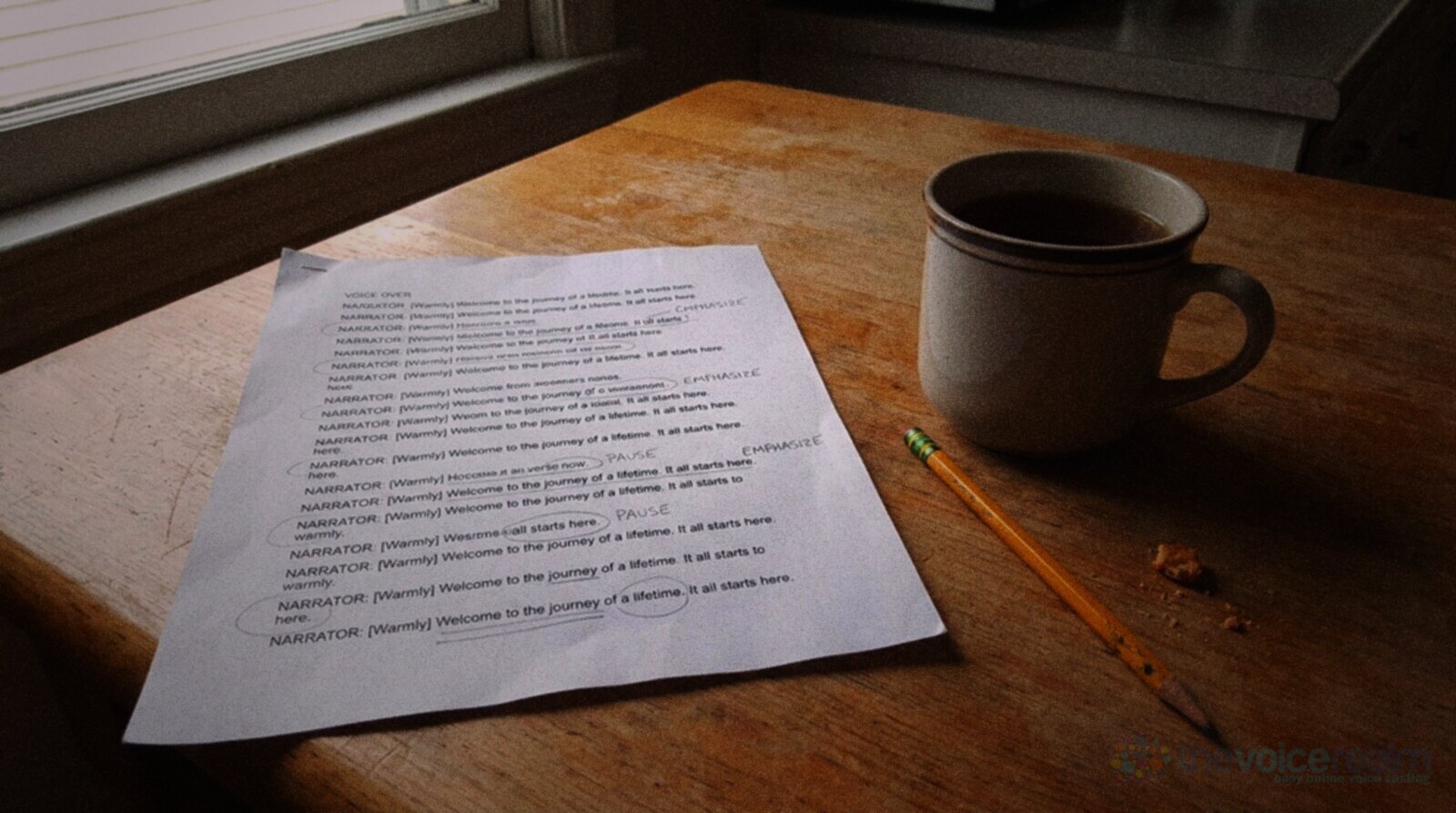
Open a script and count the numbers in it. A year, a price, a phone number, a web address, a date, a stray “Dr.” or “St.” that could mean two things. Every one of them is a small decision you’ll make out loud in front of a client, and the script almost never tells you what the decision should be. This guide is for voice actors who want to read numbers and addresses the way the client expects, and to stop re-recording lines for a reason that was never about their voice.
The script is written for eyes, and you read it with your mouth
Writers type “2010” because it’s quick. They don’t think about whether you’ll say “twenty ten” or “two thousand ten,” because on a screen it doesn’t matter. When it’s your job to say it, it does.
Voice actor Jill Goldman of Goldivox, quoted on Christy Tucker’s learning design blog, puts the problem plainly: “Please write out how you’d like it read. Also, beware of the correct way of reading numbers out loud.” She adds that this is “a pet peeve” of hers, and that many voice-over professionals don’t read numbers correctly either.
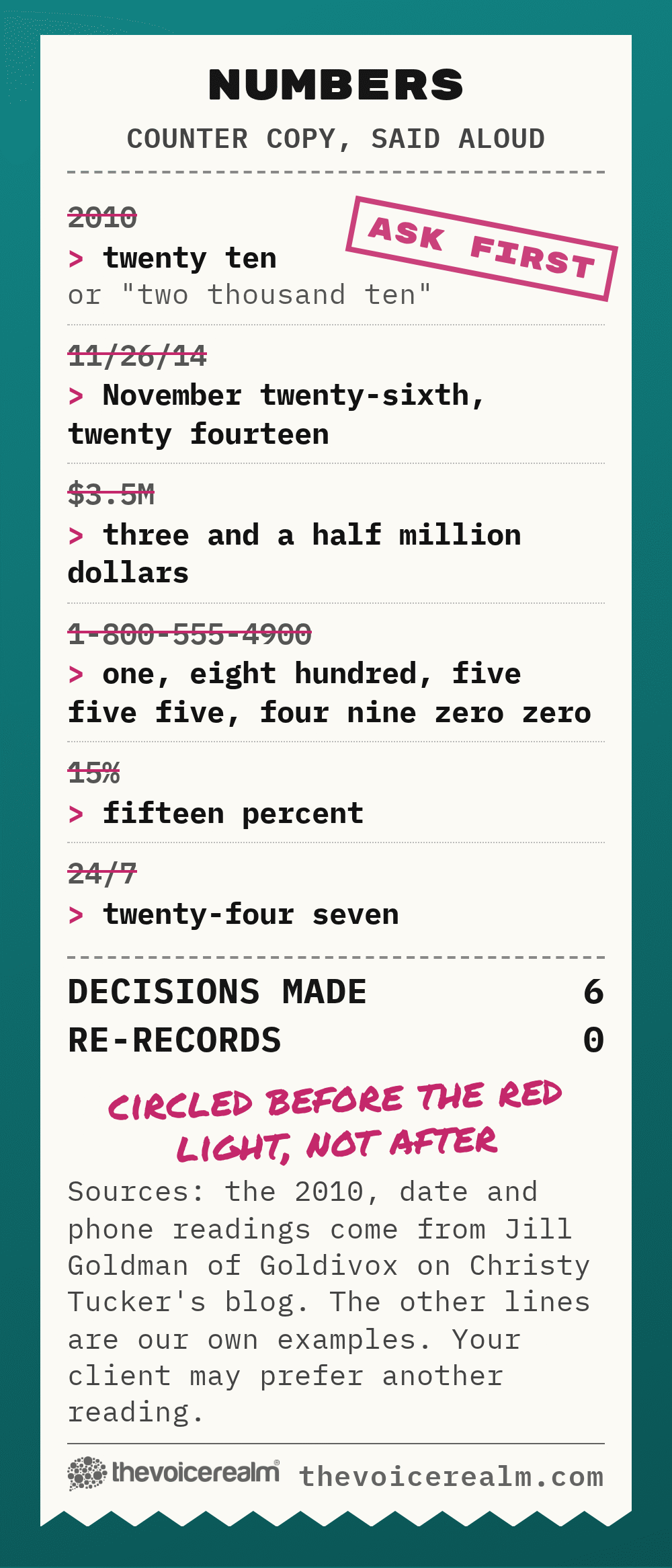
Her own example: “2010 can be read as ‘two thousand ten’ or maybe ‘twenty ten,’ or even ‘two zero one zero’ in some cases.” Three readings, one string of digits, and only one of them is what the client wants. The rest of this guide is about how to find out which, and how to stay out of trouble when nobody can tell you.
Years, amounts and the word “and”
Start with the rule that catches careful readers out. Goldman says: “2010 is NOT ‘two thousand AND ten.’ The word ‘and’ in a number indicates a fraction (or more of the number that will be coming after a decimal point).” So 359.42 in money is “three hundred fifty nine and forty two cents,” and the “and” belongs to the decimal point, not to the hundreds. In British English the habit runs the other way, with “three hundred and fifty nine” being normal, so ask the client which they use. Check the accent of the audience before you check the grammar book.
Years are the next trap. Most years in the last century read in pairs: “nineteen ninety.” The 2000s are where people split. “Two thousand five” and “twenty oh five” are both in use, “twenty twenty-six” is the common way to say this year, and “two thousand twenty-six” works too. If the script is for a brand, listen to how the brand’s own people say it in their videos, and copy that.
Long numbers need a decision, too. “$3.5M” can be “three point five million dollars” or “three and a half million dollars.” Either is fine. What isn’t fine is stopping mid-take to work it out. Do it before you press record, and write the spoken version above the line in pencil or in the margin of your script. Our guide to marking up a script before you say a word covers how.
- Circle every digit. Years, prices, times, phone numbers, percentages, units.
- Write out how you’ll say each one, above the line, in plain words.
- Check the odd ones with the client. One short email saves a re-record.
- Say each number once in its full sentence, not on its own, and check it still sounds natural.
© The Voice Realm
Dates: the second version sounds better
Dates written in numbers are worse. Tucker, who wrote the page, asks the question every narrator ought to ask: “Would you like 11/26/14 read as ‘eleven twenty-six fourteen’ or ‘November twenty-sixth, twenty fourteen’?” Her view: “I think the second sounds much more natural in narration, even though it looks clunky in writing.”
She’s right, and there’s a second reason to ask. In the US, 11/12/14 is the twelfth of November. In most of the world it’s the eleventh of December. A script that says 03/04 is a coin toss until someone tells you where the client lives. Ask, or write the month as a word. When the date is part of an offer (“ends 03/04”), a wrong guess is more than a style slip. It’s a mistake in the ad.

© The Voice Realm
Phone numbers: group them the way people dial
Phone numbers have a rhythm, and people listening are trying to write them down. Goldman notes: “With telephone numbers, if you are giving me ‘1-800-555-4900,’ usually we know the ‘one eight hundred’ part (but if you rather it is ‘one, eight zero zero,’ let me know).” She adds that you should say whether the last group is “four, nine, zero, zero” or “forty-nine hundred.”
A few habits that keep listeners with you:
- Read digits one at a time and in groups, with a tiny pause between groups, the way people actually dial.
- Say “zero” or “oh” the same way every time within one script. Ask which the client prefers.
- Slow down a touch on a number that’s meant to be remembered, and finish the last digit with a steady, falling tone. A rising last digit sounds like you’re still going.
- If the number appears twice in the script, say it the same way both times.
We cover the same care for call flows in recording IVR and phone prompts, where a number read badly costs the caller real minutes.
Web addresses and the symbols inside them
Addresses are where scripts get silly. A long URL read out in full is hard to follow, and a lot of clients know it. Carol Saller, writing for the Chicago Manual of Style’s Shop Talk blog about preparing a book for audio, suggests the cleaner route: “Delete whole URLs and when appropriate substitute a website name or short address like ‘this novel dot com.'” She doesn’t think a narrator should fret over the rest, because listeners will figure it out. That’s advice for authors preparing a manuscript, but the same instinct holds for an ad or a video: the shorter the spoken address, the more likely it sticks.
 VOICEMASTERACADEMYFirst read to first booking.Twenty modules. The first one is free.Start free
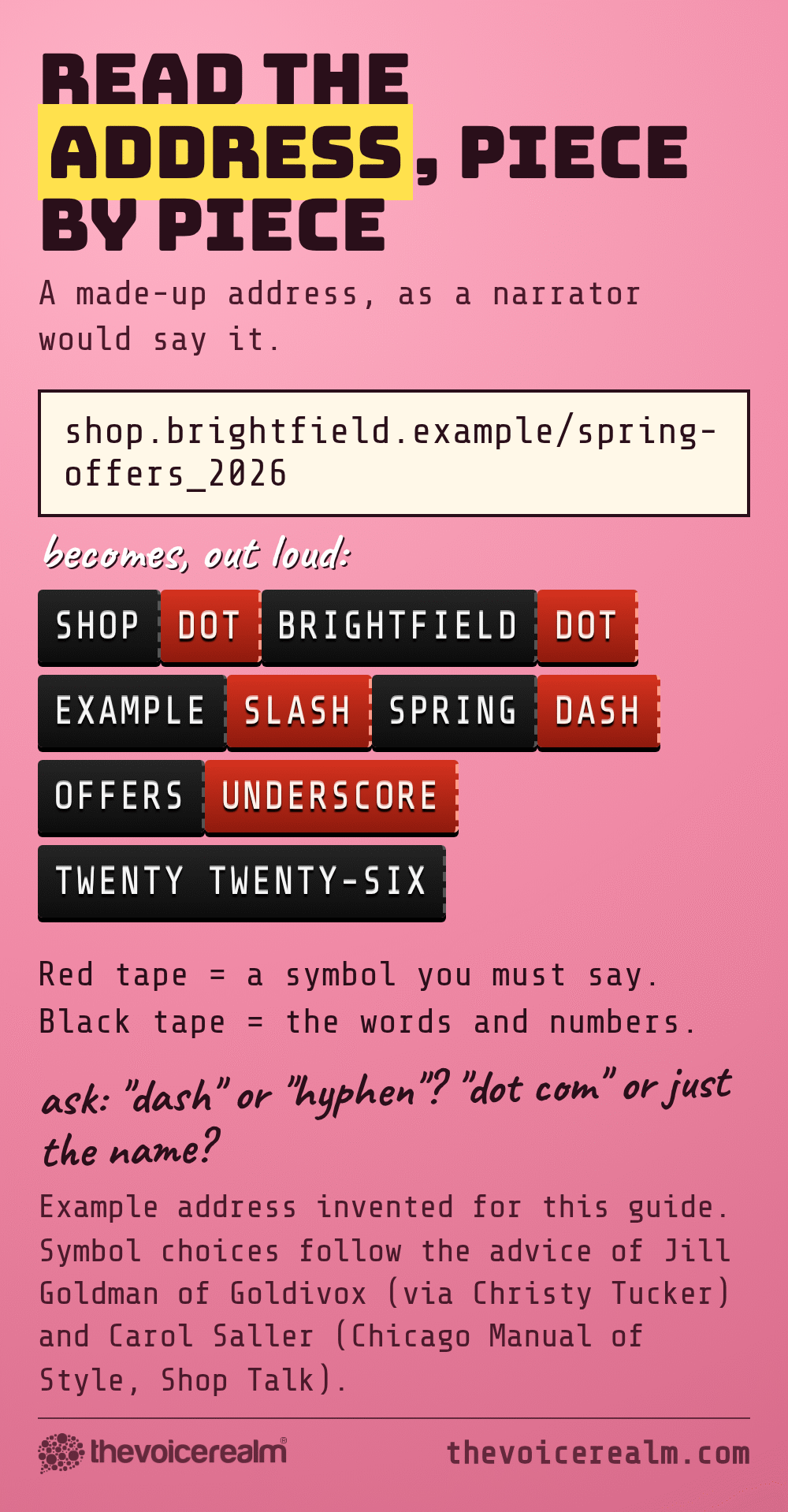
When the address stays, decide how each symbol is spoken. A dot is “dot.” An at sign is “at.” A hyphen is “dash” or “hyphen,” and an underscore is “underscore.” A slash is “slash.” Goldman notes that slash marks and abbreviations in a script need the same treatment: “type it out as you want us to read it.” She asks whether you want “slash,” “or,” “and,” or just the two words with nothing between.
Write the spoken version in your margin, something like “brand name, dot com, slash offers,” and read it aloud once before you record. Thirty seconds of work saves you from stumbling over the first long address of the day.
Percentages, units and other symbols
Symbols hide the same choices. “15%” is “fifteen percent,” and nobody objects. “5km” could be “five kilometres,” “five kilometers” or “five K,” depending on the client and the country. “&” is nearly always “and,” but not in a company name where the ampersand is part of the brand. “#1” is “number one,” and “24/7” is “twenty-four seven.” Ratios and temperatures need the same look: “3:1” is “three to one,” and “-5” on a weather line needs a decision between “minus five” and “negative five.”
None of these is hard. They’re only hard when they go by unnoticed, which is why a quick pass with a pencil before you record pays off.
© The Voice Realm
Abbreviations and acronyms: spell them or say them
Acronyms come in two kinds. Some are spoken as words: NASA, UNICEF, SaaS (often “sass”). Others are letters: FBI, ROI, URL. A few switch depending on the person: “GIF” is the classic argument. If the script doesn’t tell you, check the company’s own videos and podcasts, and follow how their people say it.
The same goes for abbreviations like “St.,” “Dr.” and “Rd.” “St. John St.” isn’t hard once you know the first is “Saint” and the second is “Street,” but a script full of them can trip you. Ask for them to be written out, or write them out yourself.
Tucker’s page suggests putting the explanation for a tricky number in a pronunciation guide, and Saller recommends the same approach for narrators of a long book: “prepare a single list of pronunciations (rather than mark every instance throughout the text).” Our guide to researching pronunciation for voice over shows how to build one, and a short list of numbers and acronyms belongs on it as much as the names do.
© The Voice Realm
What to do when nobody answers your email
Sometimes there’s no one to ask and the file is due tonight. Then decide, record it, and be open about your choice. Pick the most natural spoken form for the audience, use it everywhere in the script, and tell the client in two lines what you chose. “Dates are read as ‘March fourth,’ phone number grouped 3, 3, 4.” If they wanted something else, they’ll say so, and the change is a single line, not a rewrite.
And if it’s a short job that you can easily record twice, record both versions of the number you’re unsure about, and label them. A client who has both can pick in ten seconds.

© The Voice Realm
Practise before the take
Numbers are slippery under pressure, so rehearse them. Read the numbers in the script aloud on their own, then inside their sentences. A number inside a sentence changes its stress and speed, and a figure you can say alone can fall apart in a long line. If there’s more than one figure in a line, mark the one that matters most. The listener can hold about one number at a time.
Reading ahead with your eyes helps when a long number is coming up in the next line, and the cold reading guide is about exactly that. If the script has a time limit, remember that numbers take longer to say than they look, and the piece on timing a voice over script shows how to count.
Sources: Christy Tucker, “Voice Over Script Pitfalls”, quoting Jill Goldman of Goldivox. Carol Saller, “Preparing an Audiobook for a Narrator Who Isn’t You”, The Chicago Manual of Style, Shop Talk, 15 October 2019.
Ready to get booked?
See the jobs open right nowAbout Sarah Robbins
Sarah Robbins writes for The Voice Realm about finding voice over work, home studios, casting and the business side of voice acting.