Blog
Blog

This one’s for voice actors who keep seeing “Irish accent”, “light Southern” or “RP British” in a casting brief and either skip it or send something they hope will pass. A good accent books jobs you’d otherwise never hear about, from audiobooks with a cast of thirty to a game that needs a whole village. A bad one costs you the client’s trust in about four words. Here’s how to learn one properly, at home, in a way that holds up for a whole session.
Accent work is acting work
The first thing dialect coaches tell actors is that an accent isn’t a party trick you bolt onto a read. It’s part of who the character is: where they grew up, who they talk to, how much they want to fit in or stand out.
Dawn-Elin Fraser, a dialect coach who spoke to Playbill about teaching yourself a dialect at home, put it in three words: “Accent is acting.” A shopkeeper from Cork talking to a regular sounds different from the same woman talking to a tax inspector. If you learn the sounds without the person, you get a string of correct vowels and nobody in particular saying them.
That’s also why the accent you hear in your head is usually wrong. Most of us carry a cartoon version of every accent we’ve never lived with, built from films and sketch shows. The cartoon is what you have to unlearn first.
Go to the people who grew up with it
Joel Goldes, another coach in the same Playbill piece, was blunt about where to listen: “It’s always best to listen to primary sources, or samples of people who grew up speaking that accent, rather than listening to secondary sources, like actors who’ve learned it for a film.”
Actors’ versions are copies of copies. They’re often very good, but they carry that actor’s habits, and if you copy them you’ll pick up their mistakes along with their wins.
The easiest place to find real speakers is the International Dialects of English Archive, known as IDEA. Its founder, the dialect coach Paul Meier, set it up for exactly this. In the archive’s own words, he “established IDEA to provide actors the real-life models they need for their characters’ accents and dialects”. The site describes itself as holding “roughly 1,800 samples from 135 countries and territories”. Most of its speakers read the same short story, a passage called Comma Gets a Cure, which means you can compare one region with another word for word.
Beyond the archive, go looking for people talking unscripted. Local radio phone-ins, council meetings, regional news vox pops, podcasts made by people from the place. Pick speakers who match your character in age and background, because a teenager and a grandmother from the same town rarely sound alike.

© The Voice Realm
Learn it one word family at a time
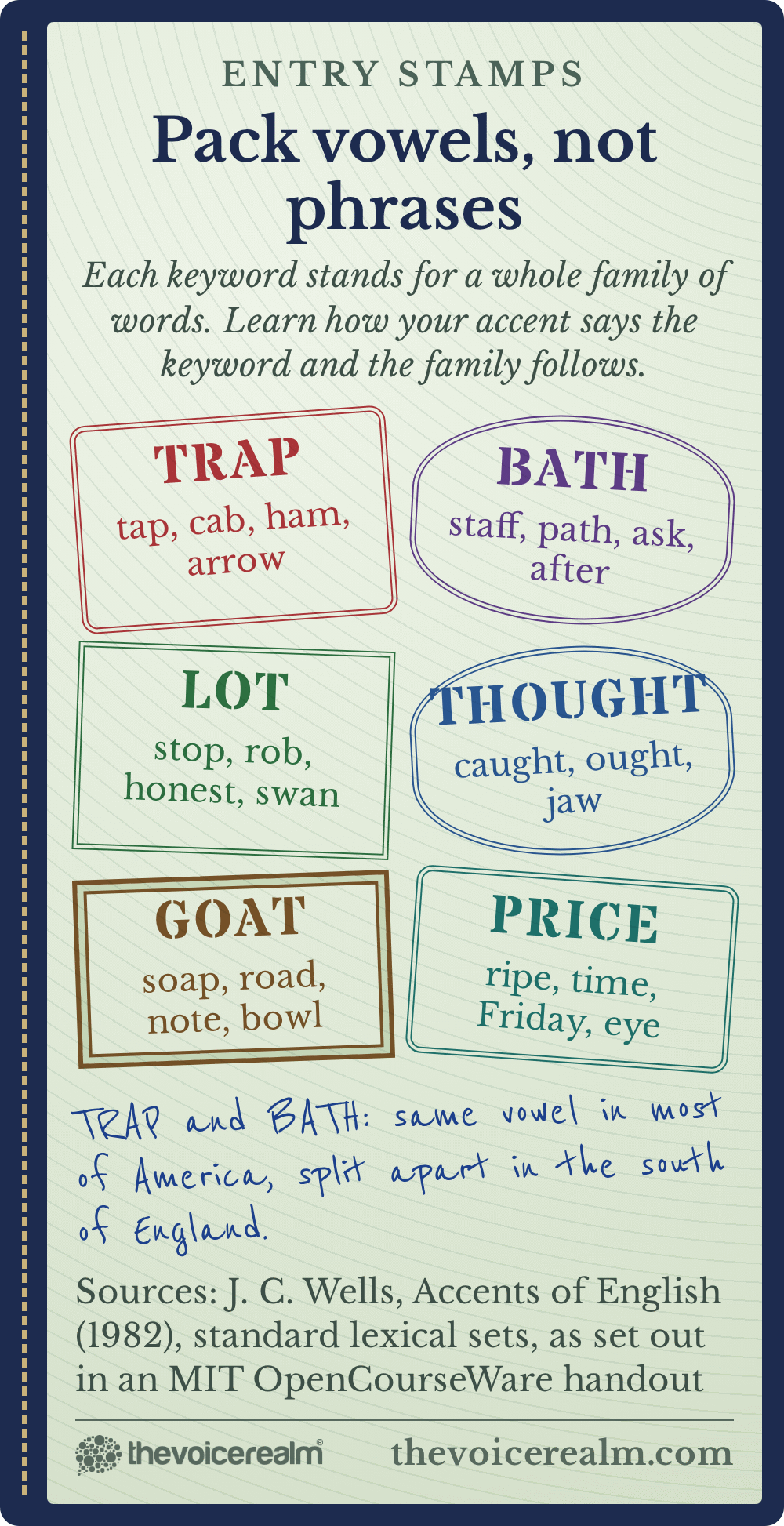
Here’s the trick that turns an accent from a vague impression into something you can control. In 1982 the phonetician John Wells sorted the vowels of English into what he called standard lexical sets: groups of words that share a vowel sound, each named after one keyword. TRAP, BATH, LOT, THOUGHT, GOAT, PRICE and so on.
The point is that accents change whole families at once. Learn how your target accent says the keyword and every word in that family follows the same rule. In much of southern England, for example, BATH words like “path” and “ask” take a long open vowel, while most American speakers say them with the same vowel as “trap”. Once you know that, you’re no longer guessing word by word.
Make yourself a cheat sheet. Write each keyword down, listen for it in your real speakers, and note how it sounds in a way you’ll understand later. You don’t need phonetic symbols. “GOAT: starts nearly like ‘eh’, slides to ‘oo'” works fine if it helps you hear it again.
© The Voice Realm
Find the tune before the words
Vowels get you halfway. The other half is music: where the voice rises, where it lands, which syllables get leaned on and which get swallowed. Plenty of people nail every vowel and still sound like visitors, because the melody gives them away.
Try this. Take a twenty second clip of one of your speakers and hum along with it, no words at all. Do it until your hum matches theirs. Then speak the same lines over the top. You’ll notice the accent sits much more easily once the tune is already in your body.
Pay attention to how sentences end. Some accents finish statements on a rise, some drop hard, some stretch the last stressed vowel. For voice work this matters a lot, because line endings are where clients hear confidence or doubt. Record yourself on your phone each time you practise, even just the hum. Your ears lie while you’re speaking. They tell the truth on playback.

© The Voice Realm
Feel where it sits in your mouth
Every accent has a home position: a resting shape for the tongue, jaw and lips that the sounds grow out of. Some live forward, near the teeth and lips. Some sit back and low. Some keep the jaw fairly closed and do the work with the tongue tip. Coaches sometimes call this placement or setting.

 VoiceEditSuiteRaw take in, clean take out.Breaths, dead air and room noise, gone.Show me
You’ll find it by watching and copying. Look at video of your speakers with the sound off and copy how their mouths move. Then sit in front of a small mirror and say a handful of keyword words in your own accent and then theirs. The differences you can see, a rounder mouth here, a lazier jaw there, are the ones you can repeat on demand.
If you already do character work, this will feel familiar. It’s the same idea as building a character from the inside out: find the physical home of a voice first, and the sounds stop slipping when you get tired.

© The Voice Realm
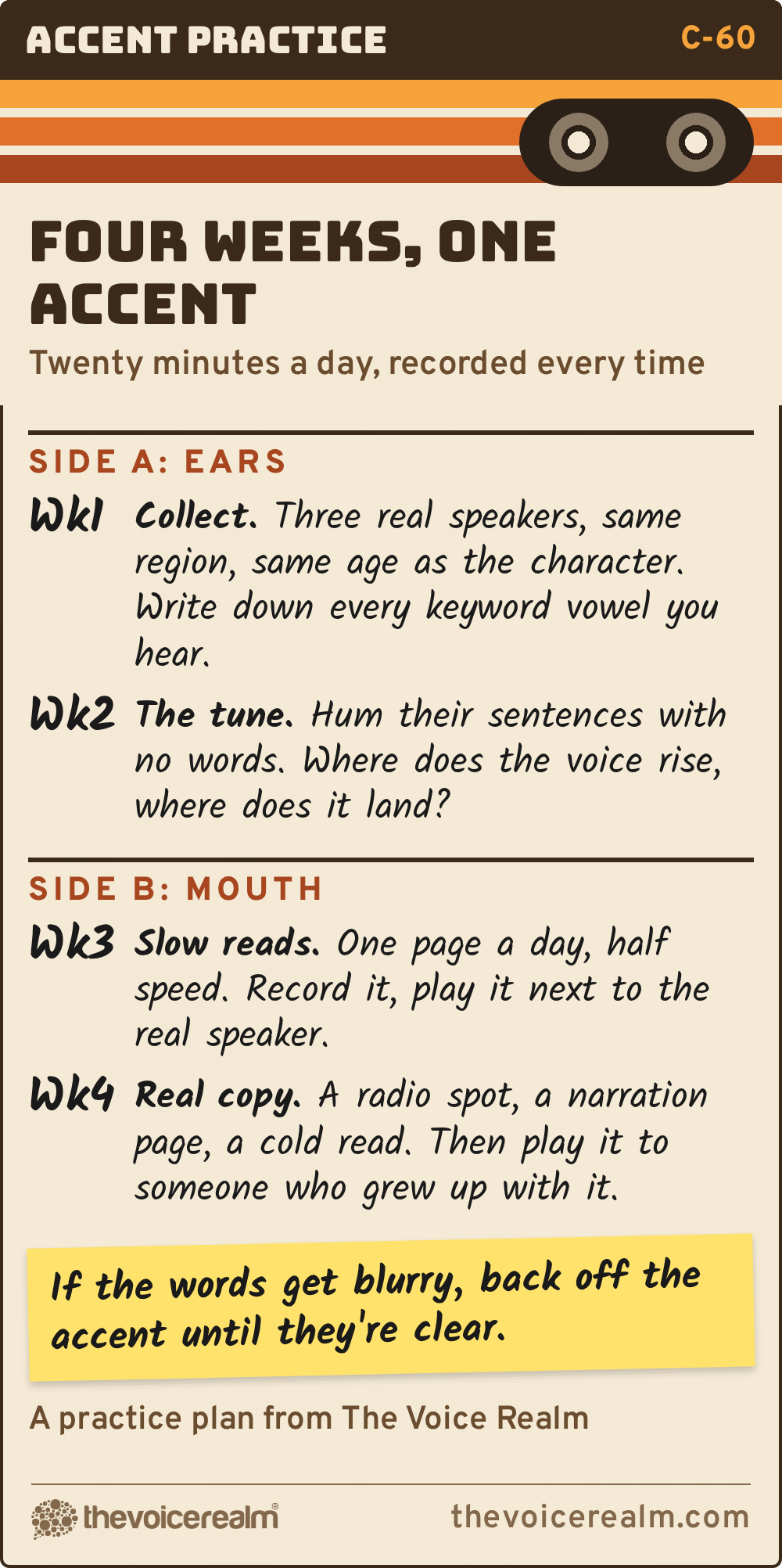
A month of practice, twenty minutes a day
Short and daily beats long and weekly. Twenty minutes a day for four weeks will give you more than a whole weekend spent cramming, because the muscles learn through repetition and sleep.
The tape card below sets out what each week is for. A few habits make every session count. Keep a single recording file per day and name it with the date, so by week four you can play day one next to day twenty six and hear how far you’ve come. Always play your take straight after the real speaker, never on its own. Mark the words that still give you away and make those the warm up for tomorrow.
Fraser makes a good case for doing this before you need it. “Learning accents outside of a specific role helps to build muscle memory and to sharpen the ear so that you have a better instrument with which to hear the subtleties of dialect,” she told Playbill. If you wait for the audition to start learning, you’ll be learning in a panic.
© The Voice Realm
Clear beats perfect, every time
Goldes has a rule that should be taped to every home booth: “the first objective in performing any accent should be clarity.” A listener can’t rewind a radio spot. If they miss the product name because your vowels went too far, the client has paid for nothing.
So dial it. For most commercial and corporate work you want a light touch: the melody and two or three signature vowels, enough that a local nods and an outsider still understands every word. Save the full strength version for character work, games and drama, where the accent is the point.
The same goes for names and places. Getting the accent right and a town name wrong undoes the whole thing, so check how locals actually say it before you record, the same way you would for any script.
Should it go on your demo and your profile?
Only when you can hold it for a full session, cold, on a script you haven’t seen, with a client listening. Plenty of jobs that ask for an accent will cast someone who grew up with it, and a borrowed accent that wobbles in take six is worse than not offering it at all.
It holds up under pressure
You can cold read a page in it, keep it through a long session, take direction like “a bit lighter” and adjust, and a native speaker you play it to doesn’t wince.
It only works on your script
It sounds good on the lines you’ve drilled, drifts on new words, or slides back to your own accent when the read gets emotional or fast.
A good test before you list anything: play a minute of your read to someone who grew up with that accent and ask one question. “Where am I from?” If they name the right place, or somewhere close, you’re ready. If they laugh, you’ve learned something useful for free.
Accents also do a lot of quiet work in long form. Audiobook narrators often voice characters from several places in one chapter, and switching cleanly between them is half the job. If that’s where you’re heading, our guide to starting out as an audiobook narrator covers the rest of what a book asks of you.
Where to go from here
Pick one accent you’re curious about, not five. Find three real speakers, write your keyword cheat sheet, and start the twenty minutes tomorrow. When the first accent feels solid, the second comes much faster, because your ear now knows what to listen for.
If you’re new to voice acting and want structured help with the rest of the craft, Voice Master Academy is a good place to build the basics alongside your accent work. And when you’re ready to put it to use, keep an eye on the voice over jobs board, where accent briefs turn up all the time.
Sources: “Special Skills: How to Teach Yourself a Dialect at Home”, Ruthie Fierberg, Playbill, 23 April 2020; “International Dialects of English Archive”, IDEA; “Standard Lexical Sets”, MIT OpenCourseWare handout after J. C. Wells, Accents of English (1982).
Ready to get booked?
See the jobs open right nowAbout Sarah Robbins
Sarah Robbins writes for The Voice Realm about finding voice over work, home studios, casting and the business side of voice acting.