Blog

This one’s for voice actors who’ve hit the line every performer dreads: “She laughs.” Or worse, “He breaks down.” There’s no joke in the booth, nobody’s died, and the director needs it in the next take. Laughing and crying on cue are skills, not gifts, and they’re learnable. Here’s why the fake version gets caught, how to build the real one from the body up, and how to do it all day without wrecking your voice.
Why a forced laugh sounds forced
Most people can tell a polite laugh from a real one, even if they can’t say how. Cognitive neuroscientist Sophie Scott at University College London has spent years studying exactly that, and her answer starts below the throat.
Talking to The Naked Scientists, she described real laughter as a physical event: “you’re actually producing incredibly strong pressure in your rib cage.” She added that “It produces a set of sounds that you don’t produce any other way.” That’s the part a forced laugh misses. It comes from the mouth and the face, with the ribs barely involved, so it sounds like the word “ha” repeated rather than air being squeezed out of you.
Listeners notice. Scott told the same programme that “your brain absolutely tells the difference between the two, whether or not you’re told to listen for them.” And her team found that the difference changes how an audience reacts. In a study published in Current Biology in 2019, people rated deliberately bad jokes as funnier when real laughter was added after them than when posed laughter was. Scientific American’s summary put it simply: “honest, involuntary laughter cued people to perceive the jokes as funnier more than fake, forced laughter did.”
For a voice actor, that’s both the warning and the brief. The audience can hear the effort. Your job is to get the breath doing what it does in a real laugh, so the sound follows.
Build the laugh from the breath, not the face
The fastest route to a believable laugh is to start with the mechanics and let the feeling catch up. Put a hand flat on your belly, just under the ribs. Now push short bursts of air out with no voice at all, like a silent “huh, huh, huh”. Feel the belly kick inwards on each one. That pulse is the engine of a laugh.
Next, add a little voice to the pulse, still quiet. Then let it climb. Real laughs rarely sit on one note. They start low and tight, jump up as the air goes, and run out of breath before they run out of funny. Let yours do the same, and let it end with a small gasp of air coming back in. That inbreath is one of the most convincing sounds in the whole laugh, and it’s the one beginners forget.
It also helps to give yourself something actually funny to react to. Many actors keep a private trigger: a memory, a ridiculous mental picture, a friend’s terrible impression. You don’t need a full belly laugh from it. You need the first true flicker, and then the breath work carries it. Real laughter is also contagious, so the second take after you’ve genuinely cracked up is often the keeper.
If you’ve done improv, you’ll recognise this. Saying yes to whatever’s happening in the room, including your own giggles, is a big part of it. Our piece on why improv makes better voice actors covers more ways to get comfortable being genuinely surprised at the mic.

© The Voice Realm
Every character laughs differently
“Laughs” in a script tells you almost nothing. Who’s laughing, at what, and who are they trying to impress? A nervous laugh is short, high and swallowed, often pushed out through the nose because the mouth wants to stay closed. A villain’s laugh is slow and usually much quieter than beginners make it, because the menace lives in the control. A grandparent at a child’s joke laughs more with the breath than the voice. A teenager trying not to laugh in class makes a choked snort and then loses it entirely.
Decide what the laugh is for before you do it. Is it covering embarrassment? Rewarding someone? Mocking them? Releasing tension after a scare? The same physical engine makes all of these, but the shape changes with the reason. This is the same thinking behind building a character voice in the first place, and our guide to building the person before the sound applies just as well to a single laugh.
A quick test: record three laughs for three different reasons and play them back to a friend without telling them which is which. If they can name the reasons, you’re there. If they all sound the same, you were laughing at the word, not at something.

© The Voice Realm
Laughing through a line without losing a word
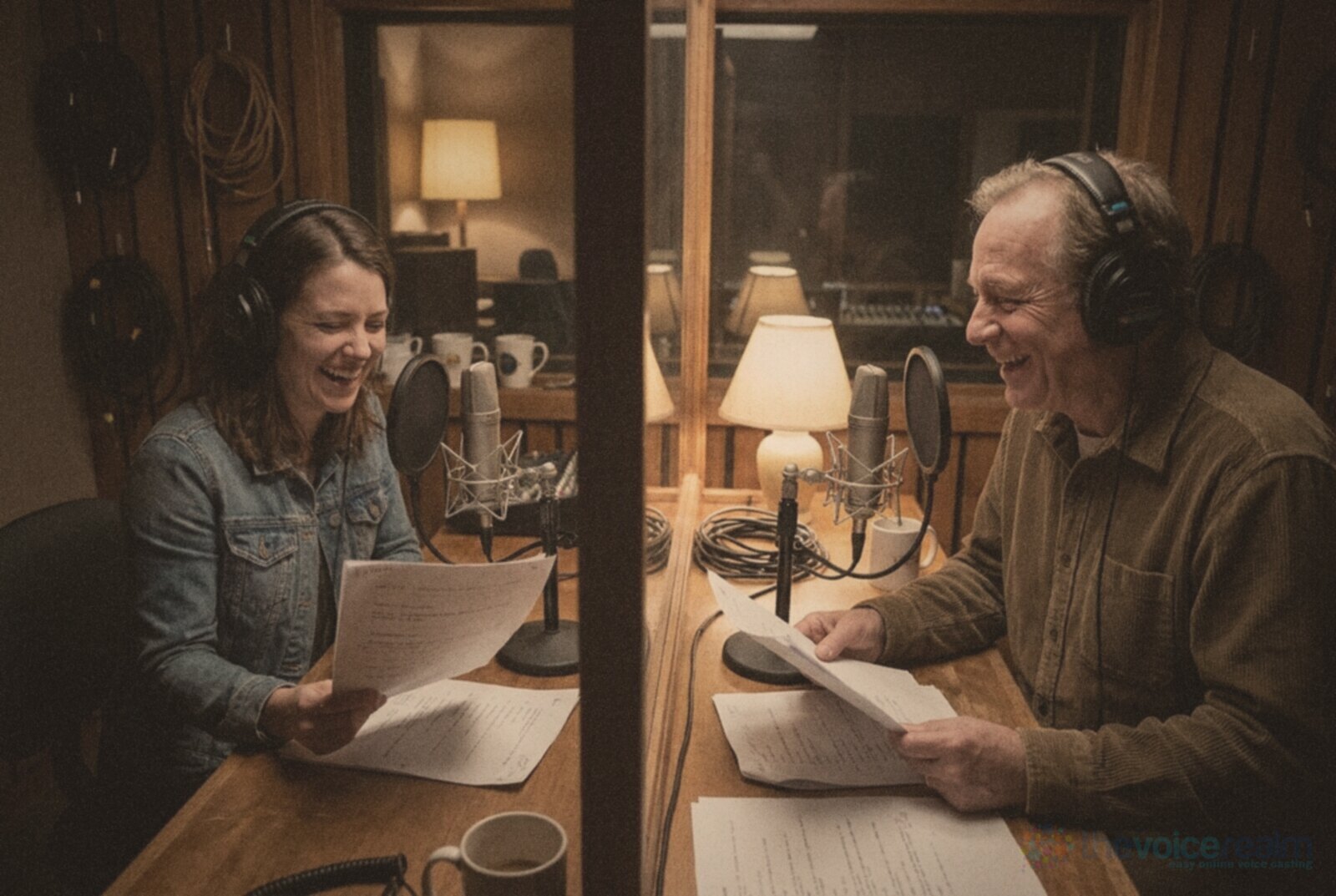
The hardest version isn’t the standalone laugh. It’s the line spoken while laughing: “Oh, you didn’t. You did not just say that.” The audience still needs every word, and in commercial or e-learning work the client absolutely needs the brand name clean.
The trick is to keep the laugh in the breath and the vowels while the consonants stay crisp. Let the pulses land in the gaps between words and on the open vowels. Keep the T, D, K and P sounds sharp, because they carry the meaning. Then let the laugh fade out over the line rather than switching off, so the listener feels the person calming down.
If the laugh keeps swallowing words, split it. Record the laugh into the line, then the line with only a trace of laugh left in it, and let the editor join them at a breath. Directors do this all the time and nobody hears the join if the energy matches.
© The Voice Realm
Crying is mostly a fight not to cry
Here’s what most beginners get wrong about crying on mic. They go straight for loud sobbing. But in real life, and in most scripts, people spend far more time trying not to cry than crying. The tension of holding it back is what moves an audience.
 VOICEMASTERACADEMYFirst read to first booking.Twenty modules. The first one is free.Start free
Your body gives you a head start. That familiar lump in the throat has a simple cause. Writing for BBC Science Focus, Dr Nish Manek explains that when we’re upset, “In an effort to take in more oxygen, the nervous system sends signals to the glottis”, telling it “to stay open for as long as possible.” Swallowing needs that same opening to close, so the two fight each other and you feel the lump. On mic, that tug of war becomes the slightly tight, catching quality of a voice holding on.
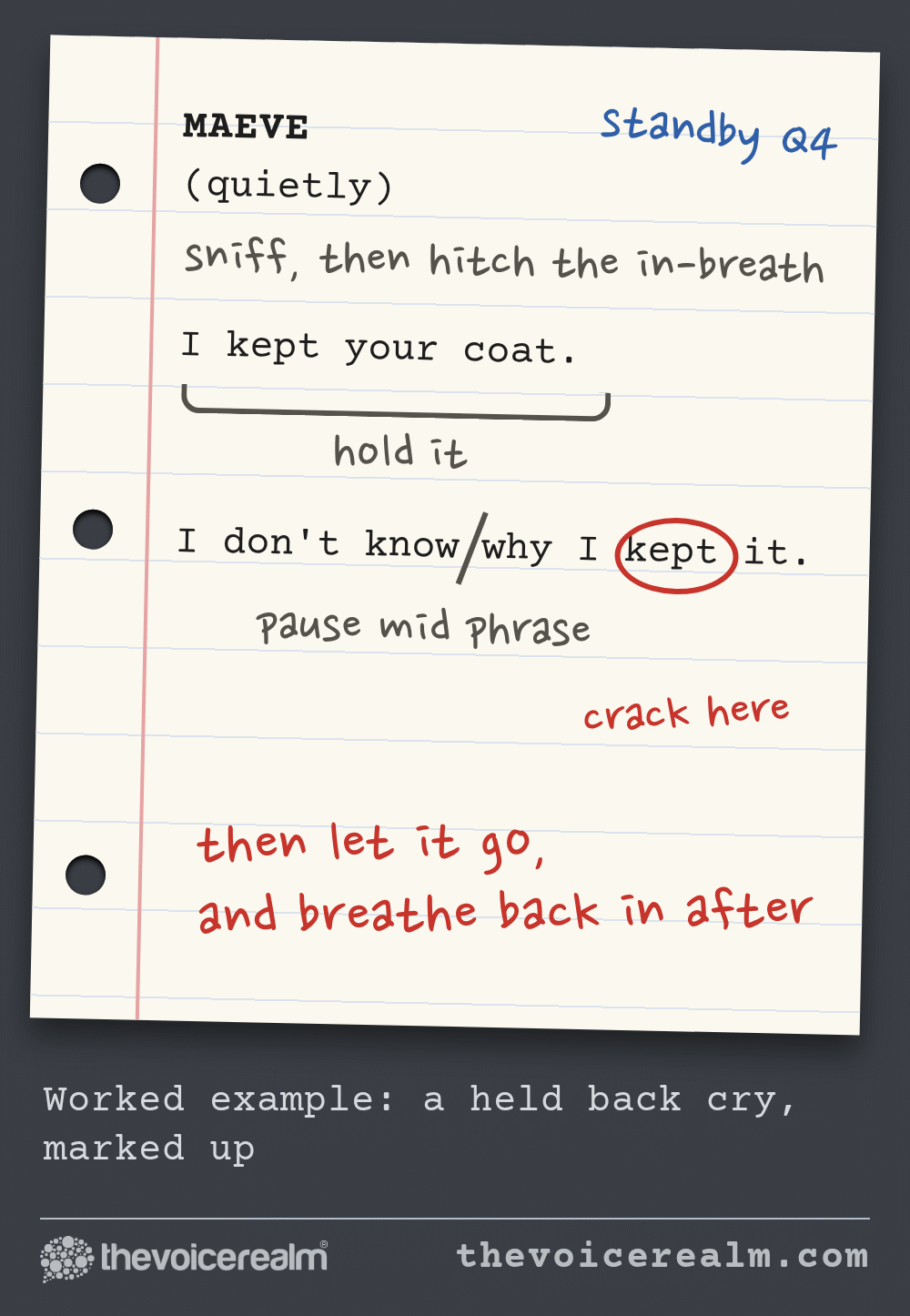
You can build it on purpose. Start with the breath again. Short, uneven inbreaths through the nose, as if you’re trying to stay calm. Let the inbreath catch once or twice, a small hitch in the middle of the air. Then speak the line slightly too carefully, the way someone does when they’re trying to keep it together, and let one word, usually the one that matters most, crack or drop away.
Sniffs, swallows and a wet sound on the M and N consonants do a lot of work. So does slowing down. Real distress makes people pause in odd places, mid phrase rather than at commas. If the script lets you, let the voice go fully at the very end, after you’ve held it back long enough that the audience is waiting for it.
© The Voice Realm
Mic technique for big emotion
Emotion changes your volume more than almost anything else you’ll do in the booth. A quiet held back cry can be far softer than the full release ten seconds later, and a belly laugh can clip a level that was set for calm narration.
A few habits keep the take usable. Tell the engineer, or yourself if you’re self directing, that a big moment is coming so the gain can be set for the loudest part, not the average. Lean in for the tight, small sounds, the catches and sniffs, because they need the close mic to register. Then ease back or turn your head slightly off axis for the loud release, so the burst of air doesn’t hit the capsule. Watch your plosives too. Sobbing and laughing both push lots of air on P and B sounds.
And always, always leave a second of room tone after a big emotional moment. The breath recovering is part of the performance, and the editor needs space to finish the moment cleanly.
“Your brain absolutely tells the difference between the two, whether or not you’re told to listen for them.”
Sophie Scott, University College London, on posed and real laughterPost this quote
Look after your voice when the scene is big
Ten real laughs in a row is a workout. So is a session full of sobbing. Both use a lot of breath pressure and plenty of squeezing through the throat, and if you push them from the neck rather than the belly they can leave you hoarse by lunch.
Keep the effort low in the body. Sip water between takes. Do the biggest emotional moments once you’re warmed up but before you’re tired, and ask for them to be scheduled that way if you can. If a script calls for repeated screams or full wailing, our guide to keeping your voice in one piece through screams and grunts has the safer technique for that end of the range.
And notice the emotional side, too. Pulling real grief or real joy up again and again can be draining. Give yourself a minute to shake it off between big takes, and something ordinary to do after the session.

© The Voice Realm
A five minute daily drill
You don’t need a scene to practise. Try this once a day for a week and record every part of it.
Start with ten silent belly pulses, hand on your stomach. Then three laughs for three different reasons, a nervous one, a cruel one, a warm one. Then one line read three ways: plain, laughing through it, and fighting back tears. Finish with the same line said with a single crack on the most important word.
Play it back the next day, when you’ve forgotten how it felt to make. That’s how a listener hears it. The takes that still make you feel something are the ones that worked, and the ones that sound like effort will tell you exactly where the breath stopped doing its job.
Sources: “Is fake laughter different to real laughter?”, The Naked Scientists; “Real Laughs Motivate More Guffaws”, Scientific American, 7 August 2019, on Cai and others, Current Biology; “Here’s why you get a lump in your throat when you’re about to cry”, BBC Science Focus.
Ready to get booked?
See the jobs open right nowAbout Sarah Robbins
Sarah Robbins writes for The Voice Realm about finding voice over work, home studios, casting and the business side of voice acting.