Blog
Blog

Ask ten working voice actors how they got their agent and you’ll get ten different stories, most of them involving a referral, a demo that was ready at the right moment, and more patience than anyone warned them about. Ask the same ten whether you need an agent to work, and they’ll mostly say not yet. This guide is for anyone who’s been recording for a while, has a few paid jobs behind them and is wondering whether it’s time to find representation. It covers what an agent actually does, when agencies will take you seriously, how to approach them, and the clauses to read before you sign anything.
What an agent actually does
The job is simpler than the mystique. An agent gets scripts from casting directors and producers, decides which of the people on their roster fit, sends the audition out, and if you book it, negotiates the fee and takes a cut. Dee Bradley Baker, who has voiced characters in animation and games for decades and runs a free advice site for new voice actors, describes it with no romance at all: “Your agent is like a dispatcher who can recommend you to casting agents, submit you for auditions, verify and negotiate your contract terms.”
He’s just as plain about what they’re not. “Agents aren’t your ‘star maker’ or manager (who exercise a lot more control over you and will take a larger percentage).” An agent won’t coach you, won’t build your demo, won’t fix your website and won’t make you a working actor. They open a door you couldn’t open yourself, a few times a week, and the rest is you.
The cut, in Baker’s experience of the American market, is a tenth. As he puts it, “your agent gets 10% of either your session fee or in addition to your session fee, that means you do 90% of the leg work.” That line is the whole relationship in one sentence. The commission is small because the agent’s part of the job is small. Yours isn’t.
Do you need one yet?
Here’s the uncomfortable part. Agencies are not looking for promising beginners. They’re looking for people who are already working, because a voice that’s already booking is easy money and a voice that might book one day is a gamble on their time.
Their own submission pages say so. Sue Terry Voices, one of the long-running London voice agencies, opens its representation page with: “Please do not apply unless you are a working, professional actor, comedian or national broadcaster.” It adds, “You also must have at least two years’ professional experience.” Voices&Co, the Dublin agency, is a touch softer: “Voices&Co are only likely to consider representation to experienced voice over talent and professionals in either acting, comedy or broadcasting. However, we may consider young newcomers to the industry who demonstrate a capability and confidence that is appropriate for the competitive nature of this industry.”
Read those two together and the message is clear. Get working first. Online casting is where most people build the first two years, auditioning for real jobs from a home studio and learning the pace of the business one script at a time. The open castings on our jobs board are exactly the kind of work that turns a beginner into someone an agent can sell, and the habit of auditioning well is the same habit an agent will expect from you later. If you’re earlier than that, before the first paid job, a structured course such as Voice Master Academy will get you to a demo faster than guessing will.
There’s a second question underneath the first. In a lot of voice work, an agent isn’t the route at all. E-learning, corporate narration, explainer videos, phone systems and most audiobooks are cast directly by the people making them. Agents matter most in commercials, animation, games, promo and anything union. If that’s the work you want, keep reading. If it isn’t, you may never need one, and that’s not a failure.

© The Voice Realm
Three things to have ready
When an agent does listen, they listen for about twenty seconds, and they listen to the first thing you send. So the three things need to be ready before you write a word to anyone.
A demo that sounds like a booking. Not a showcase of every voice you can do. A clean, produced reel in the genre you’re pitching, commercial or narration or character, that sounds like a finished spot. Voices&Co’s requirements are a useful template for anybody: “Your voice demo should be sent as an MP3 attachment, no more than 3MB in size”, “Demos should not exceed one minute and thirty seconds (1:30)”, and “Non-animation recordings should contain straight reads”. The agency also advises that “you do lots of listening to the demos on our site, and other sites too.” If your reel is more than two years old, read our piece on why a demo goes stale before you send it anywhere.
A short, honest bio. Three or four lines. Where you’re based, what you’ve booked, what you train in, the accents you genuinely own. No adjectives about your voice; the demo does that. Agents can spot a bio written by someone with no credits because it’s all warmth and no nouns.
Somewhere they can check. In the UK that usually means a Spotlight page. Sue Terry Voices asks applicants to “email a Spotlight link” and nothing else. Elsewhere it’s a simple website or a casting profile with your demos, a photo and your credits, kept current. Whatever it is, it must play on a phone, because that’s where the agent will open it.
Research before you send
The fastest way to be ignored is to send the same email to forty agencies. Agents talk to each other, and a submission that’s clearly a mail merge goes in the bin. Baker’s advice is to do the opposite: “Show them you’ve done your homework. Research the agency as much as possible and ask about their history, agents and general operation.”
Practically, that means listening to their roster. Every agency’s website has one. Play ten voices in your category and ask two questions. Do I belong on this page? And is there already someone who sounds like me? Agents don’t take two of the same voice, because they’d be competing with themselves on every audition. If you hear your twin, move on. If you hear a gap your voice would fill, that’s your pitch, and you can say so.
Then read their submissions page and do precisely what it says. If it says MP3 attachment, send an MP3 attachment. If it says link only, send a link. If it says they’re closed to submissions, believe them. Voices&Co ends its page with a line every applicant should pin above the desk: “We aim to listen to all submissions, but this can take up to 2 months so please do not chase us for a response immediately.”

© The Voice Realm
Referrals beat cold emails
Nobody likes hearing this, but almost every agent story starts with a name. A casting director who’s booked you twice mentions you to an agent. A coach whose students the agency already represents puts in a word. Another actor on the roster says, “You should hear this person.”
Baker rates the recommendation above everything else you’ll prepare: “The right recommendation is probably more crucial than having a good resumé, demo or website.” But he’s equally clear that it’s not a favour you can ask for lightly. “Your referrer(s) needs to be someone who can vouch for your talent and is willing to put their credibility on the line because they believe you are that good.” And, in his words, “Nobody’s doing anyone any favors here!” A referral is a bet that someone else places on you. You earn it by being easy to recommend: booking, delivering clean files on time, being pleasant in sessions.

 VoiceEditSuiteClean it up, check it, send it.Loudness NormalizerScript AccuracyRate CalculatorSee the suiteThe studio check is free to try.
Which is why his other piece of advice is to stop pushing and start pulling. “It’s more effective to put your work out there and use that as the bait to attract the fish, so to speak.” Post the spot you booked. Share the game credit. Keep your demos where people can find them. Agents and casting directors do go looking, and a working actor with visible work is far easier to sign than a stranger with a hopeful email.
© The Voice Realm
The approach email
When you do write, write short. An agent is reading on a phone between sessions, and the email has one job, which is to get your demo played.
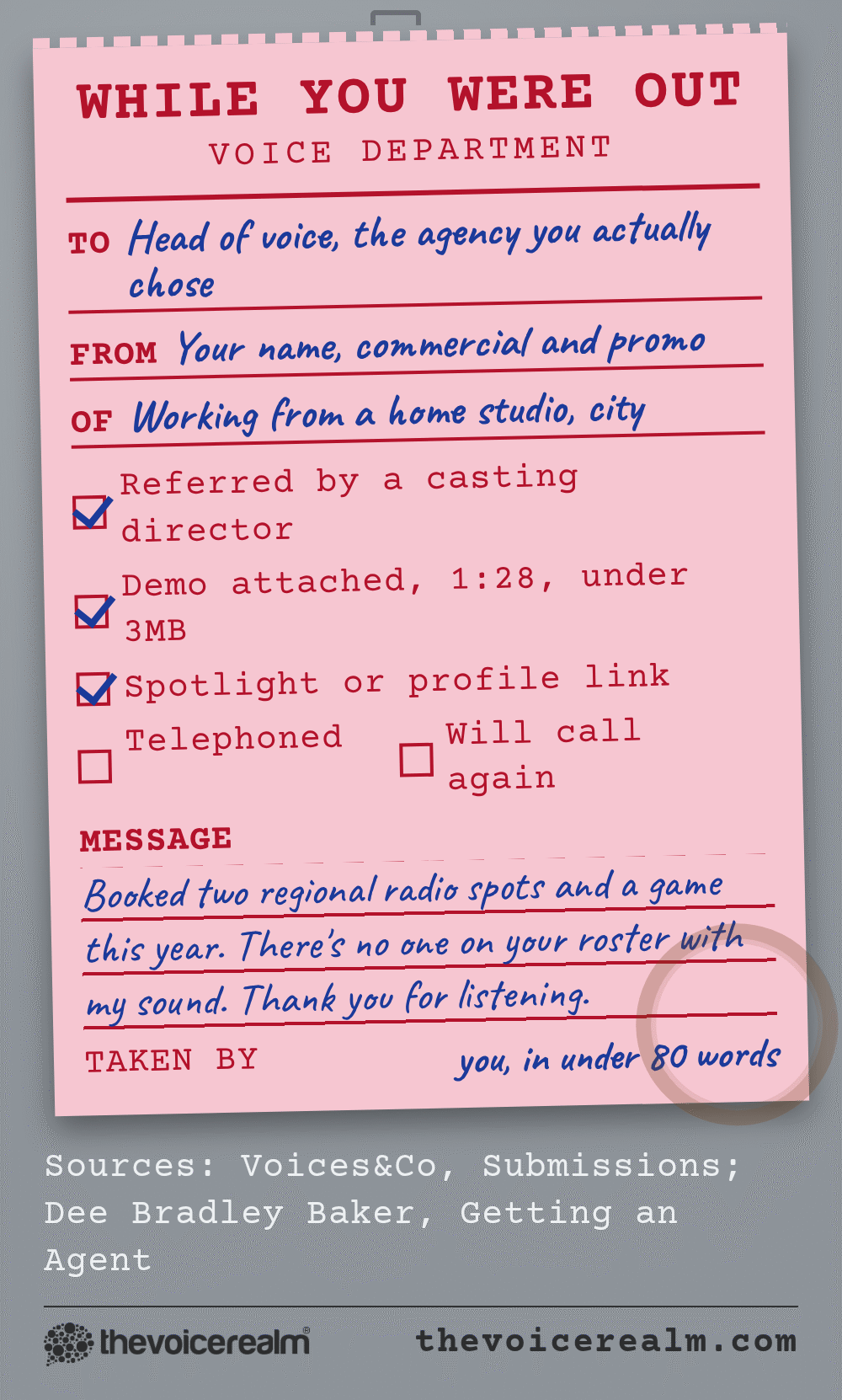
Subject line: your name, your category, and the referral if you have one. First line: who sent you, or why this agency specifically. Second line: two or three real recent credits. Third line: the demo, as a link or attachment, whichever they asked for. Then your Spotlight or profile link, your location, and a thank you. No paragraph about your lifelong dream. No list of every accent.
If it helps, imagine the message written on one of those pink “while you were out” slips an office receptionist used to leave on a desk. Name, who referred you, one line about why you called, a number to reach you. If it doesn’t fit on the slip, it’s too long.
And then wait. Two months, as Voices&Co says. If you hear nothing, you’re allowed one polite follow-up, and only with something new to say: a booking, a new demo, a fresh referral. “Just checking in” is not new.

© The Voice Realm
Hip pocket, exclusivity and the contract
An agent who likes you may not sign you straight away. Baker describes the common first step: “An agent may initially ‘hip pocket you’ (informally send you out and see if you get any callbacks/bookings), before signing you.” It’s a trial. They send you a handful of auditions, see whether casting responds, and decide from there. Treat every one of those auditions as the real test it is.
Signing changes things. “When you sign with an agent, you are obligated to only audition through them,” Baker writes, and that exclusivity usually covers a defined territory or category: all voice work in a city, say, or just commercials. Read which. Work you find yourself outside that area is normally still yours, but you need to know where the line is before you cross it.
And one clause people miss until it bites. “All residuals that come your way from gigs you worked while you were signed with a particular agency will come through that agency in perpetuity, whether you are still signed with them or not.” Residuals on a union commercial can run for years. That’s not sinister, it’s how the business works, but it’s a reason to choose carefully, because Baker’s closing line applies: “They ultimately work for you, so choose wisely. If they don’t impress you or give you a good feeling, don’t be afraid to say ‘no thanks.'”
© The Voice Realm
Read the agreement like a union would
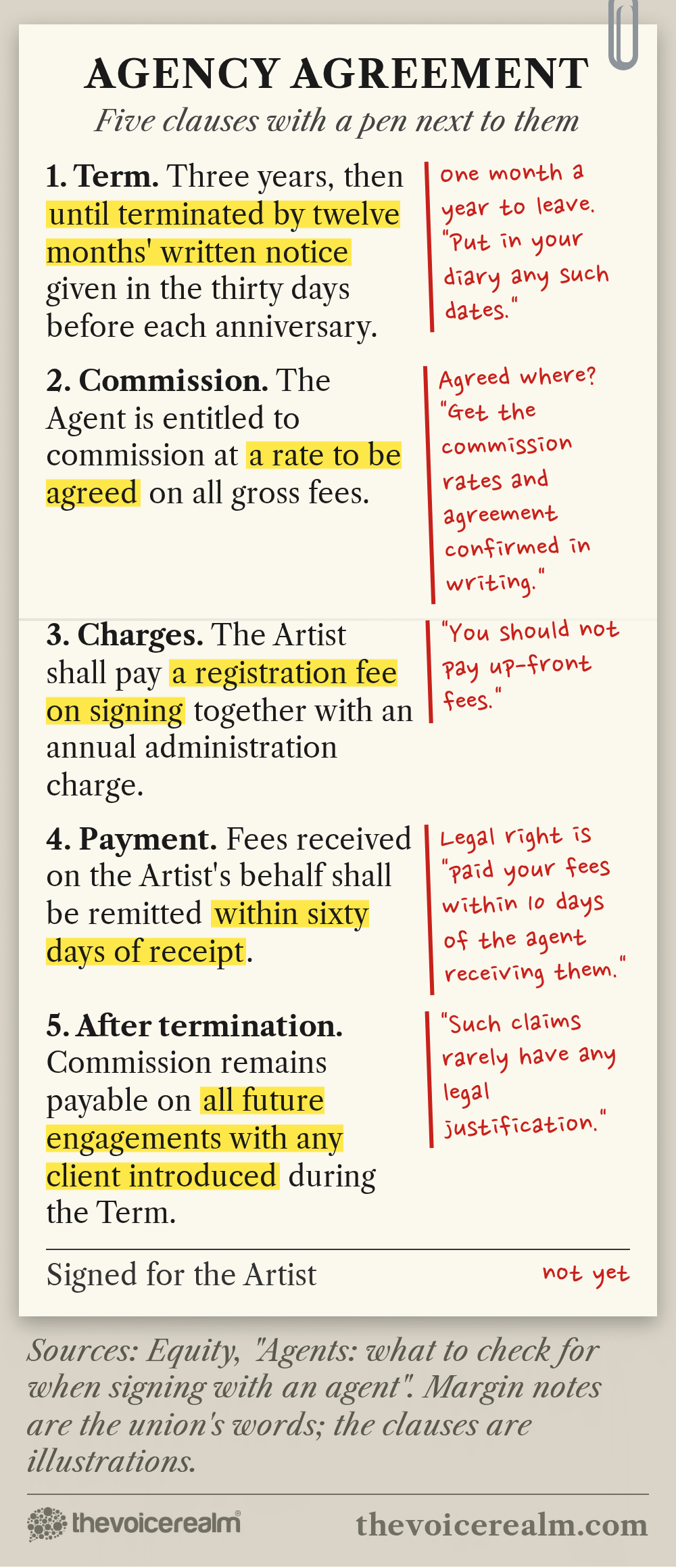
Equity, the UK performers’ union, publishes a checklist for exactly this moment, and it’s useful wherever you live because the traps are the same everywhere. Its first instruction is the one most people skip: “Insist on a written agency agreement.” A verbal arrangement is still a contract, the union points out, but with nothing on paper, “failure to do so can lead to disputes later on about what was actually agreed.”
The clauses it tells performers to look at are the length of the term, the notice period and when you’re allowed to give it, what the agency can charge beyond commission, how fast they pay you, and whether they claim a cut of your income after you’ve left. The marked-up page above shows the union’s exact words beside each one. Any agent who wants money from you before they’ve earned any is not an agent, and a clause that claims commission forever on a client they introduced is one to query before you sign, not after.
If you’re a member of a union, send them the contract before you sign it. That’s what they’re for. If you’re not, the checklist is public, and an agency worth joining won’t mind you asking about any line on it.
Once you’ve got one
Getting signed feels like crossing a line. It’s closer to a starting line. The auditions arrive on the agent’s schedule, often with a few hours’ notice, and your job is to turn each one around cleanly from a studio that’s always ready. Good reads and clean files bring more. Missed deadlines quietly end them.
Open the door
Hear about the job, pick who fits, send the audition, chase the fee, negotiate the terms, take the commission.
Walk through it
Keep the studio ready, turn auditions round fast, train, book your own direct work, deliver on time, keep them updated on what you’re making.
Baker is firm about where the weight sits: “The heavy lifting in moving your career forward is essentially your own responsibility. Growing as an artist, improving your creative powers, drawing employment to you is mostly your department.” He has a whole page on whether to call your agent and ask for more auditions, and the short version is don’t. What they want instead is news: “check in with your agent to keep them updated on your progress, your growth, all you are making, all you are learning.” An agent, in his words, “wants to hear from a growing, thriving creative power that is becoming a more interesting, able and competitive” actor. Be that, and the calls take care of themselves.
It’s also fine for it not to work out. “It is a business relationship that must work for both parties, otherwise it’s time to part ways when your contract is up.” That’s why the notice clause mattered.
If the answer is no, for now
Most first submissions get no reply. That’s not a verdict on your voice. It’s a roster that’s full, a category that’s covered, or a day when the email went under something else. Keep booking direct work, keep the demo current, keep auditioning well, and send again in a year with better credits and ideally a name attached. The reason some people audition a lot and book a little is usually fixable, and fixing it is also what makes you worth signing.
An agent is a multiplier. Ten percent of a career that’s already moving is a good deal for both of you. Ten percent of nothing is why they say no. Build the thing first, and the door opens a lot more easily than the stories suggest.
Sources: Dee Bradley Baker, I Want To Be A Voice Actor, “Getting an Agent”, “Working with Your Agent” and “Should I Bug My Agent for More Auditions?”; Sue Terry Voices, “Representation” page on the agency’s website; Voices&Co, “Submissions”; Equity, “Agents: what to check for when signing with an agent”.
Ready to get booked?
See the jobs open right nowAbout Sarah Robbins
Sarah Robbins writes for The Voice Realm about finding voice over work, home studios, casting and the business side of voice acting.