Blog

This one’s for voice actors who’ve just been handed a villain audition, or who want one on the demo. Most people’s first instinct is the same: drop the voice as low as it’ll go, add a growl, and say every line like a threat. It sounds villainous for about four lines. Then it sounds like everyone else in the casting folder, and by page three it’s started to hurt.
Below is how working actors find a bad guy who’s actually frightening, why quiet usually beats loud, five kinds of villain and how each one tends to sound, and how to keep the gravel without wrecking your voice for the rest of the week.
Start with what the villain wants, not how he sounds
The fastest way to a flat villain is to play “evil.” Evil isn’t something a person can do. Wanting something badly enough to hurt people for it is.
Alex Organ, the English voice of Loid Forger in SPY x FAMILY, put it neatly in an interview with Anime Corner. Asked whether heroes or villains were more rewarding, he said the label hardly matters “because, frankly, very few villains think of themselves as villains.” “It doesn’t really do me a lot of good to think of a character I’m playing as a bad guy because bad guys don’t think what they’re doing is bad.”
So before you make a single sound, write one line on the script: what this person wants, in their own words. Not “to destroy the city” but “to make them finally pay attention.” Not “to kill the hero” but “to protect what’s mine.” The want gives you the colour. A villain who wants respect sounds wounded and proud. A villain who wants control sounds patient. A villain who wants revenge sounds like someone who’s rehearsed this conversation for years.
Then ask what they think of the person they’re talking to. Most great villain scenes are a conversation with someone the villain finds disappointing, amusing or useful. That attitude does more for the read than any pitch you can put on it.
Why quiet is scarier than loud
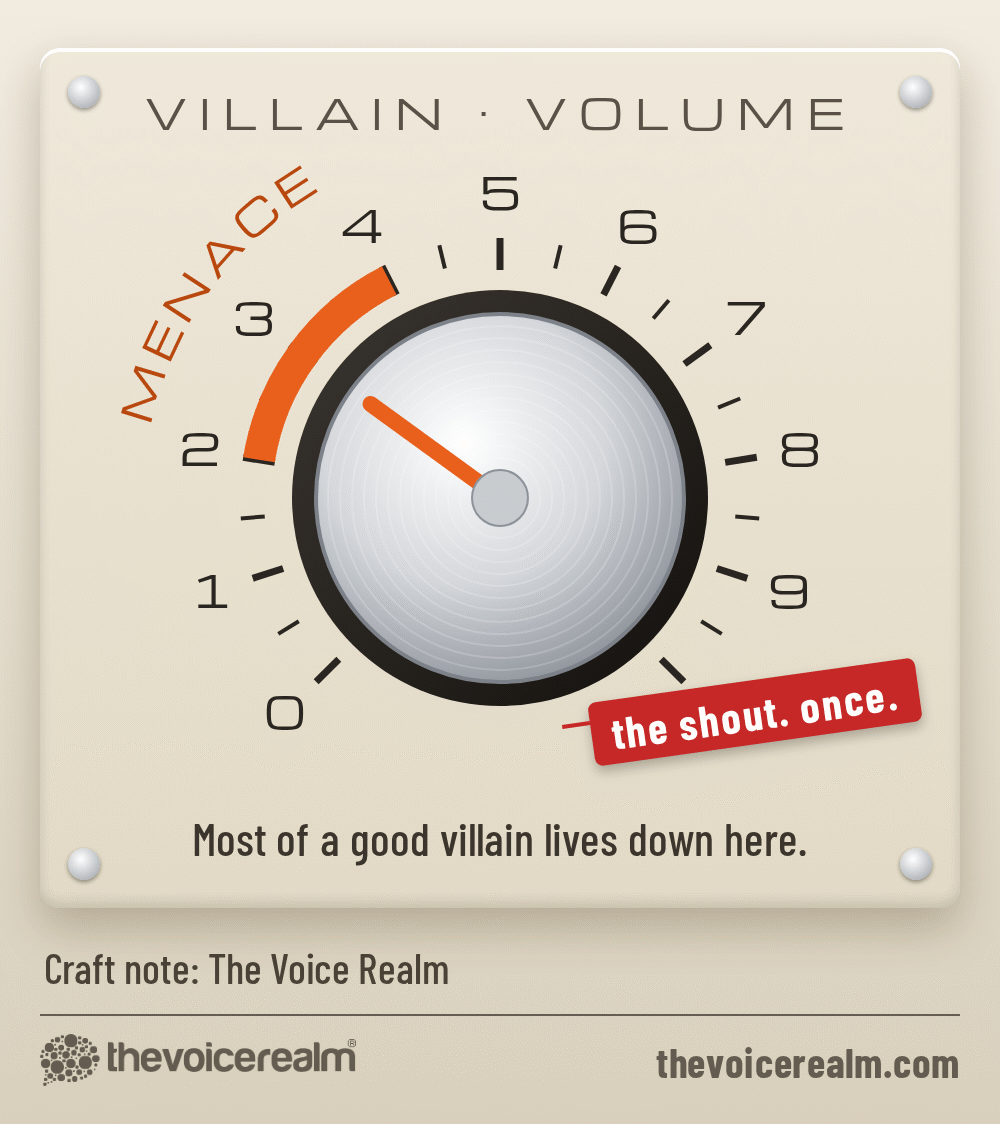
Think about who frightens you in real life. It’s rarely the person shouting. It’s the one who goes very calm, very polite and very still. Shouting is what people do when they’ve lost control. Quiet is what people do when they’re sure they have it.
That’s the single most useful thing to know about villain reads. If your bad guy is powerful, let them be the calmest voice in the room. Slow down. Leave the pause before the line, not after it. Let a smile sit behind the words, as if this is all going exactly the way they planned. A villain who sounds slightly amused is far more unsettling than one who sounds angry.
Quiet also works with the microphone rather than against it. Move in a little closer and drop your volume, and the mic picks up the warmth and the small sounds of breath and lips that make a voice feel like it’s right beside the listener’s ear. That intimacy is creepy in exactly the right way. Just watch your plosives when you get close, and angle slightly off the capsule.
The big moment still matters. But a villain who’s been quiet for a whole scene and then raises their voice once is terrifying. A villain who shouts every line has nowhere left to go.

© The Voice Realm
Five kinds of villain, five different sounds
Scripts and casting notes tend to describe a handful of familiar bad guys. Knowing which one you’ve been handed tells you where to start.
The mastermind. Calm, precise, always three moves ahead. Speak slower than feels natural, finish every consonant cleanly and keep the pitch steady. They don’t need to persuade anyone, so there’s no push in the voice at all.
The charmer. Warm, funny, likeable, and that’s the trap. Play them as the nicest person in the scene. Smile through the lines, use your real speaking voice and let the menace live in what they say rather than how they say it.
The true believer. They think they’re the hero. Play the conviction, not the cruelty: the energy and certainty of someone giving the most important speech of their life. This is the one Alex Organ is describing, and it’s the hardest to play as a cartoon.
The brute. Big, physical and short on words. This is where the low growl lives, and also where people get hurt. Put the weight in your body and your chest rather than squeezing your throat, keep the lines short and save the real effort for the few moments that need it.
The wildcard. Unpredictable, giggly, swinging from playful to furious mid sentence. The sound here is change itself: sudden shifts in pace, pitch and volume. Plan where the swings go so they feel spontaneous in the take, rather than improvising them and losing control of your voice.
Most real villains are a blend. A mastermind with a charmer’s smile, a true believer with a brute’s temper. Pick the main one and borrow a little from a second.
© The Voice Realm
Build the sound from the person
Once you know who they are, the voice can follow. Our guide to building a character voice from the inside out covers the full method, and it works just as well for bad guys. A few things matter especially here.
Posture changes everything. Stand like the character. A mastermind stands tall and completely still. A brute leans forward with weight in the shoulders. A wildcard can’t stay still at all. Your body does half the voice work for you if you let it.
Choose where the voice sits. A lot of villain colour comes from placement rather than pitch. Bring the sound forward to the teeth and lips for something clipped and cold. Let it sit a little in the nose for something sneering. Keep it in the chest for weight. None of those needs you to push your pitch down to the floor.

 VoiceEditSuiteNewAuto Clean Up now learns you.Learns from numbers, never your audio. Never used to train AI.See how it works
Keep the jaw loose. Clenching your teeth to sound menacing is very tempting and very tiring. It squeezes the sound and tires your voice in minutes. If you notice your jaw locking up on angry lines, our piece on letting go of jaw tension has a few quick releases you can do between takes.
Find one signature habit. A tiny laugh before a threat, a very slow “s,” a habit of saying the hero’s name as if it tastes funny. One small, specific choice repeated through the script makes a villain memorable. Five of them makes a cartoon.
© The Voice Realm
Play the scene, not the snarl
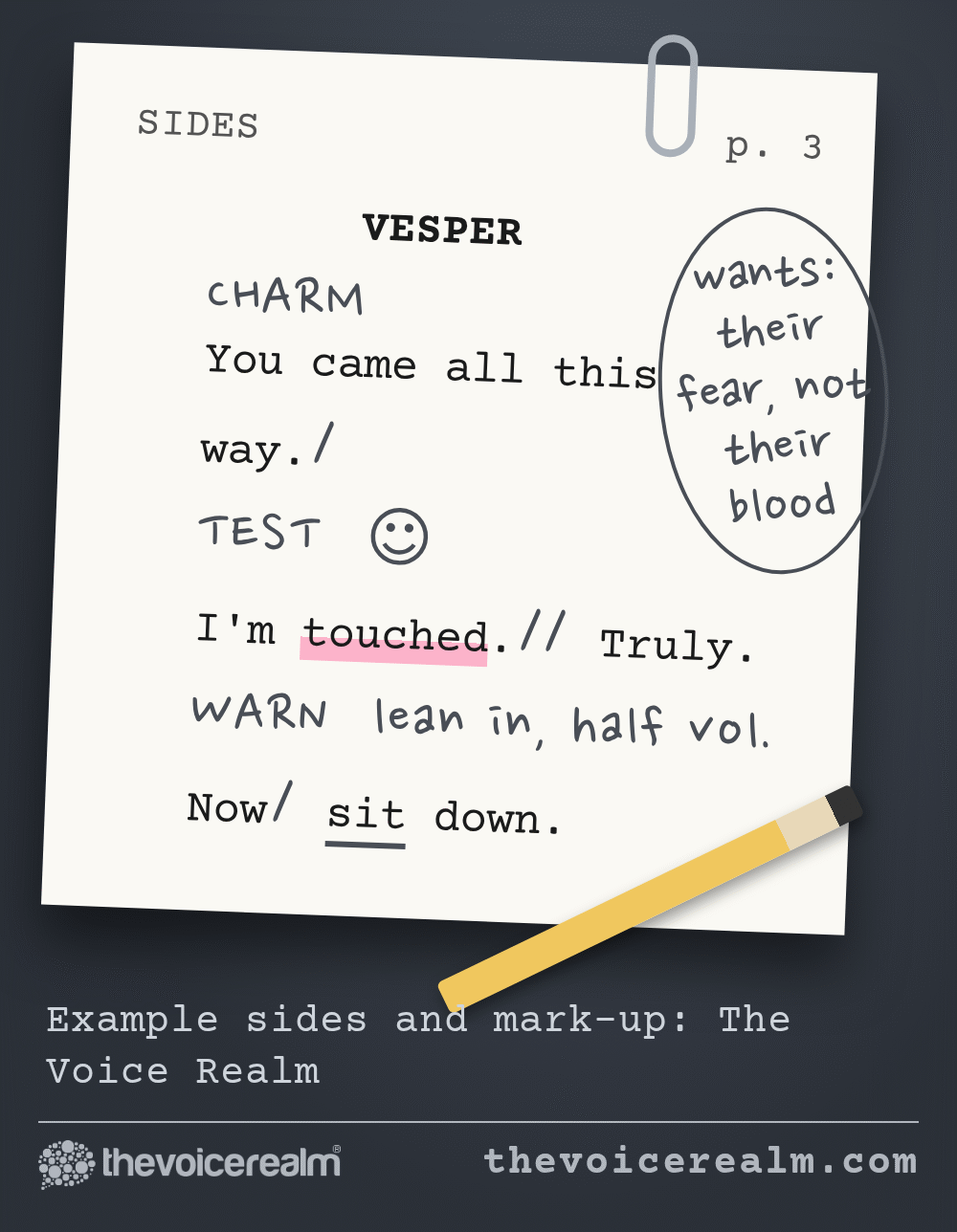
On every line, ask what the villain is trying to do to the other person. To charm them, to test them, to frighten them, to make them doubt themselves. Those are actions you can play. “Be menacing” isn’t.
Kellen Goff, who voices Overhaul in the English dub of My Hero Academia, talked about this in a recent Anime Corner interview. Describing what drives the character, he said “he’s not bad for the sake of being bad. He’s bad when he wants to hit someone back.” That one sentence tells you how to play a whole scene. Overhaul isn’t cruel at random. He’s settling scores, so every line has a target and a reason.
Write those actions in pencil above the lines, one verb each. It stops every line coming out in the same dark tone, and it gives a director something clear to adjust. If they say “more threatening,” you can change the action from testing to warning without changing your whole voice.
It also keeps you open to the other character, even when you’re recording alone. Picture the person in front of you and how they react. A villain who’s listening is far more dangerous than one who’s just waiting for their next line.
© The Voice Realm
Keep the growl off your vocal folds
Villain work is where a lot of voice actors first hurt themselves. Long sessions of low, rough, pushed sound add up quickly, and the damage often isn’t obvious until the next morning.
The Cleveland Clinic lists the signs of a voice disorder plainly. Your voice may sound strained, raspy or hoarse, or “Too high or too low,” and speaking may hurt or take a lot of effort. It also notes that “Overusing your voice is the most common cause of voice disorders. You can overuse your voice by yelling, singing or just talking too much.” A day of growling is all three.
A few habits keep the villain in your performance and out of your throat:
- Make rasp with air, not squeeze. A breathy, textured sound is far kinder than grinding your folds together. If it scratches or tickles, stop and reset.
- Don’t live at the bottom of your range. Pick a pitch a little lower than your own, not the lowest you can manage. Let placement and pace do the rest.
- Record the big stuff last. Get the quiet scenes in the can first. Screams, roars and fights go at the end, when there’s nothing left to protect.
- Drink water and take breaks. Little sips between takes, and a few minutes of silence every half hour or so.
If you’re asked for full screams or death cries, our guide to screaming safely in voice acting covers it in detail. And if a gravelly villain keeps turning into a creak at the end of every line, that’s vocal fry, which has its own fixes. Hoarseness that’s still there after a couple of weeks is a job for an ear, nose and throat specialist, not another take.

© The Voice Realm
Recording a villain audition at home
Villain auditions reward contrast. If the sides allow two takes, make them genuinely different: one quiet and controlled, one with more heat. Casting can hear your range, and you’ve given them an easy choice.
Don’t open with the biggest line in the sides. Start with something that shows the character’s mind and save the explosion for later, so it lands as a surprise. Slate in your own friendly voice, then switch. That small jump between you and the villain shows control.
“Shouting is what people do when they’ve lost control. Quiet is what people do when they’re sure they have it.”
The Voice RealmPost this quote
Watch your levels. A villain read can swing from a whisper to a shout, and your gain needs to handle both without clipping. Set it for the loudest moment and lean in for the quiet ones rather than the other way round.
If you’re new to character work and want a structured way to build these skills, Voice Master Academy’s voice acting courses are a good place to practise with feedback. And when you’re ready to put your bad guy in front of real clients, there are fresh castings most days on the voice over jobs board, including animation, games and audio drama roles.
The short version
A great villain doesn’t think they’re the villain. Work out what they want, let them be calm when they could shout, build the sound from their body and their purpose, and keep the rough stuff light enough that you can do it again tomorrow. The growl is the last thing you add, not the first.
Sources: Andrea Tran, Anime Corner, “Interview: Alex Organ on Journey From Theater to Voice Acting”; Jay Gibbs, Anime Corner, “Interview: Kellen Goff, Voice of Overhaul, Diavolo, Carnage, and More”; Cleveland Clinic, “Voice Disorders”.
Ready to get booked?
See the jobs open right nowAbout Sarah Robbins
Sarah Robbins writes for The Voice Realm about finding voice over work, home studios, casting and the business side of voice acting.