Blog

If you audition for voice work, you’ll hear no far more often than yes. Usually you won’t even hear no. You’ll hear nothing at all. This guide is for anyone who’s sent off a take they were proud of and then spent the evening refreshing their inbox. It covers why most auditions don’t book for reasons you’ll never see, what psychologists say about why it stings, and a simple routine that lets you send it, forget it and keep going.
Most no’s have nothing to do with you
Start with the thing that’s hardest to believe in the moment: the decision usually isn’t about whether you were good.
Psychologist Guy Winch, writing for TED, puts it plainly: “Most rejections, whether romantic, professional, and even social, are due to ‘fit’ and circumstance.” Voice casting is almost pure fit. The client may want someone who sounds like the founder. The game may need a voice that contrasts with the two leads already cast. The brand team may have heard a celebrity read in their heads before they wrote the brief. None of that is visible to you, and none of it is fixable by you.
Natalie Malizia, writing for the voice coaching company Such A Voice, says the same from the actor’s side, in a list of ways to handle a no: “Remember that there can be endless reasons for this rejection that have nothing to do with you.”
There’s also the simple fact that the person you sent your audition to often isn’t the one who decides. Casting and voice director Hugh Edwards, writing for the training company Gravy for the Brain about casting a video game, explained that he shortlisted the voices but the games publisher had the final say. Your read can impress the casting director and still lose in a meeting you’ll never hear about.
And the maths is brutal. Edwards shared his own numbers from that game, and we’ve put them on the ticket below. Look at the middle figure. Most of the actors he shortlisted made it through a tough first cut, were plainly good enough for the job, and still didn’t book. If one of them was you, you’d never know how close you came.

© The Voice Realm
What the person listening actually hears
It helps to picture the other end. Dee Bradley Baker, a working voice actor who runs a free advice site for newcomers, describes it bluntly: “When the decision-maker listens through a few hundred auditions, the rapidly conceived verdict is either ‘perfect’ or ‘delete.’”
He adds: “A few seconds of listening is generally enough to render the verdict.”
That sounds harsh, but it’s oddly freeing. A no after a few seconds of listening isn’t a careful grade on your whole career. It’s a quick yes or no on whether your voice matched the picture in someone’s head on one particular afternoon. Next week, a different picture, a different head.
It also tells you where to spend your effort. Those first few seconds matter enormously, so start strong, cut long slates and silence, and make a clear acting choice from the first word. Our guide on why you might be auditioning without booking goes into the technical side of this.
Why one no stings so much
If rejection is mostly about fit, why does it hurt so much? Winch’s answer is that we pile on extra damage ourselves. In the same TED piece he writes, “The greatest damage rejection causes is usually self-inflicted.”
He describes what that looks like: “We call ourselves names, lament our shortcomings, and feel disgusted with ourselves.” Sound familiar? “I’m not good enough for animation.” “My voice is boring.” “Everyone else has better gear.” Winch also points to brain imaging research suggesting that rejection lights up some of the same areas as physical pain, which is why it can feel so oddly physical.
The trap for voice actors is the volume. A stage actor might go to a handful of auditions a month. A voice actor working from home might send several a day. If each no gets the full inner critic treatment, you’re beating yourself up dozens of times a month for things that, as we’ve just seen, mostly had nothing to do with you.

© The Voice Realm
Send it and forget it
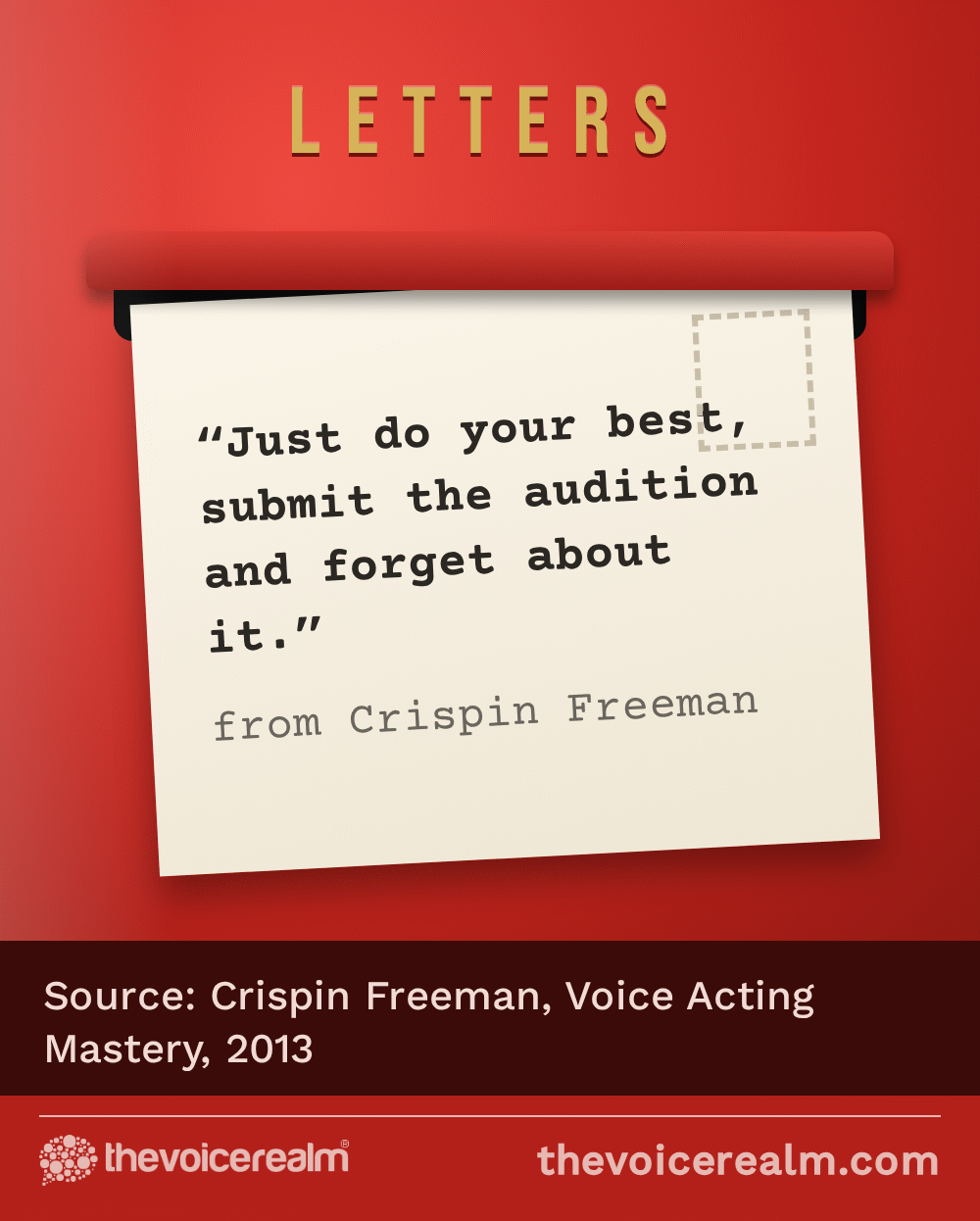
The most useful habit you can build is a firm line between sending an audition and thinking about it. Crispin Freeman, a working voice actor and coach who hosts the Voice Acting Mastery podcast, has a simple rule for this, which he gave a listener in the comments under an episode on rejection. We’ve put it on the envelope below.
He also told the same listener that “Going into an audition with nothing to lose is absolutely the best mindset.” It’s hard to feel you have nothing to lose while you’re still waiting on the last three. So build a routine that closes each one off.
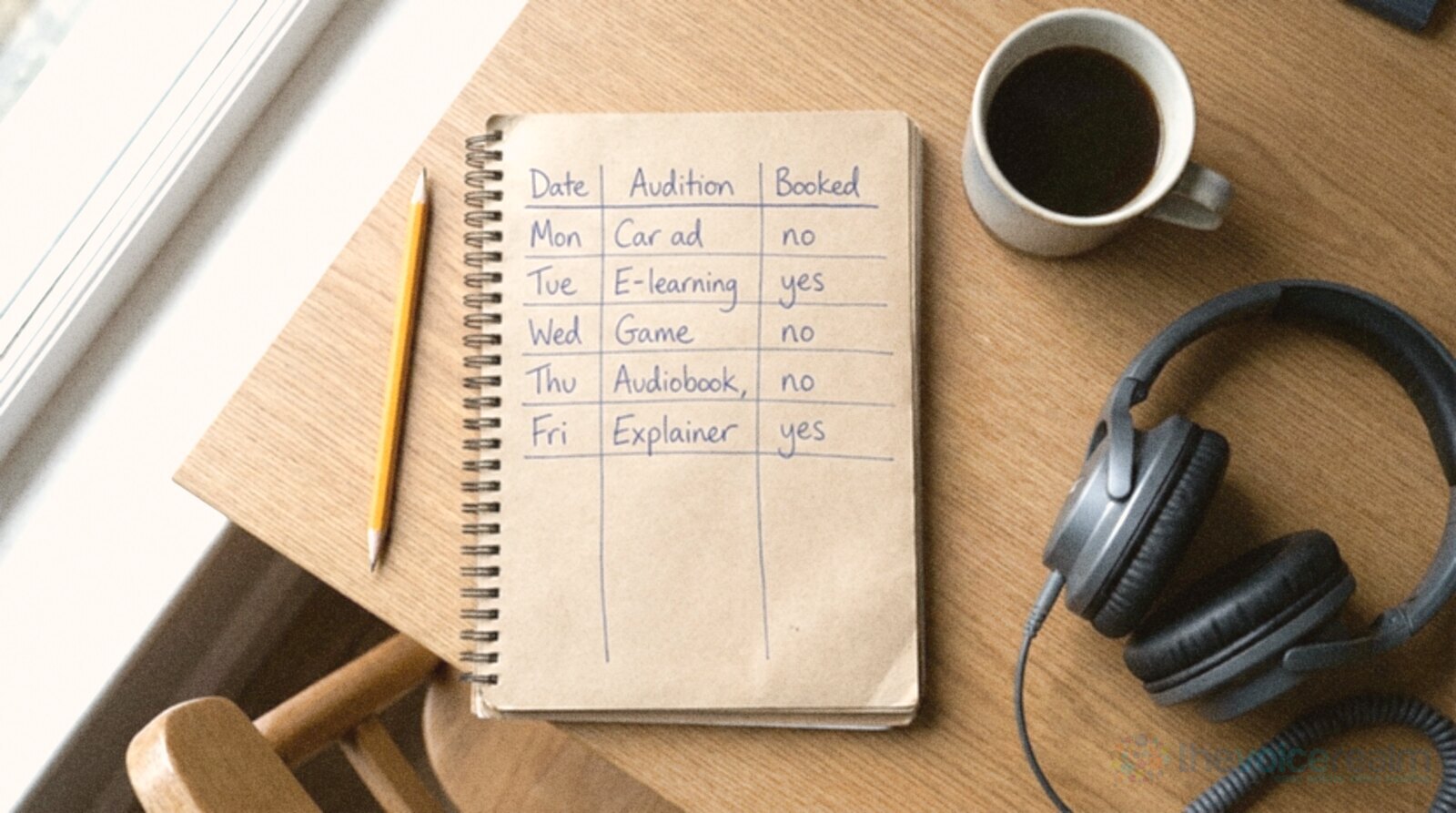
- Log it. Date, job, genre, where it came from. Thirty seconds, then done.
- Close the tab. Shut the script and the brief. Don’t listen back again.
- Start the next thing. Another audition, a marketing task, a practice read. Momentum beats rumination.
- Review monthly, not daily. Look at your log once a month, never after each audition.
The point of the log isn’t to keep score on yourself. It’s so your brain can let go, because the information is written down somewhere safe. People who don’t log tend to carry a running list in their heads, and that list gets heavier every day.
If waiting makes you anxious before you’ve even recorded, our piece on calming audition nerves has breathing and focus techniques that help on both sides of the send button.
© The Voice Realm
Learn from the pattern, not the single audition
One audition tells you almost nothing. Fifty tell you a lot.
Once a month, sit down with your log and look for patterns. Work in percentages of your own auditions rather than raw counts:
- Genres. Are your bookings coming mostly from e-learning while you’re spending most of your time on game auditions? That’s worth knowing.
- Sources. Which places send work you actually book? Put more time there.
- Turnaround. Do you book more when you audition within a few hours of a job going up? Many actors find they do.
- Read style. If you saved notes on your choices, do the bookings share one?
This turns rejection from something that happens to you into data you can use. A month with no bookings in one genre and two in another isn’t a verdict on your talent. It’s a direction.

 VoiceEditSuiteNewYour breath. Your pace. Your edit.Learns from numbers, never your audio. Never used to train AI.See how it works
Feedback helps too, but get it from the right people. A coach or a trusted working actor can listen to a batch of your auditions and spot what you can’t hear. Asking a client why you weren’t chosen rarely gets a useful answer, and it can come across as pushy.
© The Voice Realm
Talk to yourself like a coach, not a critic
Some people worry that being kind to themselves will make them lazy. Research on self-compassion suggests the opposite.
Psychologist Kristin Neff, in an interview with UC Berkeley’s Greater Good Science Center, describes it like this: “Self-compassion is a way of relating to ourselves kindly when we fail.” She warns that harsh self-talk backfires: “Self-criticism is very strongly linked to depression.” And she says that when self-compassionate people miss a goal, “they’re much more likely to pick themselves up, dust themselves off, and re-engage in a new goal.”
In practice, after a no, try saying what you’d say to a friend in the same spot. “That was a good read. It wasn’t their pick. There’ll be another one tomorrow.” Then go and do something that reminds you what you’re good at. Winch recommends exactly that: “The best way to boost feelings of self-worth after a rejection is to affirm aspects of yourself you know are valuable.” Reread a kind note from a past client. Listen to the best job you’ve ever delivered. Write down three things you do well at the mic.
Malizia ends her list on a note worth keeping: “Rejection means you’re brave enough to go after a dream, and that’s something to celebrate.”
Build a week that one no can’t sink
Rejection hurts most when everything rides on one job. The fix is structural: spread your hopes out so no single audition carries too much weight.
- Audition steadily. A regular flow means each one matters less. Keep an eye on the latest voice over jobs and make sending auditions a daily habit rather than an event.
- Market between auditions. Direct clients, repeat customers and your own website all bring work that never goes through an open audition.
- Keep training. Classes give you a room where a stumble is expected. If you’re just starting out, a structured course such as Voice Master Academy gives you feedback and a plan, which takes some of the guesswork and sting out of early auditions.
- Find your people. Other voice actors understand exactly how a week of silence feels. A coffee with one of them is worth more than an hour of scrolling.
Talent matters, but so does staying in the game long enough for it to show. Our piece on whether talent alone is enough makes the case that persistence is a skill you can practise.

© The Voice Realm
When it’s more than a bad week
Everyone has a flat day after a run of no’s. That’s normal. But if low mood hangs around for weeks, stops you sleeping or eating, or makes it hard to face the mic at all, that’s more than rejection talking. Speak to your doctor or a mental health professional. Freelancers carry a lot alone, and getting support is part of looking after your career, not a sign it’s failing.
For the ordinary weeks, keep it simple. Do your best read, send it, log it, close the tab and start the next one. The audition that books will often be the one you’d already forgotten about.
Sources: Guy Winch, “Why rejection hurts so much, and what to do about it”, TED Ideas, 2015. Natalie Malizia, “Five Steps for Mastering the Art of Rejection”, Such A Voice, 2024. Hugh Edwards, “Getting Cast For Voiceover Work: Why You’re Not Working!”, Gravy for the Brain, 2015. Dee Bradley Baker, “Home Alone: Why Don’t I Book?”, I Want To Be A Voice Actor. Crispin Freeman, “VAM 045: Dealing with Rejection”, Voice Acting Mastery, 2013. Jason Marsh, “The Power of Self-Compassion”, interview with Kristin Neff, Greater Good Science Center, UC Berkeley, 2012.
Ready to get booked?
See the jobs open right nowAbout Sarah Robbins
Sarah Robbins writes for The Voice Realm about finding voice over work, home studios, casting and the business side of voice acting.