 Blog
Blog

This one’s for UK businesses, producers and agencies who need a voice for an advert, a corporate film or a phone line, and for the voiceover artists who’d like to be the one they find. Every working day, someone in Britain types “voiceover artist UK” into Google with a deadline looming. We pay close attention to what they type next, and it’s a big part of why The Voice Realm is now the fastest growing voiceover platform in the UK. Here’s what British clients search for, why demand for voices keeps climbing, and how to book the right one without a week of emails.
What Brits type when they need a voice
British searches have their own vocabulary. It’s “voiceover”, usually as one word, and “advert” rather than “ad”. People search “British voiceover”, “voice over artist London”, “Northern voiceover”, “Scottish voiceover artist” and “RP voiceover” when the accent matters, and “corporate video voiceover”, “explainer video voiceover” or “voiceover for advert” when the job does. A surprising number add the word “professional”, which tells you they’ve already tried doing it themselves and listened back.
Three patterns jump out. British clients are precise about accent in a way few other markets are, because in the UK an accent says where you’re from, and listeners hear it in the first two words. They search by format, because they know the audio is for a LinkedIn film or a radio spot long before they’ve pictured the voice. And they search with “UK” on the end because they want someone who understands the market, the pronunciations and the tone that works here.
That last point is the one we built the UK side of The Voice Realm around. If a marketing manager in Leeds types “Yorkshire voiceover for advert”, the answer shouldn’t be a wall of generic profiles. It should be a handful of real Yorkshire voices with demos you can play straight away.

© The Voice Realm
Video ate the advertising budget, and video needs a voice
The demand behind those searches is real, and it’s growing. IAB UK’s Digital Adspend study, run with Oliver Wyman, found the UK’s digital ad market grew 10 per cent in 2025, “significantly outpacing UK GDP growth of 1.4%”. Video led the way. Investment in video across social platforms, broadcasters, streamers and publishers rose 20 per cent year on year, outpacing the market as a whole.
Jon Mew, chief executive of IAB UK, put it simply: “Digital advertising has continued to show resilience in a challenging environment.” The report also says the market is forecast to keep growing through 2026 and 2027.
Every one of those videos is a script waiting for a voice. A social advert, a product demo, a training module, a charity appeal: most of them work with the sound off, and almost all of them work far better with it on. Podcasts are pulling in the same direction. IAB UK’s figures for 2024 showed podcast advertising still growing year on year, and every sponsor read, trailer and show intro is another booking for a British voice.

© The Voice Realm
Britain’s fastest growing voiceover platform
So why are more UK businesses booking through us? Because we took the slow parts out. You describe the job, British voiceover artists send free auditions reading your actual script, and you choose the one that sounds right. No chasing agents for availability, no picking from a headshot, no paying before you’ve heard a word.
When you hire a British voiceover artist with us, the first auditions usually arrive within hours and the finished recording typically comes back within a day of booking. The voices are working professionals from all over the UK, recording in their own treated studios, and if the first take needs a tweak, the artist sorts it. You get to compare real reads side by side, which is the only way anyone has ever really chosen a voice.
Most of our growth has come from clients coming back. A Bristol agency tries us for one explainer and then sends its whole client roster. A Glasgow charity books an appeal, then a podcast intro, then a set of phone messages. When the process is easy, people use it again.
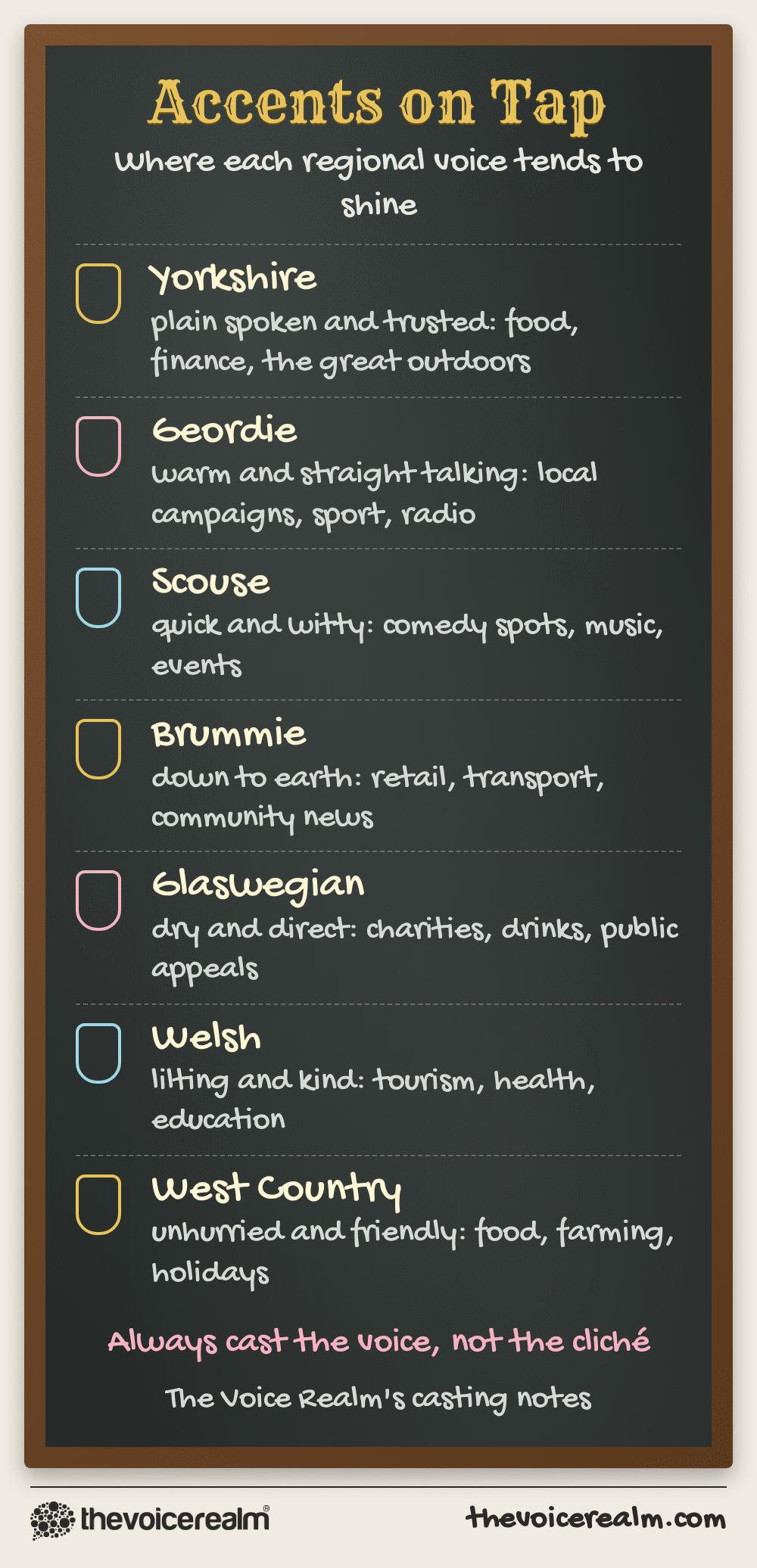
It’s not just England, either. Clients in Scotland, Wales and Northern Ireland have spent years being handed a London voice by default and told it would do. It often doesn’t. A tourism film for the Highlands, a health campaign in Cardiff or a recruitment advert in Belfast lands far better in a voice its audience recognises, and those are exactly the briefs where we see clients light up when the auditions arrive. Some of those jobs need a bilingual read too, and Welsh speaking voiceover artists are worth their weight in gold when the script switches language halfway through.
© The Voice Realm
Accents are Britain’s secret weapon
Few countries pack so many distinct accents into so little space. Drive an hour in almost any direction and the vowels change. For a brand, that’s an advantage, because the right accent can do in two seconds what a paragraph of copy struggles to do: tell the listener who you are and whether you’re on their side.
 VOICEMASTERACADEMYFirst read to first booking.Twenty modules. The first one is free.Start free
The trick is matching the voice to the audience and the message rather than defaulting to the sound you heard on the last advert. A national bank and a local brewery shouldn’t sound the same, and a Newcastle campaign that’s voiced from somewhere else will be noticed. If your audience is in the capital, London voiceover artists cover everything from crisp received pronunciation to relaxed Estuary and the multicultural London English younger listeners hear every day.
Accents also carry the place names. A local voice knows that Bicester, Loughborough and Keswick aren’t said the way they’re spelt, and won’t need a pick-up session to fix it. Clients don’t always think to brief this, and a good voiceover artist will ask.

© The Voice Realm
Corporate, training and the jobs nobody talks about
Adverts get the attention, but a huge share of British voiceover work never goes near a TV. It’s the induction video for new starters, the compliance module everyone has to finish by Friday, the investor film, the museum audio guide and the menu you hear when you ring the council. These jobs need a voice that’s clear, warm and trustworthy for a long stretch, which is a different skill from selling a sofa in 30 seconds.
If that’s your brief, browse our corporate voiceovers and listen for stamina as much as tone. Ask for a longer audition if the script runs past five minutes, because the voice that sparkles for one paragraph isn’t always the one that holds attention for twenty. We covered what makes a read sell in our guide to commercial voice over, and a lot of it applies to corporate work too: know who’s listening, and talk to one of them.

© The Voice Realm
How to brief a UK voiceover so the auditions hit the mark
A good brief is the cheapest way to a great recording. Voiceover artists can only aim at the target you describe, and the clearer it is, the closer every audition lands.
“Friendly British voice, female, 60 seconds.”
Every artist guesses what friendly means, nobody knows where it will play, and you spend the afternoon listening to thirty different ideas of the same thing.
“Warm Northern female, like a neighbour giving good advice.”
Where it plays (a LinkedIn film and the website), who’s watching (small business owners), the feeling (reassuring, not salesy), any tricky names spelt out, and the script timed to fit.
When the auditions come in, play them on the speakers your audience will use: a laptop for a website film, a phone for a social advert, a car stereo for radio if you can manage it. Shortlist two or three and then pick with your ears. If you’re torn, ask both for a short paid test of the opening lines with your direction. It’s usually obvious within a sentence.
One more tip for phone audio, which British businesses tend to leave until last. Callers hear your on hold message and menu more often than they’ll ever hear your advert. Book the same voice for both so the whole call sounds like one company.
And settle the usage before the session. Tell the artist where the recording will run, for how long and in which media, because that’s what decides the fee and the licence. A social advert that later ends up on broadcast television is a different job, and agreeing that up front saves everyone an awkward email when the campaign does better than expected.
For voiceover artists: how to be found by UK clients
If you’re on the other side of the mic, those searches are your marketing plan. Name your accent the way a client would, in plain words: “Yorkshire”, “Glaswegian”, “neutral southern”, “RP”. Put your town and region on your profile. Lead your demos with the work British clients book most, adverts and corporate reads, and keep each one short. And audition early, because UK clients often choose by the afternoon.
Look after the rights side too. As we wrote in our piece on the campaign to protect British voices in law, it’s worth agreeing in writing what a recording can be used for, and keeping AI training out unless it’s been agreed and paid for. Clients who book real voices want that clarity as much as you do.
Our take
The UK has never been short of great voices. What it’s been short of is a quick, fair way for a business in Belfast or Brighton to hear the right ones before they commit. That’s what we built, and it’s why The Voice Realm has become Britain’s fastest growing voiceover platform. Video budgets are rising, audiences can hear an accent from the first word, and clients want real people who sound like they belong. Post your script, listen to the auditions, and pick the voice your customers will recognise as one of their own.
Sources: “Digital Adspend 2025: UK’s digital ad market reaches £40.5bn”, IAB UK with Oliver Wyman, 2026; “IAB UK: podcast ad market grows 8% in the UK; video grows 20%”, IAB UK via Podnews, April 2025.
Ready to get booked?
See the jobs open right nowAbout Sarah Robbins
Sarah Robbins writes for The Voice Realm about finding voice over work, home studios, casting and the business side of voice acting.