Blog

This guide is for voice actors who want more of the steady, unglamorous work that keeps a voice business ticking over between the exciting jobs: corporate narration. Onboarding videos, safety modules, product walkthroughs, the chief executive’s quarterly message, the brand film that plays on a loop in reception. It rarely makes anyone famous. It pays, it repeats, and good clients come back for every module in the series.
We’ll cover what the work includes, who’s really listening, how to find the right read, how to handle jargon and acronyms, timing to slides, and how to get more of it.
What counts as corporate narration
The SAG-AFTRA Foundation, describing a class it ran with veteran narrator Bill Ratner, called it “a somewhat ‘under-the-radar’ niche of voiceover,” and added that “there are many opportunities for voice actors to thrive in this sector.” It also gave the scope in one line: “Non-broadcast corporate narration ranges from training videos, internal communications, and corporate imaging, to public communications & branding.”
Non-broadcast is the key word. These scripts don’t run as paid ads on TV or radio. They live on intranets, learning platforms, trade show screens, websites and in meeting rooms. That’s why they can be long, why they’re often written by people who aren’t scriptwriters, and why a single client can need dozens of them a year. Union members in the United States usually work them under SAG-AFTRA’s Corporate/Educational and Non-Broadcast contract; plenty of the work is non-union too.
It overlaps with two areas we’ve covered before. If the script teaches something step by step inside a course, it’s closer to e-learning narration. If it’s a ninety-second animated pitch for a product, that’s an explainer video. Corporate narration sits around both, and it often asks for the same voice across all three.
Who’s listening, and why it changes everything
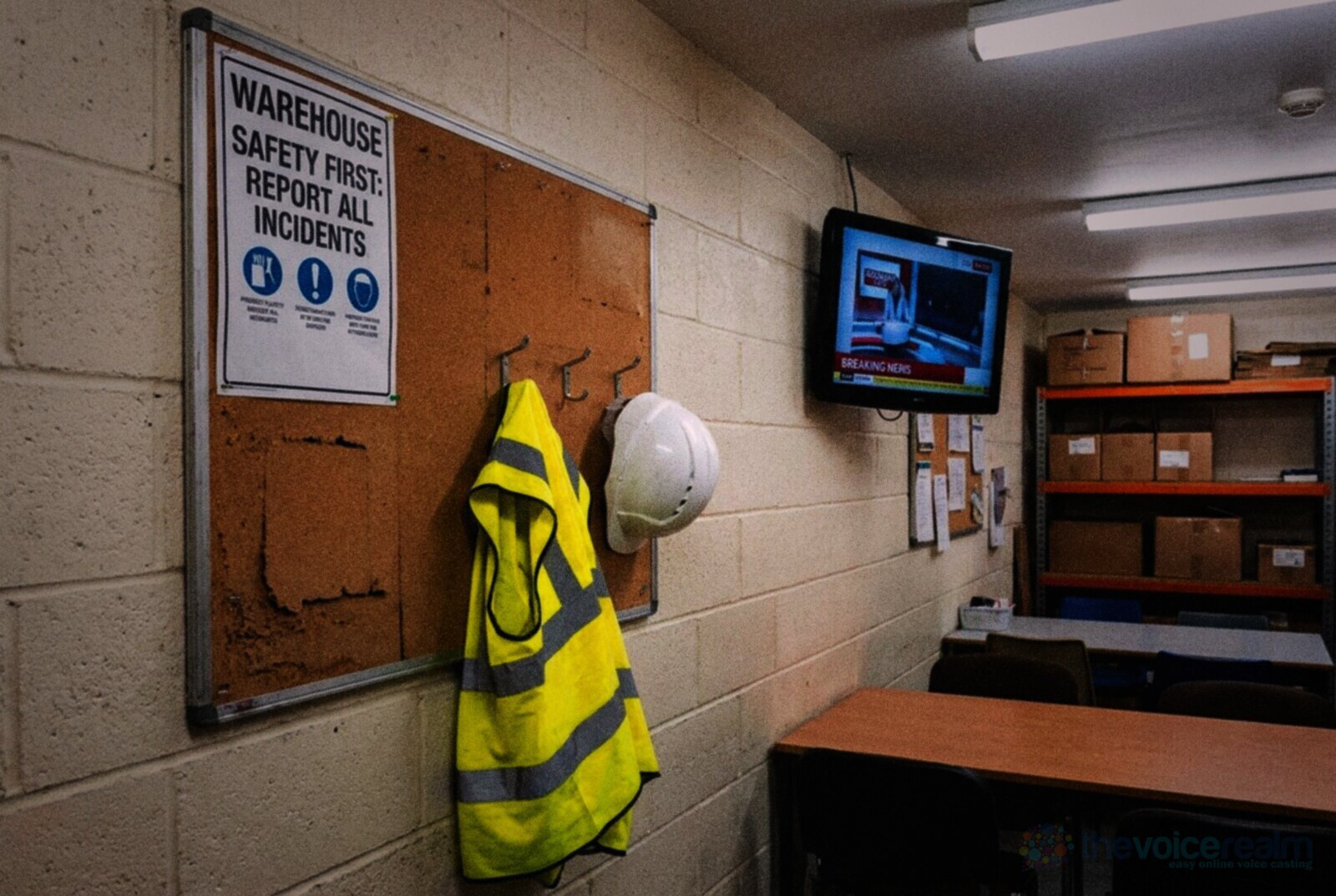
Here’s the part most narrators skip. The audience for a lot of corporate work didn’t choose to be there. A new starter is clicking through a compliance module on day two. A warehouse team is watching a safety refresher in the break room. A sales team has the product update on in the background while answering email.
That listener has a finger on the skip button and a head full of other things. Your job is to sound like the one person in the company who’s actually on their side.
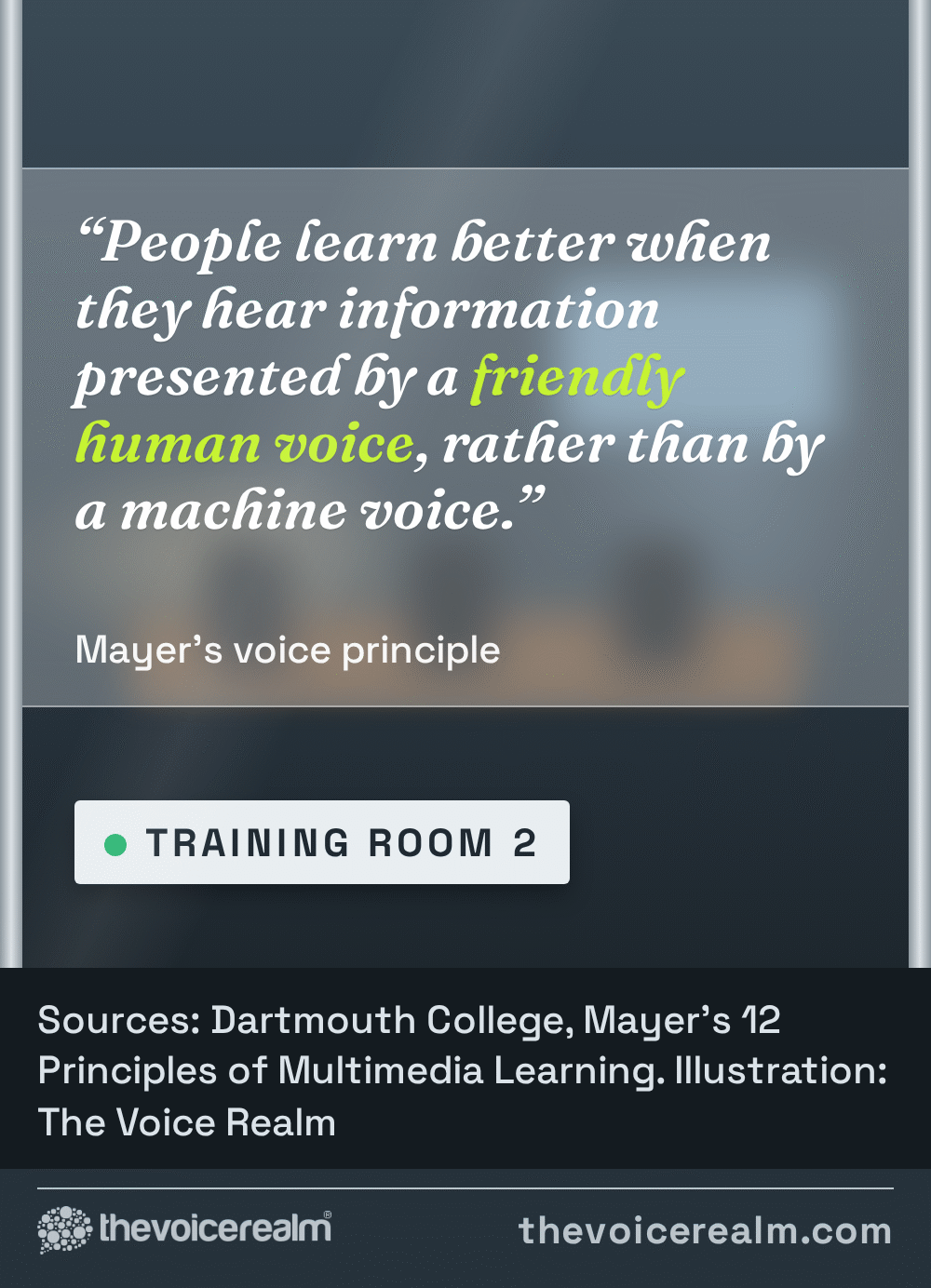
The research on learning backs this up. Dartmouth’s summary of Richard Mayer’s principles of multimedia learning puts it simply: “Learning is more effective when teachers use a friendly, conversational style, rather than a formal style.” The same summary makes a point about narration specifically, and it’s one every corporate client should hear.
Friendly is doing a lot of work there. Not bubbly, not salesy. Friendly the way a good manager is when they explain something properly the first time.
© The Voice Realm
Finding the friendly expert
The read that books corporate work most often is a knowledgeable colleague. Someone who’s done this job, likes the person they’re talking to, and wants them to get it right. It’s warmer than a news read and calmer than a commercial.
Picture one real listener before you press record. Not “employees,” but Priya in accounts on her second day, coffee in hand, slightly nervous. Talk to her. The read drops half a step in pitch, the pace evens out, and the corporate stiffness in the copy starts to sound like a person wrote it.
Watch for three habits that sink a corporate read. The announcer lift, where every sentence starts high and bright. The over-smile, which makes serious content sound flippant. And reading every line with the same weight, so the one instruction that really matters gets lost in the middle of a paragraph about company values. If you’ve been told you sound like you’re reading, our guide on making a script sound unscripted has exercises that work well here.

© The Voice Realm
Not every corporate script wants the same voice
“Corporate” covers a wide spread of tones, and the brief won’t always tell you which one you’re in. A quick way to sort them is by what the listener must do afterwards.
If they need to remember a rule, like a safety procedure or a data policy, slow down, land the instruction clearly and leave space after it. If they need to feel something about the company, like a brand film or an anniversary video, you’re closer to a documentary read with a bit of lift at the end. If they need to use something, like a software walkthrough, keep it brisk and practical and match your pace to the clicks on screen.
Clear, patient, steady
Even pace, the key rule landed and left to breathe, no sell at all. You’re the colleague making sure nobody gets hurt or fined.
Warm, proud, a little cinematic
More shape and colour in the voice, room for music, a lift into the final line. You’re telling the company’s story back to it.
The chief executive’s message is its own case. Sometimes you’re voicing their words in the third person, sometimes you’re the narrator around their on-camera clips. Either way, match their energy rather than outshining them. A narrator who sounds more excited than the boss sounds odd.
© The Voice Realm
Jargon, acronyms and the chairman’s name
Corporate scripts are full of words nobody outside the building says out loud. Product names with odd capitals, internal acronyms, regulations, place names, and the names of the senior people in the room. Get one wrong and the whole video gets pulled for pickups.

 VoiceEditSuiteYour breath. Your pace. Your edit.Auto Clean Up learns your pace from every file and puts your own pause back wherever it cuts a mistake.See how it worksLearns from numbers, never your audio. Never used to train AI.
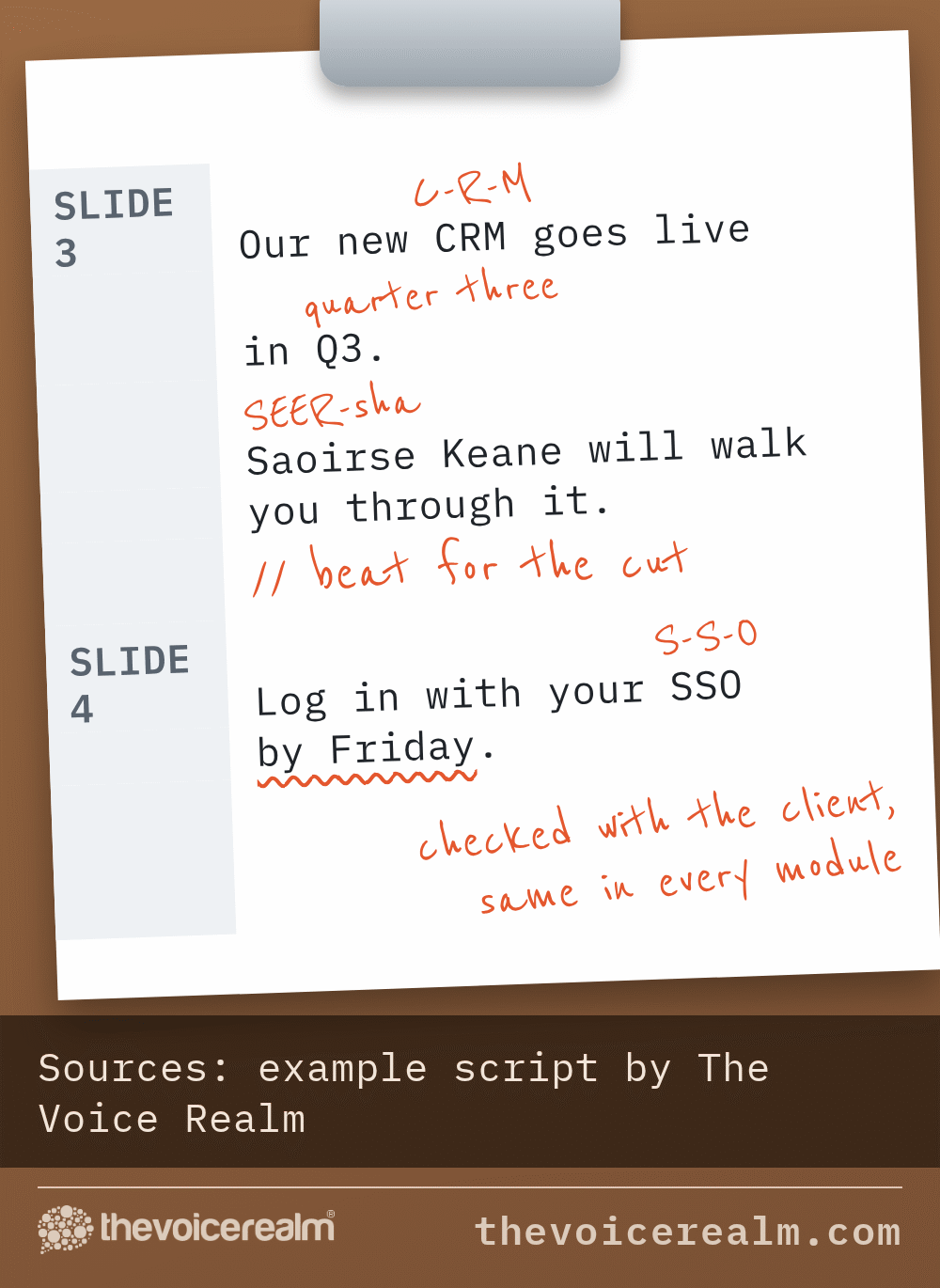
Before you record, go through the script and mark every one. Then ask the client, in one message, how each is said. Is it “S-Q-L” or “sequel”? Is “KPI” spelled out? Is it “twenty twenty-seven” or “two thousand twenty-seven” in their house style? Is the founder’s name stressed on the first syllable or the second? Most clients are delighted to be asked, because they’ve been burned before.
For anything the client can’t answer, research it properly rather than guessing. Our guide to checking how a name is said walks through where to look. Then write the answer into the script phonetically, so you say it the same way on module nine as you did on module one.
© The Voice Realm
Timing to slides and the video you can’t see
Much corporate narration is recorded before the visuals are finished. You may get a script with slide numbers and a target length, and nothing else. Leave a clean beat of silence at every slide change so the editor can cut there, and keep each slide’s section as one unbroken take where you can.
If a target length is given, time a rehearsal before you commit. A rough guide is around 150 words a minute for a relaxed narration pace, which turns a 900 word script into about six minutes. If you come in far over or under, tell the client before you deliver rather than speeding up or dragging to fit. Our piece on timing a script by word count has the maths for other paces.
When there is video, ask for a rough cut even if it’s ugly. Ten seconds of watching where the product appears on screen tells you more about pace than any written direction.
Keeping a series consistent
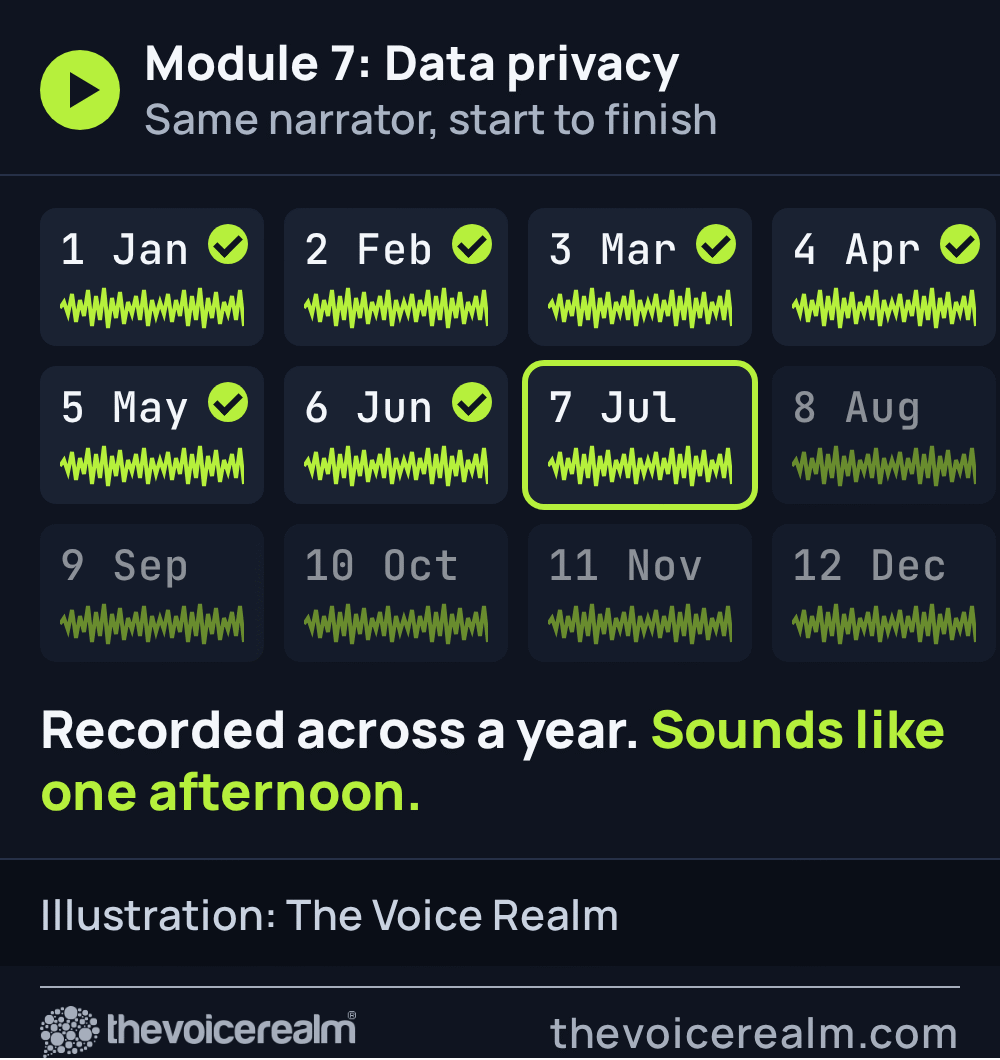
The best corporate clients aren’t one video. They’re a course of twelve modules, a library of product guides, or a quarterly message that runs for years. That’s where the repeat work is, and it depends on you sounding the same every time.
Keep a session sheet for each client: mic, position, gain, any processing, the room you used, and a note on the read. Save one finished file as a reference and listen to it before every new session. When pickups come in weeks later, you’ll match far more easily. Name your files exactly as the client’s brief asks, and keep a phonetic list of their terms in the same folder.
Corporate clients also tend to have legal and brand teams reviewing scripts, so expect more revisions than on a radio spot. Agree up front how many rounds of changes are included, and price script changes made after recording as new work. Our guide on quoting without underselling yourself covers how to set that out.
© The Voice Realm
How to get more corporate narration work
Start with a short narration demo built for this world: a safety line, a software walkthrough, a warm brand moment and a calm explainer, each a few sentences long. Clients listening to corporate demos want to hear one thing: can this person make our script sound like a human being cares about it?
Then go where the work is posted. Keep an eye on the voice over jobs board for corporate, training and internal communications briefs, and audition for them steadily. They often come with longer scripts and a clearer brief than other genres, which suits careful readers.
Your own network matters more here than in most genres. Corporate video is made by small production companies, in-house video teams and learning designers, and they tend to stick with a narrator who made their life easy. A short, friendly note after a project, asking whether they have more modules coming, is often how one job becomes ten.
If you’re newer to voice work and want structured practice reading long-form copy, the courses at Voice Master Academy are a good place to build the habits this work rewards.
Corporate narration won’t get you on a red carpet. It might get you the same client every quarter for five years, and a voice that a whole company quietly trusts. That’s a pretty good gig.
Sources: SAG-AFTRA Foundation, “The Founders Series: Voicing Corporate Narration with Bill Ratner”; Dartmouth College, “Mayer’s 12 Principles of Multimedia Learning”.
Ready to get booked?
See the jobs open right nowAbout Sarah Robbins
Sarah Robbins writes for The Voice Realm about finding voice over work, home studios, casting and the business side of voice acting.