Blog
Blog
Put on an audiobook in Australia and there’s a good chance the voice reading it to you grew up a long way from here. That’s not a hunch. A new survey from the Australian National University asked Australians about the last audiobook they listened to, and the accent that turned up most often wasn’t ours. This piece is for Australian voice over artists who narrate, or want to, and for the authors, publishers and producers who choose who reads their books.
The timing is worth noting. Last week Spotify began taking audiobooks to more than 180 markets around the world. More listening is coming everywhere, and the question for us is simple: when the world presses play on an Australian story, whose voice will it hear?
What the survey actually found
The report is called Audiobook Reading in Australia, written by Dr Millicent Weber, a senior lecturer in English at ANU who leads the Audiobooks and Digital Book Culture project. The survey ran in October 2025 with 503 Australians who’d listened to at least one audiobook in the previous year, alongside a matching survey of German listeners. It was published in June 2026 under a Creative Commons licence, with a line we love: “please attribute usage, but otherwise you may do what you like with it.” So we have.
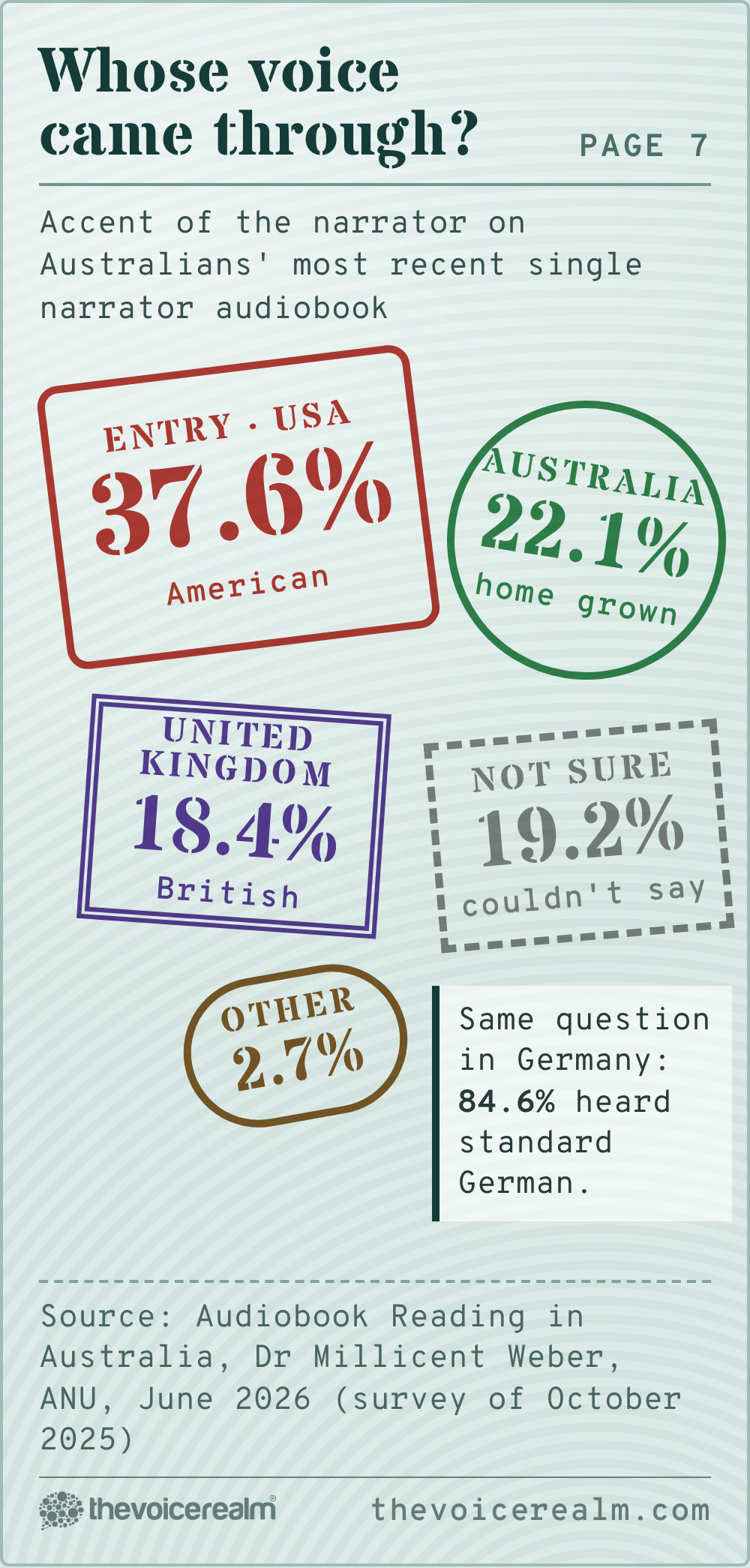
The headline finding for anyone who records for a living sits in plain words on the summary page: “The Australian market is dominated by US accents.” More than a third of respondents said their most recent audiobook had an American narrator. Roughly one in five said Australian. The report links this to the shape of the market itself, describing it as “dominated by international platforms, with minimal production and distribution infrastructure available to independent authors and narrators.”
Elsewhere it puts the history in one sentence. Compared with Germany, where audiobooks have a long tradition of specialist publishers, “the Australian market is relatively young, and its growth has been shaped by digital platforms and the prominence of cultural imports from the US and UK.” In other words, we didn’t choose American voices. We mostly got them with the catalogue.
Why the voices in our ears sound American
Think about how most Australians find their next listen. They open an app that was built overseas, sorted by charts that are mostly overseas, stocked with titles recorded where the big publishers are. A crime novel set in Ballarat can still arrive with an Australian reader, because local publishers and producers make that happen, but a huge share of what we play was never made with an Australian ear in mind.
Spotify’s expansion makes the point bigger, not smaller. TechCrunch reported that before the move, audiobooks on the service “were available primarily in English-speaking markets like the U.S., U.K., Ireland, Australia, and New Zealand, as well as in Germany.” Australia was already in the club. What changes now is the size of the audience on the other side of the world, and the size of the catalogue fighting for every listener’s attention. In a bigger shop, the shelf with Australian voices on it needs to be easier to find, not harder.
There’s also a quieter reason. Listeners don’t always notice accent at all. Nearly one in five respondents in the survey weren’t sure what accent their last narrator had. That’s a gentle reminder that a good read disappears into the story. It’s also a reminder that “neutral” usually means “the accent I’ve heard most”, and for a lot of Australian listeners that has become American by default.
© The Voice Realm
Listening while life happens
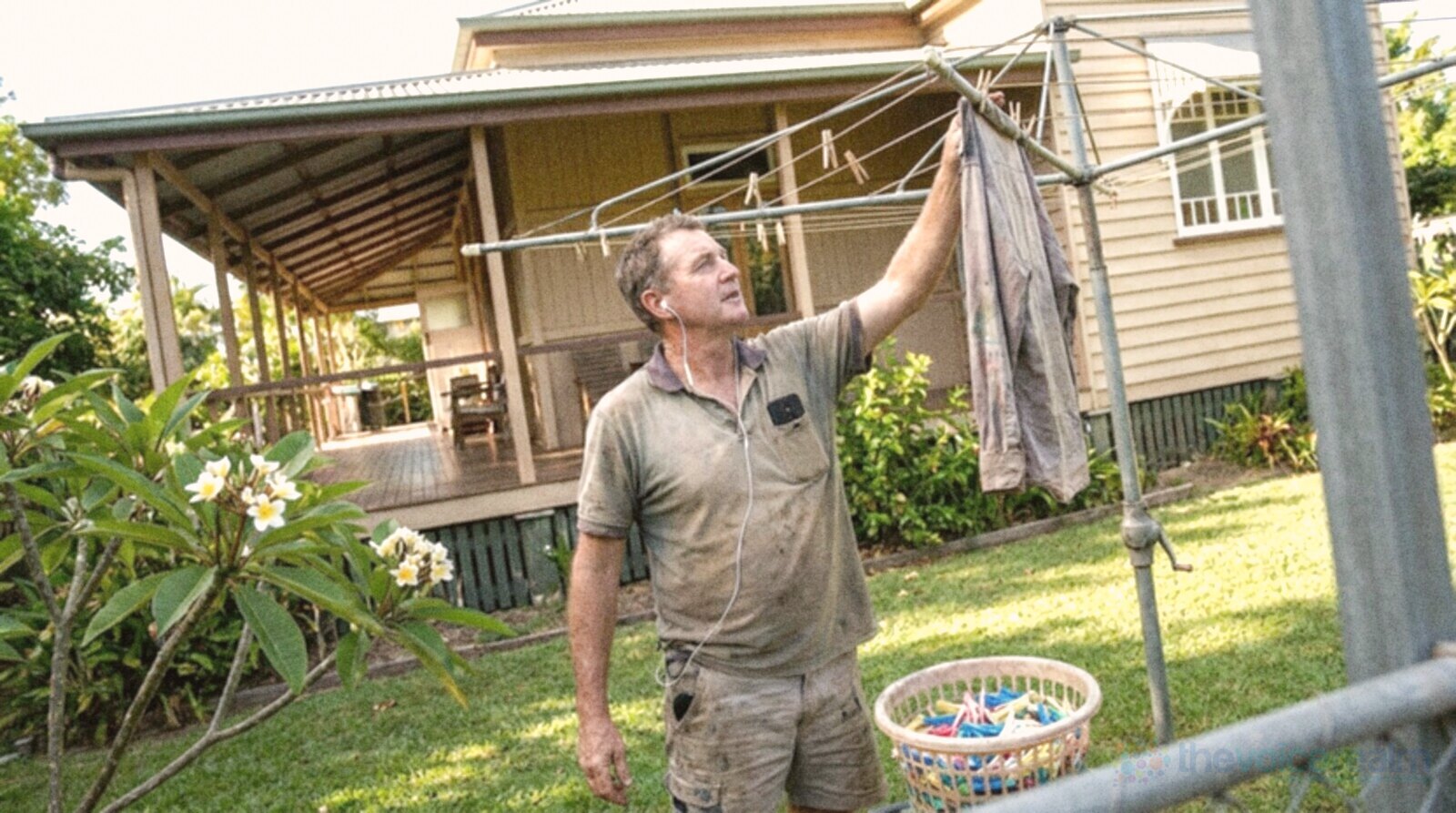
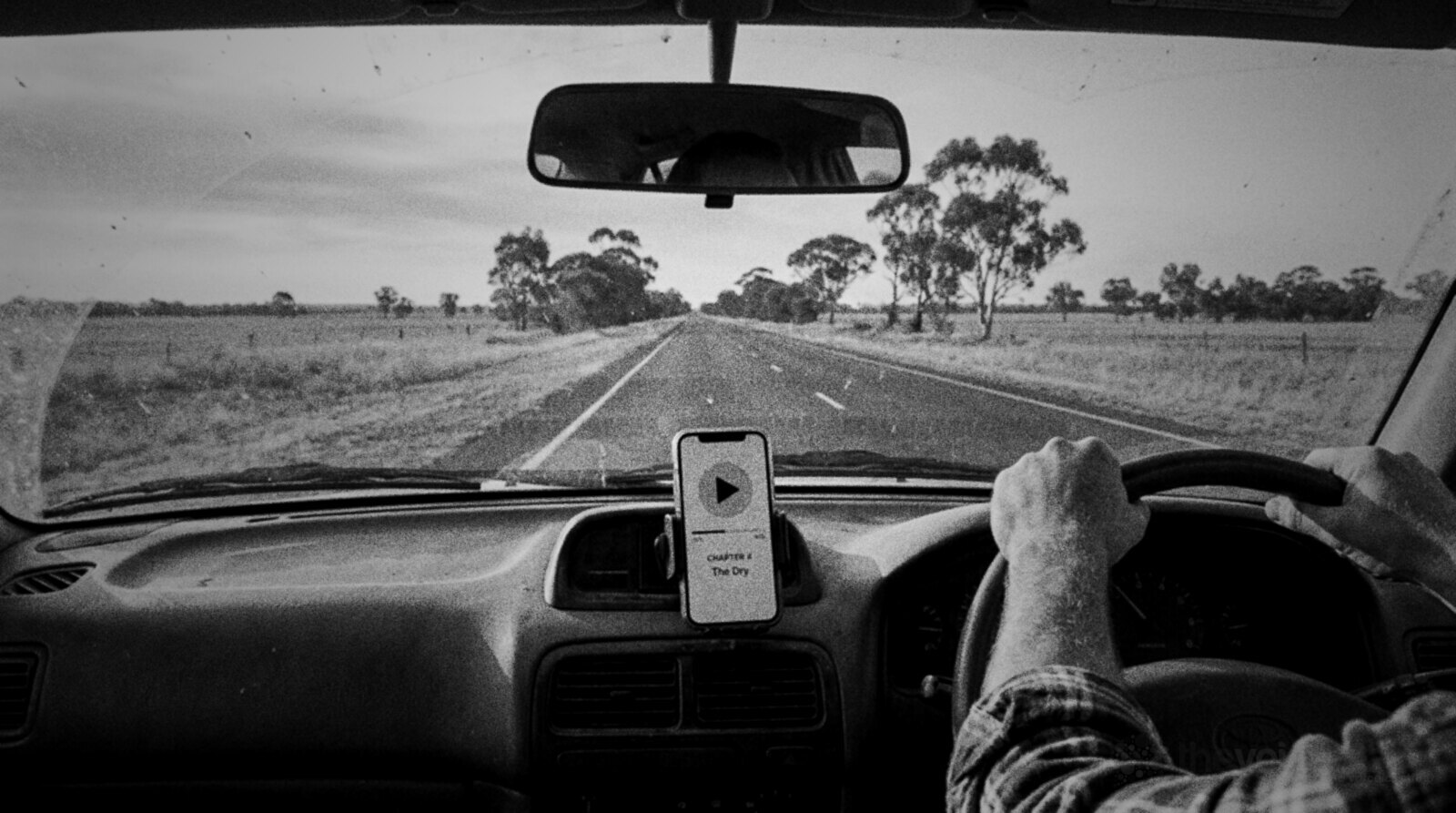
The survey paints a lovely picture of how Australians actually listen. People who start don’t stop: “Once people begin consuming audiobooks, they quickly become habitual listeners,” the report says, with close to three in five listening at least weekly. And almost nobody sits still to do it. Only a small slice of Australian listeners use audiobooks without doing something else at the same time, which means the washing, the commute, the dog walk and the long drive to the coast are where your narration really lives.
That has a practical edge for narrators. A listener hanging out the washing isn’t hanging on your every breath. They need clarity first: clean diction, steady levels, character voices that are easy to tell apart without looking at a page, and a pace that holds up when a car goes past. Fancy is fine. Clear is essential.
It also tells you something about who’s listening. These aren’t only book lovers in armchairs. They’re tradies, nurses on night shift, parents in the school pick-up line and retirees on the Hume. A voice that sounds like their own street, their own footy club, their own kitchen, has a real chance with them, because the story is arriving in the middle of their actual day.
© The Voice Realm
Men, women and who reads to them
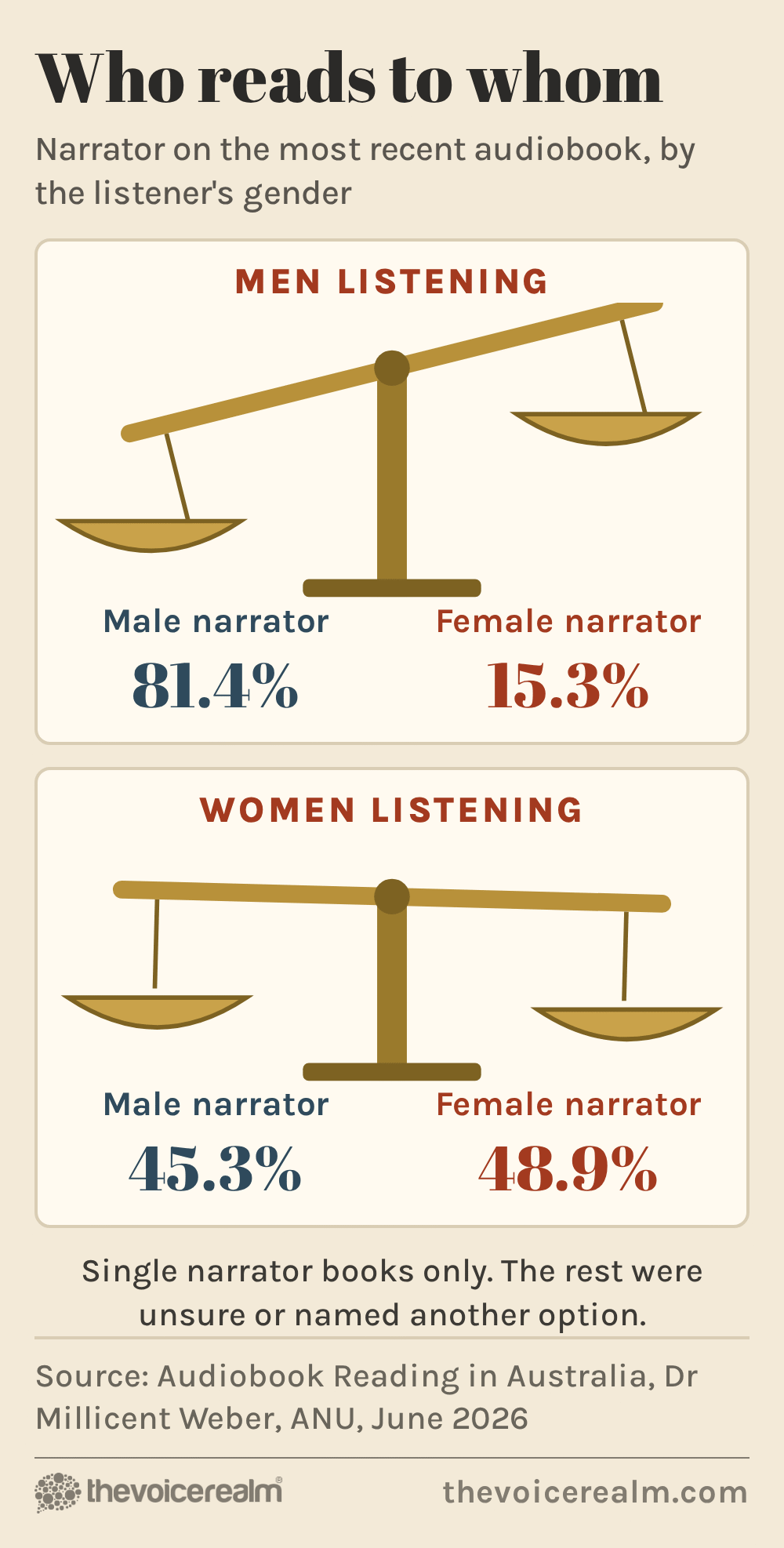
The finding that surprised us most was about gender. Male listeners in the survey overwhelmingly picked books read by men, while women split their listening almost evenly between male and female narrators. Weber is careful about why. The pattern, she writes, “may reflect trends in print publishing and reading and genre trends; it may also reflect listener preferences for gender identification with the narrator.”
“Once people begin consuming audiobooks, they quickly become habitual listeners.”
Audiobook Reading in Australia, ANU, June 2026Post this quote
Here’s our read on what it means in a casting room. If men mostly hear men, then the books aimed at men are mostly cast with men, and the cycle keeps itself going. Female narrators lose out on a big slice of non-fiction, thrillers and sport, not because they read those books worse, but because nobody tested the alternative. Producers who want to reach male listeners might simply never have tried a woman at the mic for a business book or a true crime series. Australia has a deep bench of female voice over artists who narrate across every genre, and the audition costs nothing but a few minutes of listening.
 VoiceEditSuiteEvery word checked against the script.Upload the recording and the script. Script Accuracy Checker shows every flub, mispronunciation and missing word, word by word.See how it worksYour recordings are never used to train AI.
The report also notes that a large majority of Australian listeners had most recently heard a book with a single narrator, with full cast productions still a small corner of the market. That’s good news for solo narrators, and it means the one voice you cast carries the whole book.
© The Voice Realm
What Australian voice over artists can do about it
None of this is a reason to feel hard done by. It’s a gap, and gaps are where work comes from. Here’s what we’d do this month if we were building a narration career in Australia.
Make your accent a feature, not a footnote. If you’re Australian, say so loudly in your narration demo and your profile, and show your range inside it: an educated urban read, a relaxed regional read, a few characters from different parts of the country. Publishers looking for an Australian sound need to find it fast. If you also do a convincing General American or British read, that’s a bonus, but lead with home.
Chase Australian stories. Local fiction, memoir, history, sport and true crime all have a natural claim on a local voice. Follow the publishers and audio producers who make Australian titles, read the books they’re putting out, and write to them about a specific title you’d be right for. A narrator who knows how to say Toowoomba, Kalgoorlie and Wagga Wagga without a second take saves a producer real time.
Build for the busy listener. Record a short sample, two or three minutes, and listen back on cheap earbuds while you do the dishes. If you lose the thread, so will they. Work on breath control and consistent character voices, because a listener who’s driving can’t rewind easily. Our guide to keeping vocal fatigue at bay over long sessions is worth a read before you take on a twelve hour book.
Widen the work that sits around a book. Plenty of Australian narrators keep the lights on with e-learning, documentary, museum audio guides and corporate training, then take on books as they come. If you’re starting out, our listing of narration voice over work in Australia shows the range of long-form reads clients are booking, and our step by step route into audiobook narration covers the rest.
Test the gender assumption. Female narrators, put a business book or a sports memoir chapter in your demo. Male narrators, show a tender first person read. Give producers evidence that the old pattern is a habit, not a rule.
© The Voice Realm
A word for the people who book narrators
If you’re an author, a small publisher or a production company, the survey is quietly on your side. Listeners stick with audiobooks once they start, they listen often, and a fair number don’t even notice accent unless it jars. So the real question isn’t whether an Australian voice will “work” overseas. It’s whether your Australian story deserves to sound like the place it’s set.
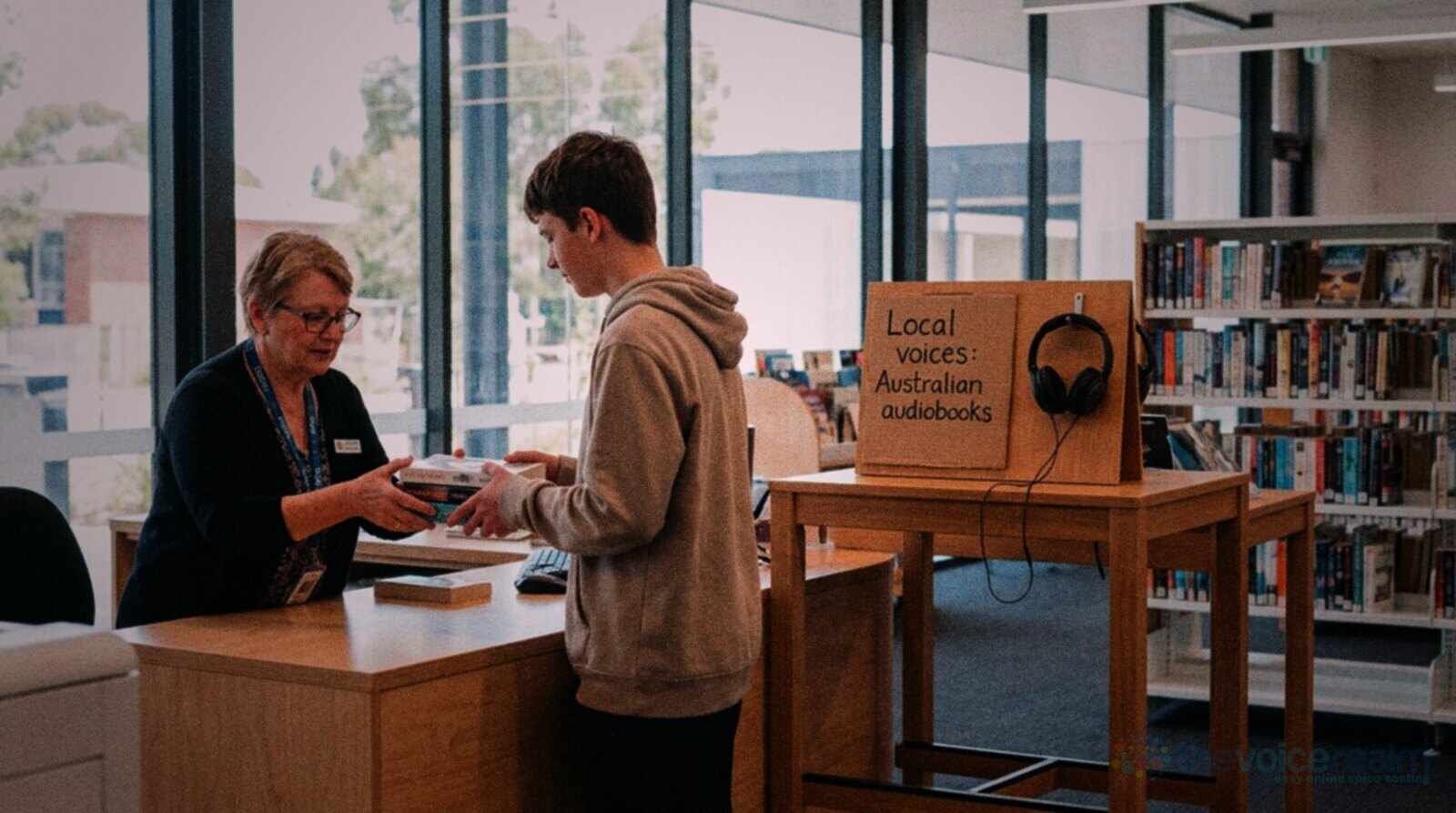
Cast with that in mind. Ask for two or three short auditions from Australian narrators with different textures, and include at least one voice you wouldn’t have picked on instinct, a woman for the footy biography, an older voice for the young adult novel. Universities, cultural institutions and government bodies are big buyers of narration too, and many of them sit in the capital. If you’re one of them, there are Canberra voice over artists who can read a report, an exhibition or an oral history in a voice your own audience will recognise.
One more finding deserves a mention. The survey found that most respondents had never listened to an AI narrated audiobook, and that uptake was highest among listeners with vision and hearing impairments. Weber’s conclusion is that “Accessibility needs to be more prominent in conversations about AI narration.” We agree, and it’s a fair challenge to the whole industry: human narrators make the strongest case for themselves when they make books easier to hear for everyone.
© The Voice Realm
Our take
We think this report is one of the most useful things published about Australian audio this year, and it’s free. It says, with numbers, what a lot of Australian narrators have felt for a long time: the voices in Australian ears are mostly imported, not because listeners rejected local voices, but because the market grew up on overseas shelves.
That’s fixable. Listeners are loyal once they start, they’re listening in the middle of ordinary Australian days, and they barely notice accent unless something sounds wrong. That’s an opening for local narrators, not a closed door. The world is about to get a lot more audiobooks. Let’s make sure some of the best ones sound like here.
If you narrate, lead with your own voice this month. If you publish, give an Australian narrator a real audition on your next Australian book. And if you’re a listener, check the narrator’s name next time you press play. You might be surprised where they’re from.
Sources: “Audiobook Reading in Australia: A Report on the Audiobooks and Digital Book Culture Survey”, Dr Millicent Weber, Australian National University, June 2026 (CC BY); “Spotify expands audiobooks to over 180 markets”, TechCrunch, 7 October 2026.
Ready to get booked?
See the jobs open right nowAbout Sarah Robbins
Sarah Robbins writes for The Voice Realm about finding voice over work, home studios, casting and the business side of voice acting.