Blog

Your nose is blocked, your throat feels coated and you’ve cleared it nine times before the first take. If that sounds like every spring and autumn, you’re not imagining the effect on your voice, and you’re not alone.
This guide is for voice actors who live with hay fever, dust or mould allergies and still have to sound like themselves on a deadline. It covers what allergies do to the voice, why some allergy medicines make it worse, the habit that quietly does the most damage, and a simple plan for recording through a bad week. It isn’t medical advice. Your doctor or pharmacist knows your history and should have the last word on any medicine.
Allergies show up in the voice too
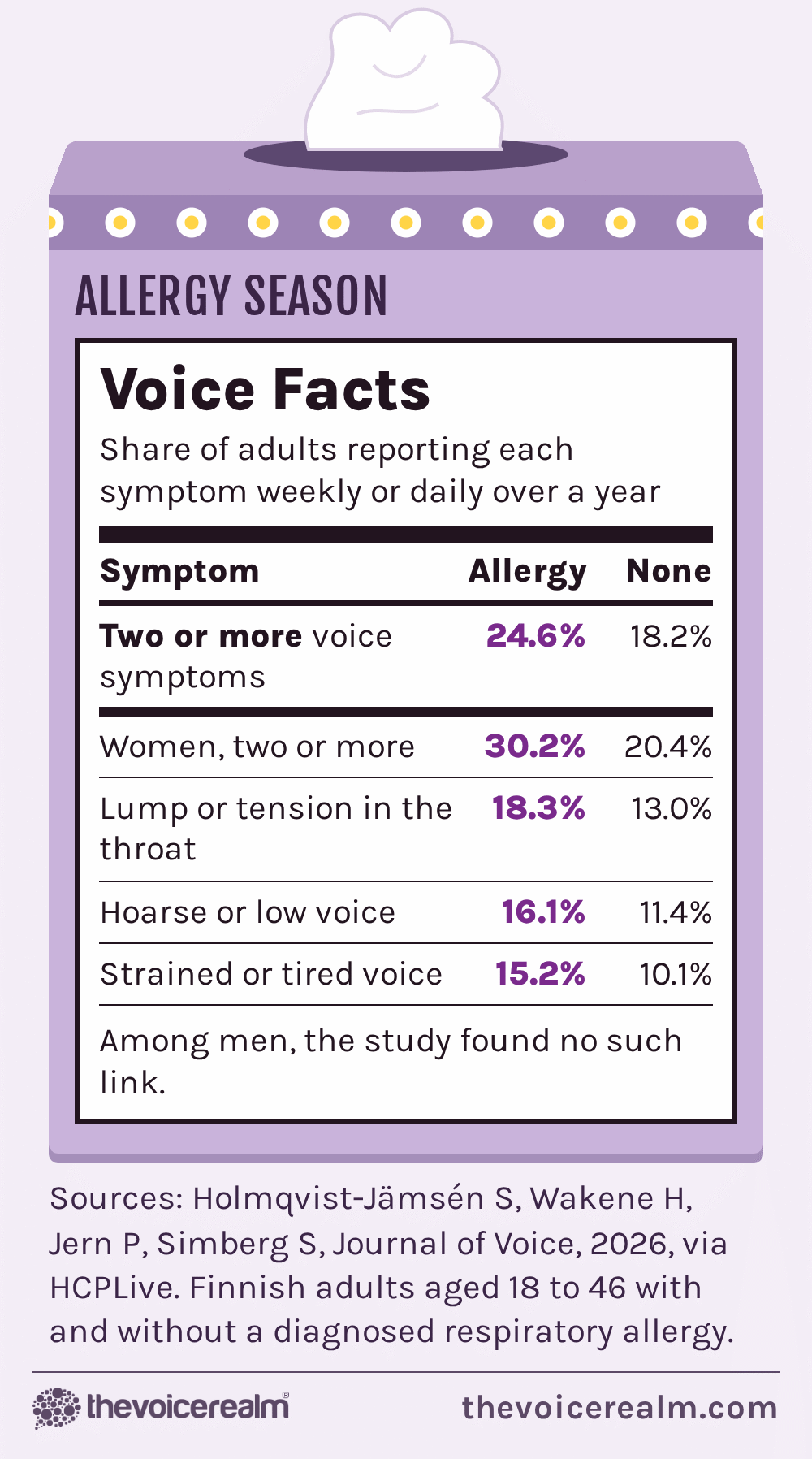
Most people think of allergies as a nose and eyes problem. A team led by Sofia Holmqvist-Jämsén of the University of Helsinki wanted to know how often they reach the voice, and in February they published a population study on it in the Journal of Voice.
They asked Finnish adults aged 18 to 46 about weekly or daily voice symptoms over the past year. People with a diagnosed respiratory allergy were more likely to report a heavier load of voice problems, and the difference was clearest in women. Speaking to HCPLive about why the study mattered, Holmqvist-Jämsén said: “Clinicians often observe that allergy flares coincide with hoarseness or throat clearing or voice fatigue, but large population-based data have been scarce.”
For a voice actor, the most telling part is which symptom was reported most often. It wasn’t hoarseness. It was coughing and clearing the throat, the very thing that ruins a clean take and, as you’ll see below, irritates the voice further.
© The Voice Realm
How an allergy gets into a read
CEENTA, an ear, nose and throat practice in the Carolinas, sums up the routes neatly. First, “allergens themselves can irritate and enflame the vocal cords, which can cause hoarseness.” Second, congestion from a stuffed nose or postnasal drip makes it hard to breathe easily. Third, the medicines you take for relief can affect the voice too.
On the microphone, each of those has its own sound. Swollen vocal folds give you a rougher, lower voice that cracks on soft lines, and you’ll notice it most in quiet, close reads like narration. A blocked nose takes the ring out of your m, n and ng sounds, so “morning” comes out closer to “bordig”. Postnasal drip brings wet clicks and a constant urge to swallow, which shows up as mouth noise in the edit. If that last one is familiar, our guide to clicks, smacks and sticky saliva has fixes that help on allergy days too.
It’s worth learning which version you’ve got on a given morning, because the fix is different. A blocked nose is a sound problem you can sometimes work around. Swollen, irritated folds are a voice problem, and pushing through them is how a bad week becomes a bad month.
© The Voice Realm
Check the medicine cabinet
Here’s the part that surprises people. The tablet that stops the sneezing can make your voice worse.
CEENTA explains why: “Antihistamines dry up the mucus in your body. While this helps relieve congestion, it also dries up the layer of mucus that protects your vocal cords.” Dry folds, the practice adds, “can stiffen or inflame, which can make your voice raspy.”
That doesn’t mean voice actors should suffer without treatment. It means the type of treatment matters. CEENTA otolaryngologist S. Brett Heavner, MD, puts it this way: “For professional voice users, topical medications like nasal steroids and nasal antihistamines seem to work better since they have less of a drying effect on the throat and voice.”
Tell your doctor or pharmacist that you use your voice for work, and ask which options are least drying for you. Some nasal sprays take days of regular use before they work fully, so start well before a big job, not the morning of it. And if a medicine leaves you groggy, that’s a performance problem too: a drowsy read is a flat read.
Swallow, don’t clear
The throat clear is the habit to break first. It feels like it helps, which is exactly why it’s so hard to stop.
National Jewish Health, a respiratory hospital in Denver, describes what actually happens: “It is equivalent to slamming the vocal cords together, as opposed to the simple closure that occurs when talking. Excessive throat clearing can cause damage to the vocal cords and result in hoarseness.” Its suggestion is to take a small sip of water and swallow, or simply swallow, which helps clear the secretions and eases the urge. The water also thins them.
The trouble is that clearing creates more irritation, which creates more urge to clear. Breaking the loop takes a few days of catching yourself. Keep a glass of water at the mic, and when the urge comes, sip and swallow instead. A gentle, silent huff of air, like fogging a mirror, can also move things without the slam. You’ll notice the difference in your takes, and so will whoever edits them.
Keep the moisture where it belongs
Allergy season and the dry air from heating often arrive together, and both pull moisture from the throat. The basics still apply: drink steadily through the day rather than gulping a bottle before the session, and breathe in steam when your throat feels scratchy. Our piece on what hydration really does for your voice explains why water you drink never touches the folds directly, and why steam gets closer.
Many allergy sufferers also rinse their noses with salt water, using a squeeze bottle or a neti pot, to wash out pollen and mucus. If you do, the water matters. The US Centers for Disease Control and Prevention advises: “When rinsing your sinuses or nasal passages, use store-bought distilled or sterilized water, or tap or faucet water that’s been boiled and cooled.” Plain tap water straight from the faucet isn’t safe for this, however clean it looks.
A clear nose helps the sound too. Rinsing or using a spray an hour or so before recording, rather than right before, gives everything time to settle so you’re not sniffing between lines.

© The Voice Realm
Record in the morning, if you can
If pollen is your trigger, the clock is on your side. In a study shared by the American College of Allergy, Asthma and Immunology, allergist Stanley Fineman, MD, and his colleagues tracked hourly pollen in three areas of Atlanta for a week. He reported: “We found that lower pollen levels occurred between 4:00 a.m. and Noon.”
 VOICEMASTERACADEMYLearn the craft in order.Module one is freeStart module oneTwenty modules, start to finish.
One city and one week isn’t a rule for everywhere, and your local weather app’s pollen forecast is the better daily guide. But the pattern gives you a useful nudge. When you can choose your session time, book the morning, and leave afternoons for editing and admin.

© The Voice Realm
Fineman also suggested “closing windows and taking off shoes and pollen-laden clothes when you walk in your door, and immediately throwing your clothes in the washing machine.” For a home studio, the windows part is the easy win. A booth or a closet full of clothes is a soft place for pollen and dust to settle, so keep it closed up in high season and give it a vacuum more often than you’d like to.
A recording-day plan for allergy season
Put it together and an allergy-season session looks something like this.
- Check the forecast. If pollen is high, move what you can to the morning and keep the windows shut.
- Treat early. Use the nasal spray or rinse your doctor suggested an hour before, not at the mic.
- Warm up gently. Hums and lip trills before full voice, and stop if anything catches or hurts.
- Water at the mic. Sip and swallow instead of clearing, and pause the take rather than pushing through a tickle.
Gentle warm-ups matter more than usual when the folds are already irritated. Our five-minute vocal warm-up is a good routine to lean on, done softly. And if the voice simply isn’t there, tell the client early. A short delay with an honest reason beats a raspy file that needs re-recording next week.
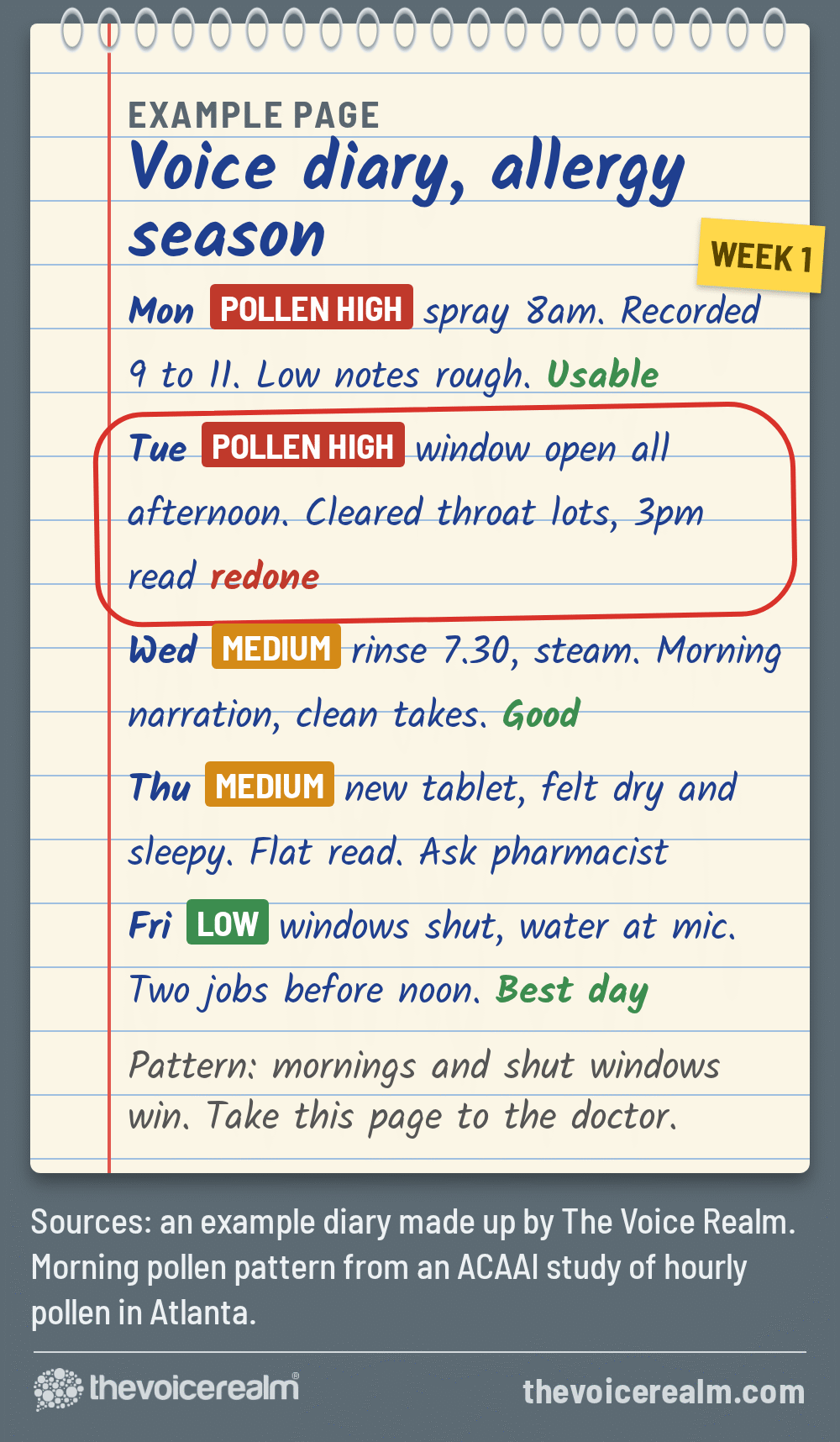
It also helps to keep a small voice diary through the season. Note the pollen level, what you took, when you recorded, and how the voice felt. After a few weeks you’ll see your own patterns, and it gives a doctor something real to work with if you need one.
© The Voice Realm
When to see a specialist
Allergy hoarseness should come and go with the pollen. If it doesn’t, get it checked. The US National Institute on Deafness and Other Communication Disorders says: “You should see your doctor if your voice has been hoarse for more than three weeks, especially if you haven’t had a cold or the flu.”
The American Academy of Otolaryngology’s ENT Health site also lists, among the reasons to see an ear, nose and throat specialist, “Vocal professionals (singer, teacher, public speaker) who cannot do their job”. That’s you. A laryngologist or an ENT with a voice clinic can look at the folds directly, tell allergy from reflux or strain, and suggest treatment that fits a working voice. If your symptoms come with heartburn or a sour taste, our guide to silent reflux and your voice is worth a read before the appointment.
Allergies are one of those things most voice actors just put up with. You don’t have to. A few changes to what you take, how you treat your throat and when you record can turn a lost week into a slightly sniffly one.
Sources: HCPLive, “Respiratory Allergies Linked to Vocal Symptoms, With Holmqvist-Jämsén, PhD” and “Respiratory Allergies Linked to Frequent Vocal Symptoms”, on Holmqvist-Jämsén S, Wakene H, Jern P, Simberg S, Journal of Voice, February 2026; CEENTA, “Allergies Affecting Your Voice”; National Jewish Health, “Let Your Voice Be Heard: Tips to Protect Your Vocal Cords”; Centers for Disease Control and Prevention, “How to Safely Rinse Sinuses”; American College of Allergy, Asthma and Immunology, “Lowest Pollen Counts Occur Between 4:00 a.m. and Noon”; NIDCD, “Hoarseness”; ENT Health, “Hoarseness”.
Ready to get booked?
See the jobs open right nowAbout Sarah Robbins
Sarah Robbins writes for The Voice Realm about finding voice over work, home studios, casting and the business side of voice acting.