Blog
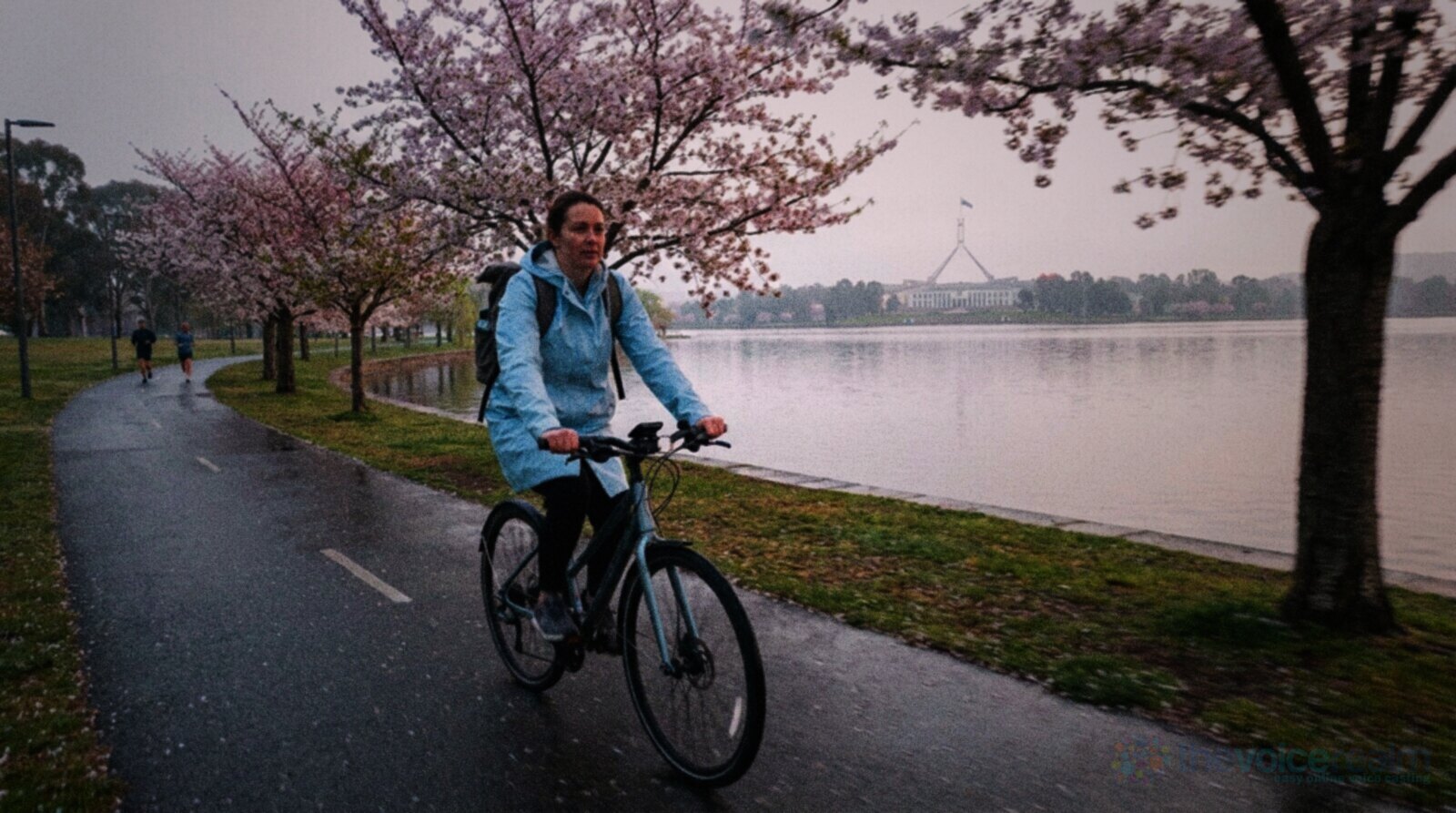
On Tuesday a parliamentary committee in Canberra tabled its final report on artificial intelligence, and buried among 46 recommendations about data centres, frontier labs and national security was a sentence that every Australian voice over artist should read twice. The committee wants the government to look at giving Australians the right to control how their face, voice and likeness are used. This piece is for voice over artists wondering what that would mean for their next booking, and for the producers, agencies and businesses who hire them.
We’ll say up front that we’re pleased. We’ll also say that a recommendation isn’t a law, and this one comes with a word attached that deserves a hard look.
What the committee actually recommended
The Joint Select Committee on Artificial Intelligence, chaired by Jo Briskey, the member for Maribyrnong, handed down a report titled Artificial intelligence, the Australian way. Three of its recommendations land squarely on people who earn a living with their voice.
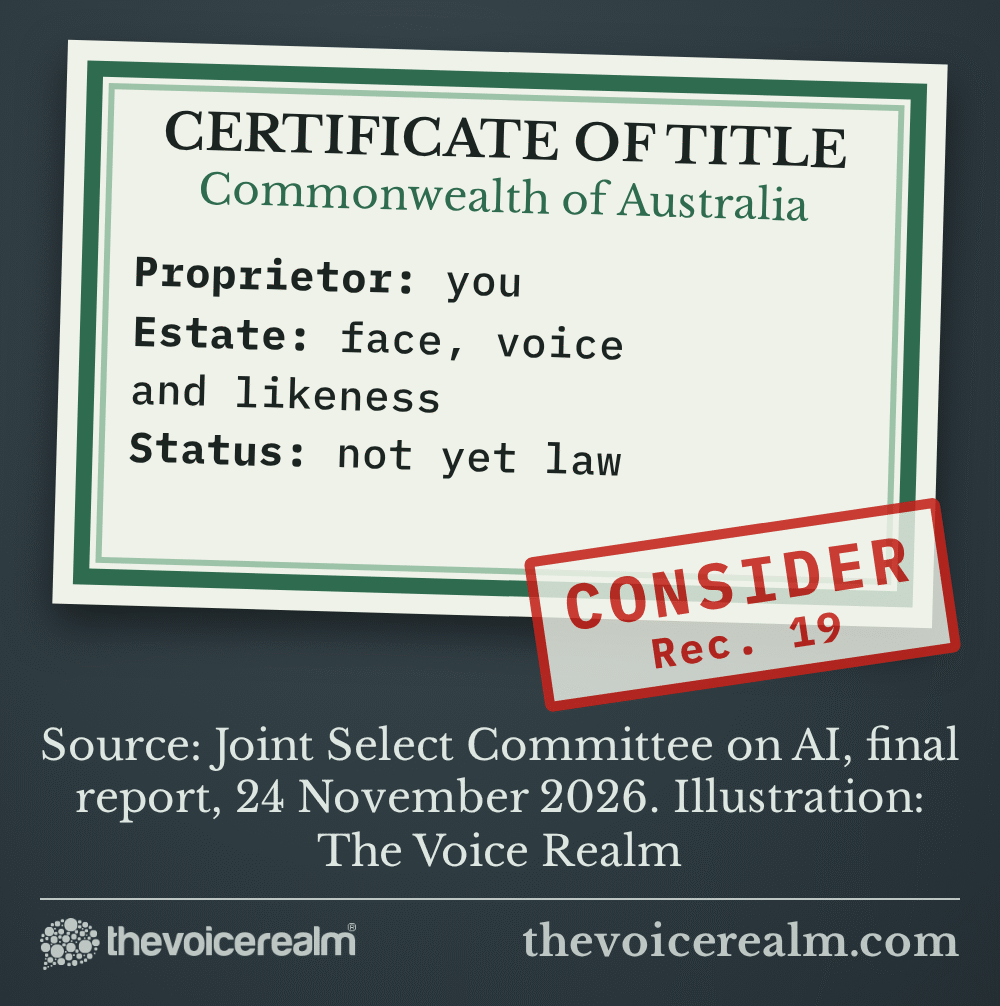
The first is the headline one. Recommendation 19 reads: “The JSCAI recommends that the Australian Government consider mechanisms that would give Australians the right to control how their face, voice and likeness are used.” Evidence to the committee pointed to Denmark as the model. The federal communications department told the committee that Denmark “is considering reforms to strengthen individual control over the use of a person’s likeness, voice and image in AI-generated content”.
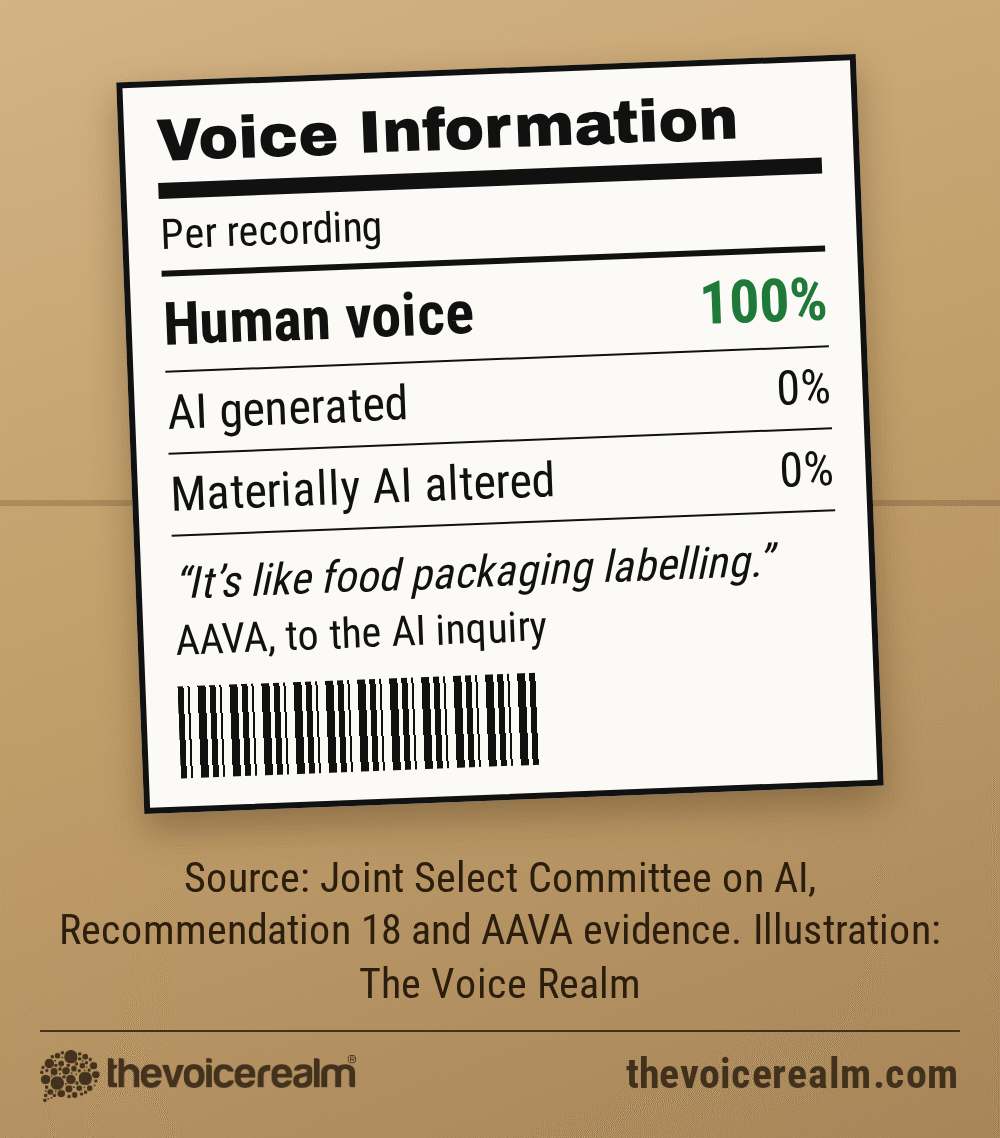
The second is about labels. Recommendation 18 asks the government to “consider mandating machine-readable labelling of AI-generated and materially AI-altered photos, videos or voice recording, so that Australians can tell what has been produced with AI.” Read that again and notice the words “voice recording”. Audio is named, not left to be argued about later.
The third sits in the copyright chapter. The committee wants copyright strengthened so that “the value of creative labour is recognised and quantified in the distribution of payment to creative workers in the same way payment to rights holders is.” That’s a quiet but important line for anyone who has ever read a commercial and signed away the recording on the same day.
© The Voice Realm
Why voice actors were in the room
This didn’t come from nowhere. The Australian Association of Voice Actors, AAVA, gave evidence in person, with its president Simon Kennedy and vice president Teresa Lim both listed as witnesses, and it put a written submission in too. One sentence from that submission went straight into the report: “copyright law protects creative works, it does not protect the voice, likeness, identity, or biometric data of the people whose performances are contained in those works”.
That’s the gap in a nutshell. When a production company owns the copyright in a recording, it owns the file. It doesn’t own the person. But until now, nothing in Australian law clearly said a machine can’t learn the person from the file.
Kennedy also had little patience for the argument that copyright law is broken and needs loosening for AI. “I also think that the status quo not working is a little bit of a furphy,” he told the committee, “because it’s akin to the police officers standing by, watching everyone loot the shop and saying, ‘Well, the law’s not working’.” It’s the most Australian sentence in the whole report, and it lands.
The Media, Entertainment and Arts Alliance made a related point about ownership. Its research and policy lead, Lilia Anderson, explained that many creative workers hand over their rights as part of being paid, so when those rights are later sold on for AI licensing, nothing necessarily flows back to the person whose work it was. Voice over artists who work on buyouts will know that story well.
© The Voice Realm
The word doing the heavy lifting: consider
Here’s the catch. Recommendation 19 asks the government to “consider” mechanisms. Recommendation 18 asks it to “consider” mandating labels. The committee’s deputy chair, Liberal senator Jonathon Duniam, was clear with reporters that none of this binds anyone. “They can look at that and be guided by what we have found through the committee’s work and develop legislation,” he said, according to AAP.
Independent senator David Pocock, the only crossbench senator on the committee, wrote a dissenting report and took aim at exactly that softness. “We have to actually stand up and ensure that we are giving the government firm recommendations, not you should just consider this, you consider that,” he told reporters. His dissent goes further on labelling, calling for a mandatory national AI labelling framework rather than one the government might consider.
Pocock’s dissent also carries a story every voice over artist will wince at. AAVA told the committee about a voice actor whose vocal identity was cloned. It took him a year to get the videos taken down from YouTube, and ten days later they were back up, because he couldn’t produce a court stamped injunction. That’s what “no practical recourse” sounds like in real life.
On the other side of the committee, independent MP Kate Chaney called the report “world leading” and wants action now. So there’s energy behind it. Whether that energy becomes a bill is a question for 2027.
What a right over your voice would change
If something like the Danish approach did arrive, the day to day work of a voice over artist wouldn’t change much on the surface. You’d still audition, record, deliver and invoice. What would change is the floor underneath every booking.
Right now, the protection a voice over artist has against being cloned mostly lives in the contract. If the agreement says the recording can be used for a radio campaign for twelve months, it shouldn’t be used to train a synthetic voice, but proving it, and doing anything about it, is slow and expensive. A personal right over your voice would mean the starting position is yours. Someone who wants to copy your voice would need your permission, and the burden would shift toward them.
“When a voiceover artist reads a commercial for a company, they consent to getting paid for one specific job.”
Simon Kennedy, AAVA president, to the Joint Select Committee on AIPost this quote
It would also matter well beyond ads. Government buys a lot of voice work, from public information campaigns to the e-learning modules every public servant clicks through, and plenty of it is recorded by voice over artists in Canberra a short drive from the building where this report was tabled. Those reads sit on servers for years. The same goes for the induction and training videos that businesses keep in rotation long after the session ended. Long life and wide reach are exactly what makes a recording valuable as training data.
 VOICEMASTERACADEMYLearn the craft in order.Module one is freeStart module oneTwenty modules, start to finish.
And then there’s long form. An audiobook is hours of clean, consistent, single voice audio. If you wanted to teach a machine to sound like someone, you couldn’t design better material. That’s why Australian audiobook narrators have more riding on Recommendation 19 than almost anyone.

© The Voice Realm
Practical steps for voice over artists
You don’t need to wait for Canberra to protect yourself. Most of this is housekeeping, and it pays off whatever the law ends up saying.
Read the usage clause before the script. Look for words like “derivative works”, “any media now known or hereafter devised”, “synthetic” and “training”. If a clause would let your recording be used to build a voice model, ask for it to come out or be limited. Our guide to reading a booking agreement clause by clause walks through the usual traps.
Add a plain no AI line. Something as simple as “The recording may not be used to train, develop or create any synthetic or AI voice” is easy for an honest client to agree to. If a client won’t agree, that tells you something.
Keep a record of every job. Date, client, script, usage, term and the final files. If your voice ever turns up somewhere it shouldn’t, that record is what turns a hunch into a complaint anyone will act on.
Watch where your voice lives. Search for your name and your best known reads now and then. Keep your demos on pages you control.
Back the people at the table. AAVA and MEAA were in the room for this report and will be in the room when the government responds. If you’ve had a voice cloned or a usage clause stretched, tell them. Real cases changed this report, and they’ll shape whatever comes next.
If you followed the October promises on AI and copyright, this report is the next step in the same story, with voices named far more clearly than before.
© The Voice Realm
For the people who book voices
If you hire voice over artists, none of this should worry you, and some of it should help. Labelling rules, if they arrive, will reward brands that can say their ads use a real person. A clear right over voices makes it simpler to know what you’re allowed to do with a recording, and simpler to promise customers you’re not cutting corners.
The easy move is to get ahead of it. Put the usage you actually need in the brief, name the term, and say in writing that you won’t use the recording to train a synthetic voice. Good voice over artists will notice, and they’ll remember who treated their voice like it belonged to them.
© The Voice Realm
Our take
Here’s our read. Recommendation 19 is the most important sentence an Australian parliamentary committee has written about voice work in years, and it’s wrapped in the softest verb in the dictionary. “Consider” can mean a bill next year. It can also mean a polite line in a government response and nothing else.
What gives us hope is who turned up. Voice actors gave evidence in their own words, not through a lobbyist, and the committee listened closely enough to quote them. The labelling recommendation names voice recordings outright. The copyright chapter talks about creative labour, not just rights holders. Those are signs the people writing policy now understand that a voice isn’t just a file.
So our advice is simple. Treat your voice as yours today, in every contract and every booking, and push for the law to catch up. If the government does move, you’ll be ready. If it doesn’t, you’ll still be protected by the one thing that’s always worked in this business: knowing exactly what you’ve agreed to.
Sources: Parliament of Australia, Joint Select Committee on Artificial Intelligence, “List of recommendations”, “Chapter 4: Copyright and First Nations data sovereignty”, “Chapter 7: The human element of AI” and “Dissenting report from Senator David Pocock” (24 November 2026); AAP, “Doubts cast over AI ‘blueprint’ for government” (24 November 2026).
Ready to get booked?
See the jobs open right nowAbout Sarah Robbins
Sarah Robbins writes for The Voice Realm about finding voice over work, home studios, casting and the business side of voice acting.