Blog
When you’re asked the question, what brand would you recommend when buying anything? Apple, Ford, Coca-Cola, Hunt’s, Nestle, Dole, McDonald’s. A lot of these brand names are known globally and people treat them as household names. People see a logo like McDonald’s yellow arches and immediately know what it’s for and start craving their burgers or McNuggets. People also develop such an affinity to these brand names that they become the product and not just a brand of the product: smartphones and tablets are Apple’s iPhones to some people, and they would say ‘may I borrow your iPhone?’ instead of ‘may I borrow your mobile phone?’ Or, “I want a Coke,” instead of “I want soda.” And, “may I have a Colgate,” instead of “may I have some toothpaste.”
But how did they get into our heads, our subconscious, as if their brand names have been stamped in our brains? The answer is that these companies have spent billions of dollars to market and advertise their brands, and hundreds of hours of creative and intellectual analysis to get your memory to pop their name in your head when thinking of a product. These companies know their products and services so well that they could very clearly articulate what messages would resound and what would fall flat on audiences’ ears.
It’s hard to imagine how these brands come up with an ad, an ad that is designed to capture an audience’s interest, that introduces the product to them and that would spark an interest in them. Jane Barratt, Founder & CEO at GoldBean, shares what the basics are.
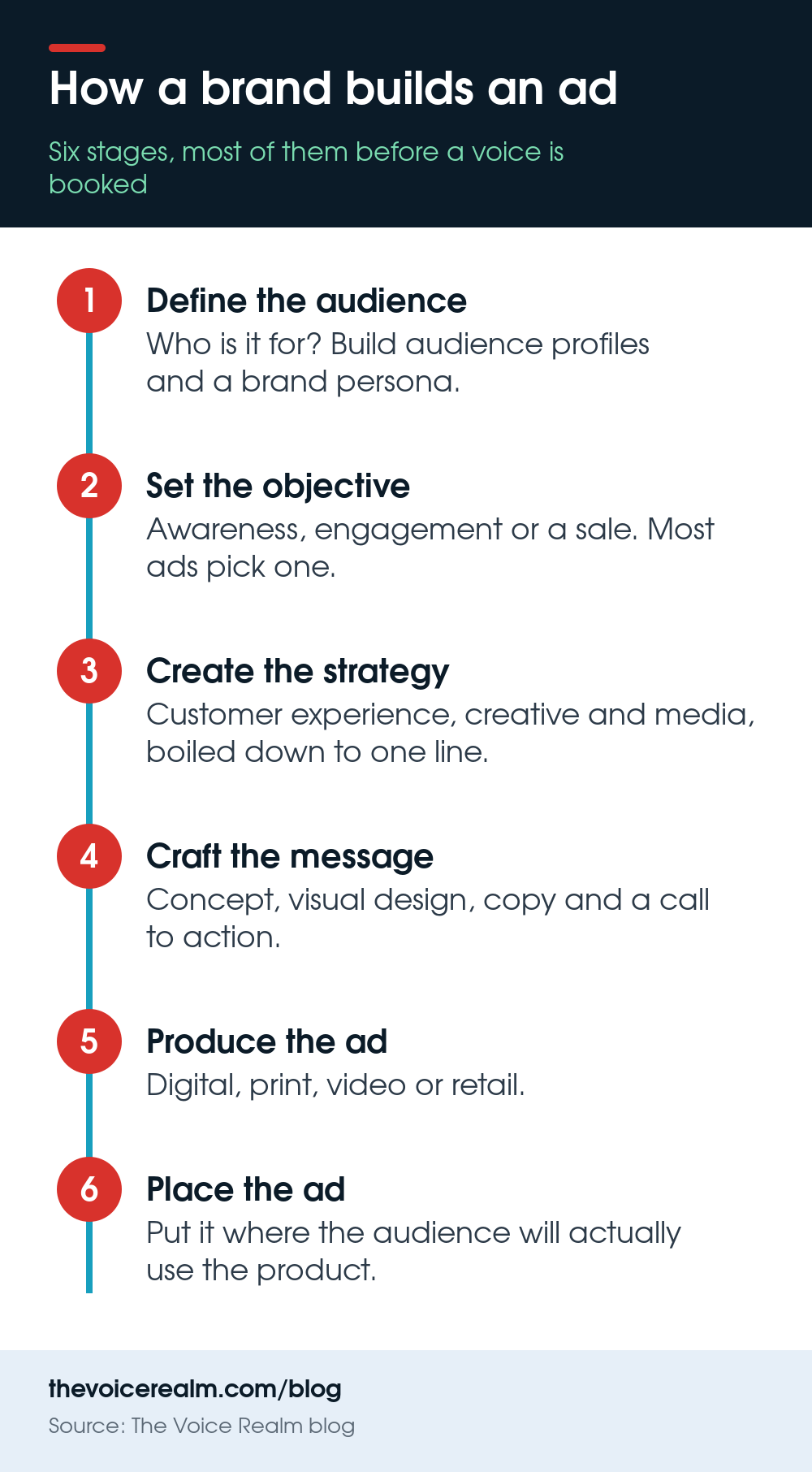
Six stages, and the voice comes in near the end © The Voice Realm
Defining Your Audience
 Barratt says, “people are discerning and smart and don’t take purchase decisions lightly.” Companies put a lot of study into defining their audience. They need to know which people to target and introduce their products and services to. The geographic distribution of their ads and products is part of that research as well. Then they start building their product and brand personas and build up their audience profiles.
In one aspect of the creation of the video, this can explain why, when choosing the voice talent to voice an ad, a lot of these creatives tend to be specific about the intonation, how the script should be read, the tone and speed of reading, whether male or female voice talent is needed, and how their brand name is pronounced with just the right inflection. All these add up to their brand persona that matches their audience profile.
Setting Objectives
When coming up with their concept for the ad, one of the things the companies do is set up, evaluate and measure an objective for the video. Is the video to raise awareness of their brand? Are they working on engaging consumers? Or is it an ad to push conversion, where the audience purchases their product?
Not all ads cover these funnels, as it is extremely difficult to do all three in one ad. Oftentimes, they choose which of the three to work on for their video.
Creating Strategy
Customer experience planning, creative strategy and media strategy are the three core elements of creating strategy. This has become a bit more complex with the rise of digital media resulting in a wider target audience. That being said, it is not that easy to narrow down their target and to map out how customers will find them. This is where they try to boil down what they stand for into a single line and where they create the details that help them connect with their customers.
Crafting The Message
 The difference between good work and bad work is hard to discern. Sometimes the most brilliant and well done creative work does not get the job done, as audience response does not materialize or is not what they had hoped for. Barratt says, “you can only ever really know in hindsight.” She adds, “the building blocks of a great piece of communication regardless of media and give tips on how to guide a creative process and judge the work. First, the basic building blocks of any piece of communication are Concept. What’s the idea behind the ad? Visual design, what does it look like? Is it photography, illustration, headline, logos? Copy, what do the words say whether it’s scripted for audio visual media or written for digital and printed media, and Call to action. What do you want the viewer or reader to do?”
These certainly are a lot of aspects, but with the research done in the earlier stages, they’d have an idea of how to go about this stage.
A lot of voiceover actors feel like they can ask for the script to be changed. Maybe. What they seem to forget is that a lot has already been spent on and put into coming up with the message to read with their video. Perhaps not all companies put the same work and cost into researching their ad, but they are the ones who know their product and who know their consumers. Usually, when they have come to the point of hiring a voiceover actor, they’ve got all the other details down, including the type of voice and how the script is to be read.
Producing The Ad
Digital media has helped a lot in bringing down the cost of the ad. This includes the cost of hiring a voiceover actor, which, too, has gone down over the years and can also be attributed to the ease of exchange of digital media.
There are five main buckets to consider, Barratt says in Advertising Fundamentals: “there’s digital with things like websites, search engine optimization, paid search, banner ads and buttons.” In addition to that, “there’s print meaning magazines, newspaper ads, outdoor and brochures. There’s video consisting of TV ads, online videos, animated graphics and explainer videos for your site, and then there’s retail.”
As you can see, not all ads involve a voiceover, although video and audio ads are those most employed in ad production.
Placing The Ad
It does not always have to be the expensive way. That’s why we went through the steps above. Once  these brands have narrowed down their customer target, their objectives and their message, these all help to trim down and take away unnecessary cost. Companies do not want to place their ads where audiences won’t find a use for their product or service.
Now all these are done within a timeline, especially if the message the company wants to send is timed with an event, say, for example, Black Friday or a company anniversary, and they have discounts to offer their loyal customers. This is why they have deadlines when they hire talent from outside their companies, like a voiceover actor, to read their message.
 VOICEMASTERACADEMYFirst read to first booking.Twenty modules. The first one is free.Start free
This piece is a small picture of what goes on in the creation of an ad, but one thing is for sure: an ad can only be 30 seconds long, but a lot has been put into it. A lot of factors need to come together to make it work, but work it must, because each step taken is money and time invested. When put this way, the voiceover part may seem like a small fraction of it, but at the same time it has a large role for the voice actor who delivers the message in the persona the company has developed the brand to be. It is the voice talent’s voice that reaches people’s ears and one that they would remember playing in their heads.
What ads that used voiceovers have you seen on TV that you liked best?
Ready to get booked?
See the jobs open right now